🕒 13 min read · 📝 2502 words
The First Reference to Sleep
1 Corinthians 15:6
“After that, he was seen of above five hundred brethren at once; of whom the greater part remain unto this present, but some are fallen asleep.”
Paul has already used the language of death when describing Christ’s crucifixion (1 Cor. 15:3-4), yet throughout the chapter he repeatedly chooses the language of sleep for believers (1 Cor. 15:6, 18, 20, 51).
This distinction is significant.
Death is presented as the great enemy that entered through Adam and is ultimately destroyed by Christ (1 Cor. 15:21-22, 26).
Sleep, however, is the term Paul repeatedly chooses when speaking of believers (1 Cor. 15:6, 18, 20, 51).
The sleepers are described as brethren. Paul is therefore discussing a condition that occurs within the believing community.
This understanding is reinforced later in the chapter when Paul commands:
“Awake to righteousness, and sin not” (1 Cor. 15:34).
The chapter moves from sleep toward awakening and transformation.
In this sense, Christ’s death and resurrection become the pattern for His followers (1 Cor. 15:20-23), who die to the old life and rise to walk in newness of life (Rom. 6:4-11; Col. 3:1).
God is making Christ’s enemies His footstool until all things are placed under His authority (1 Cor. 15:25-28). This includes conforming believers to the life revealed in His Son (Rom. 8:29).
Throughout Scripture, different authors use different symbols to describe this same redemptive process.
The process depends upon maintaining faith.
If faith is maintained, God continues transforming the believer into the likeness of Christ throughout this life.
The Meaning of Sleep in the Greek Text
All four references to sleep in 1 Corinthians 15 come from the Greek word:
κοιμάω (koimaō)
The word simply means:
“to sleep” or “to rest.”
Although the same word is used throughout the chapter, Paul presents sleep from four different perspectives.
1 Corinthians 15:6
ἐκοιμήθησαν (ekoimēthēsan)
This word focuses on entering the sleeping condition.
In simple terms:
Some entered sleep.
1 Corinthians 15:18
κοιμηθέντες (koimēthentes)
This word identifies people by the sleeping condition.
In simple terms:
These are the ones who are asleep.
1 Corinthians 15:20
κεκοιμημένων (kekoimēmenōn)
This word describes people who entered sleep and remain there.
In simple terms:
They continue in the sleeping condition.
1 Corinthians 15:51
κοιμηθησόμεθα (koimēthēsometha)
This word points toward the future.
In simple terms:
We may enter the sleeping condition.
A Key Observation About the Greek
All four references to sleep are expressed in the passive voice.
This means the sleepers are not described as actively putting themselves to sleep.
Rather, sleep is presented as a condition into which they enter and in which they find themselves.
By contrast, Paul’s language of death is commonly active:
- Christ died for our sins (1 Cor. 15:3).
- In Adam all die (1 Cor. 15:22).
- “I die daily” (1 Cor. 15:31).
- “Put to death the deeds of the body” (Rom. 8:13).
- “Mortify therefore your members which are upon the earth” (Col. 3:5).
Paul regularly speaks of men actively dying.
Yet he consistently speaks of believers passively sleeping.
The passive voice does not identify the agent responsible for the sleep. It does not say who put the believers asleep.
However, it does show that the sleepers are not presented as the primary actors.
They are recipients of the condition.
This is an important distinction.
Sleep and Divine Correction
The passive sleep language aligns with a broader biblical pattern.
In Romans 1, God gives people over to the consequences of rejecting truth (Rom. 1:24, 26, 28).
In 2 Thessalonians 2, God sends strong delusion upon those who refuse the love of the truth (2 Thess. 2:11-12).
In 1 Corinthians 11, believers are judged and chastened by the Lord so that they will not be condemned with the world (1 Cor. 11:31-32).
The same principle appears in Ezekiel:
“According to their uncleanness and according to their transgressions have I done unto them, and hid my face from them” (Ezek. 39:24).
As God hides His face, the sinful believers spiritual perception diminishes.
Hidden conditions are exposed.
Judgment and discipline follow.
Repentance and restoration become possible.
The sleep language of 1 Corinthians 15 naturally fits this corrective pattern.
Sleep is not presented as destruction.
It is presented as a condition from which awakening is expected.
The Progression of Sleep in 1 Corinthians 15
Taken together, the four references reveal a progression:
1 Corinthians 15:6
Entering sleep.
1 Corinthians 15:18
Being identified by sleep.
1 Corinthians 15:20
Remaining in sleep.
1 Corinthians 15:51
Potentially entering sleep in the future.
The underlying concept of sleep remains the same, but the relationship to the condition of sleep changes.
Read in light of Paul’s exhortation:
“Awake to righteousness, and sin not” (1 Cor. 15:34),
Sleep is presented as a reversible condition from which awakening and transformation are expected.
The Central Observation
A significant pattern emerges from Paul’s language.
Throughout his letters, Paul commonly speaks of death using active language.
Active voice means the subject performs or experiences the action directly.
Examples include:
- Christ died for our sins (1 Cor. 15:3).
- In Adam all die (1 Cor. 15:22).
- “I die daily” (1 Cor. 15:31).
- “Put to death the deeds of the body” (Rom. 8:13).
- “Mortify therefore your members which are upon the earth” (Col. 3:5).
By contrast, the sleepers of 1 Corinthians 15 are consistently described through passive forms of κοιμάω (koimaō).
Passive voice means that the subject receives or undergoes the action rather than performing it.
The sleepers are therefore presented as entering or undergoing a sleeping condition rather than actively producing it themselves.
Paul speaks of believers passively sleeping, while he commonly speaks of death actively (Put sin to death in the flesh).
He then commands believers to awaken (1 Cor. 15:34).
This distinction forms the foundation of the present study.
The passive voice does not by itself identify who or what causes the sleep.
However, it does show that the sleepers are not presented as the primary actors. They are recipients of the condition.
This observation aligns naturally with passages where God gives people over to the consequences of their choices (Rom. 1:24, 26, 28; 2 Thess. 2:11-12) and with Paul’s teaching that believers may be judged and chastened by the Lord so that they will not be condemned with the world (1 Cor. 11:31-32).
Within that broader biblical pattern, the sleep of 1 Corinthians 15 may be understood as a God-permitted condition designed to expose, correct, and ultimately restore the believer.
The Four Sleep References
Second Sleep Reference
1 Corinthians 15:18
“Then they also which are fallen asleep in Christ are perished.”
This statement is part of Paul’s hypothetical argument.
If Christ had not been raised, then those who sleep in Christ would truly have perished.
The argument only has force because Christ has in fact been raised.
Third Sleep Reference
1 Corinthians 15:20
“But now is Christ risen from the dead, and become the firstfruits of them that slept.”
Notice the distinction.
Christ is said to have risen from the dead.
Believers are described as those who slept.
Paul deliberately preserves the distinction between death and sleep.
Christ’s resurrection guarantees the awakening and transformation of those who sleep if they maintain their faith.
Fourth Sleep Reference
1 Corinthians 15:51
“Behold, I shew you a mystery; We shall not all sleep, but we shall all be changed.”
Not all believers enter the sleeping condition.
Yet all believers experience transformation.
The ultimate goal is not sleep.
The goal is change.
1 Thessalonians 4–5 Confirms the Pattern
Paul uses the same imagery in 1 Thessalonians.
In chapter 4, he speaks of believers who are asleep and associates them with those who are “dead in Christ” (1 Thess. 4:13-16).
Yet without changing the subject, he immediately tells living believers:
“Let us not sleep, as do others; but let us watch and be sober” (1 Thess. 5:6).
Here sleep clearly extends beyond physical death.
Paul is speaking to living believers.
Sleep therefore includes spiritual inattentiveness and lack of vigilance.
This provides a balancing principle.
Believers are responsible to remain spiritually awake.
Yet if they resist truth, they may enter a sleeping condition.
That condition is portrayed as something undergone rather than performed.
Awakening remains possible.
When all of these passages are placed together, a larger progression emerges:
- Entering sleep (1 Cor. 15:6)
- Being identified by sleep (1 Cor. 15:18)
- Remaining in sleep (1 Cor. 15:20)
- Potential future sleep (1 Cor. 15:51)
- Existing in sleep (1 Thess. 4:13)
- Being warned against sleep (1 Thess. 5:6)
- Awakening from sleep (1 Cor. 15:34)
The movement is always toward awakening.
Refined Summary of 1 Corinthians 15
Scripture discusses both physical death and spiritual death (Rev. 11:3-13).
Sleep represents a condition of spiritual inattentiveness or diminished participation in the life of Christ.
It is not yet death, but it is a condition that can deepen toward death if faith is abandoned.
A person may enter this condition.
A person may avoid it.
A person may remain in it.
A person may be awakened from it.
If faith is maintained during the sleeping condition, the condition corresponds to what Scripture describes as being lukewarm rather than completely separated from Christ (Rev. 3:15-19).
Christ stands as the firstfruits for those caught in this condition (1 Cor. 15:20).
Sleep therefore represents a state between life and death, characterized by dulled spiritual perception, from which awakening and transformation are necessary.
If faith is abandoned, sleep ultimately gives way to unbelief and spiritual death. If faith is maintained, however, sleep corresponds more closely to the condition Scripture describes as lukewarmness, a condition that remains subject to correction and restoration (Rev. 3:15-19; Rev. 18:23).
σῶμα: The Form of Resurrection Existence
The Question Asked by Paul
Paul asks:
“But some man will say, How are the dead raised up? and with what body do they come?” (1 Cor. 15:35).
The Greek phrase is:
ποίῳ δὲ σώματι (poiō de sōmati)
Literally:
“With what kind of body?”
The emphasis falls on the words:
ποίῳ (poiō)
which means:
“what kind” or “what sort.”
Paul is not asking whether a body exists.
He is asking what kind of body accompanies resurrection.
The Meaning of σῶμα
The Greek word:
σῶμα (sōma)
simply means:
“body.”
However, throughout 1 Corinthians 15 Paul’s concern extends beyond physical anatomy.
He is discussing the form in which life is expressed.
This becomes clear because he immediately begins discussing:
- a seed being transformed (1 Cor. 15:36-38),
- different kinds of flesh (1 Cor. 15:39),
- heavenly and earthly bodies (1 Cor. 15:40-41),
- the natural body and the spiritual body (1 Cor. 15:44).
His emphasis is therefore on transformation.
The question is not:
“Do they have a body?”
The question is:
“What kind of body do they have?”
The emphasis comes from the Greek word ποίῳ (poiō), meaning “what kind” or “what sort.” Paul’s concern is therefore not merely the existence of a resurrection body, but the quality, nature, and mode of existence associated with resurrection life (1 Cor. 15:35).
Paul’s seed analogy also harmonizes with his teaching on baptism. As believers die to the flesh, they are buried with Christ in baptism, being immersed into His death and raised to walk in newness of life (Rom. 6:3-4; Col. 2:12). Just as a seed is sown before new life emerges, the old man is surrendered to God so that Christ’s life may be formed within. Paul emphasizes that the sown seed does not determine its own final form, for “God giveth it a body as it hath pleased him” (1 Cor. 15:38). The process of baptism therefore represents more than a single event; it describes an ongoing participation in Christ through which the flesh is put to death and the believer is progressively transformed. As the seed is buried, God Himself clothes it with the form appropriate to its growth, conforming the believer throughout this life to the image of His Son (Rom. 8:29; 2 Cor. 3:18).
Natural and Spiritual Bodies
Paul eventually contrasts:
σῶμα ψυχικόν (sōma psychikon)
meaning:
“natural body”
with
σῶμα πνευματικόν (sōma pneumatikon)
meaning:
“spiritual body”
(1 Cor. 15:44).
The discussion concerns two different modes of life.
Paul’s emphasis is transformation rather than simple restoration.
Resurrection as Present Participation
Paul’s resurrection language is not limited to a future event.
Believers have already been buried and raised with Christ:
- Romans 6:4-11
- Colossians 2:12
- Colossians 3:1
Paul writes:
“If ye then be risen with Christ, seek those things which are above” (Col. 3:1).
Believers therefore participate in resurrection life even now.
Christ’s death, burial, and resurrection function as a pattern to be experienced.
The historical events become the model for spiritual transformation.
The Redemption of the Body
Paul teaches that believers await:
“the redemption of our body” (Rom. 8:23).
At the same time:
“Though our outward man perish, yet the inward man is renewed day by day” (2 Cor. 4:16).
He also writes:
“Who shall change our vile body, that it may be fashioned like unto his glorious body” (Phil. 3:21).
The focus remains transformation.
Life in Adam is progressively replaced by life in Christ.
The Covenant Confirmation Pattern
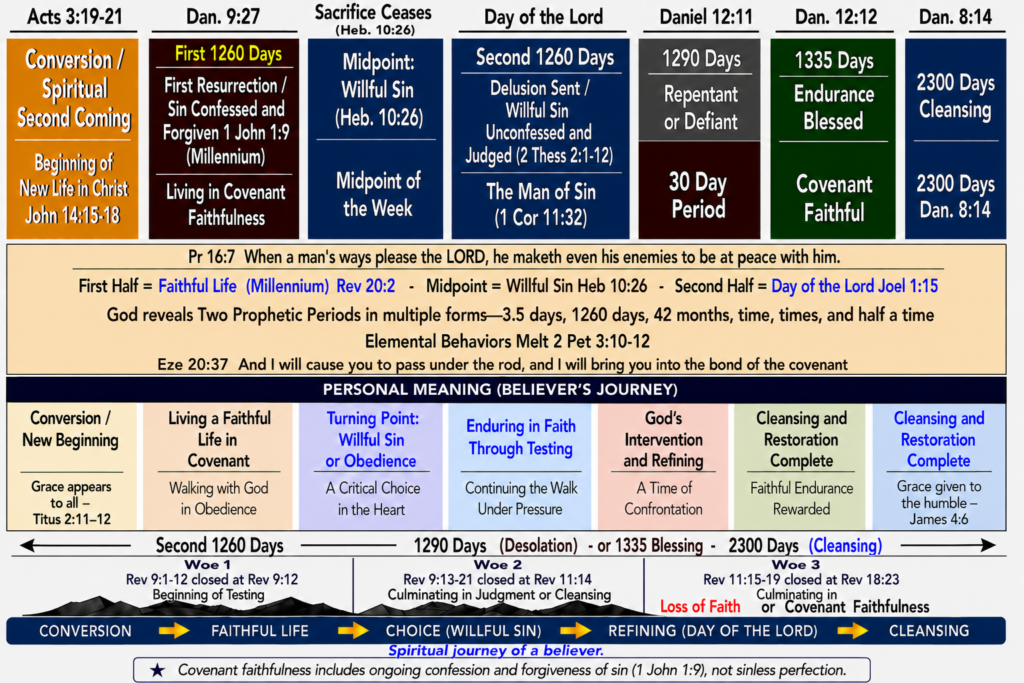
The pattern observed in 1 Corinthians 15 appears throughout Scripture in various forms. Daniel presents it prophetically, the Gospels present it, and Paul presents it experientially in the believer. Though the symbols differ, the movement remains the same: conversion, covenant faithfulness, testing, correction, endurance, cleansing, and restoration.
The following chart illustrates how these themes interrelate within the believer’s journey.
Death as the Final Enemy
While Paul distinguishes sleep from death throughout the chapter, he does not exclude death from the discussion. On the contrary, death remains the great enemy introduced through Adam and ultimately destroyed through Christ (1 Cor. 15:21-22, 26). Sleep is repeatedly presented as a condition from which awakening is possible, whereas death represents the full consequence of separation from the life God provides. For this reason Paul exhorts believers to awaken and stand firm in the faith (1 Cor. 15:34, 58). The movement of the chapter is therefore not merely from death to resurrection, but also from sleep to awakening, from the natural man to the spiritual man, and from Adam to Christ. Christ’s resurrection guarantees both the awakening of the sleeper and the ultimate victory over death itself. Those who endure in faith through God’s corrective dealings ultimately share in that victory, as the Day of the Lord accomplishes its work of exposing, refining, and restoring His people.
Definitive Conclusion
Paul intentionally distinguishes between death and sleep.
Christ died for sins (1 Cor. 15:3).
Believers are repeatedly described as sleeping (1 Cor. 15:6, 18, 20, 51).
The Greek text consistently presents sleep as a condition undergone rather than performed. The sleepers never place themselves into sleep. They are portrayed as entering a condition from which awakening is expected.
When this language is read alongside Paul’s command to “awake to righteousness” (1 Cor. 15:34), his warning “let us not sleep” (1 Thess. 5:6), his teaching concerning divine chastening (1 Cor. 11:31-32), and God’s giving people over to delusion (2 Thess. 2:11-12), sleep is best understood as a God-permitted condition of spiritual dullness.
In that condition, hidden sin is exposed, corrected, and ultimately overcome.
The goal is not sleep.
The goal is awakening.
The goal is not remaining in Adam.
The goal is being transformed into the image of Christ (Rom. 8:29; 1 Cor. 15:49).
The goal is not death.
The goal is participation in the resurrection life of Christ, both now and in the age to come (Rom. 6:4-11; Col. 3:1; 1 Cor. 15:57-58).
In this light, 1 Corinthians 15 can be read as more than a chapter about a future resurrection event. It is also a chapter describing God’s work of bringing believers from spiritual sleep to spiritual awakening, from Adamic existence to Christ-centered life, and from the natural man to the spiritual man.