
🕒 7 min read · 📝 1368 words
A unified theology of darkness, exposure, discipline, and restoration
The Day Begins With Darkness, Not Fire
The Day of the Lord does not begin with flames or final judgment. It begins with a merciful barrier of delusion — a protective dimming of perception that keeps a person from crossing into irreversible judgment. Scripture describes this as blindness, smoke, fog, or obscurity: the mind clouded before the heart is exposed.
This is the first movement of the Day.
1. The Day of the Lord Is Always “Near” to the Heathen
Scripture repeatedly declares that “the Day of the LORD is near upon all the heathen” (Obadiah 1:15). This nearness is not chronological but covenantal. Judgment is always at the door of those who resist God because the principle of the Day is simple:
As you have done, it shall be done unto you.
This is the pure form of the Day: immediate reaping.
Paul describes the same condition in 2 Corinthians 4:4, where the “god of this world” blinds the minds of the unbelieving. This blindness is not passive. It is the first stage of the Day — the protective dimming before exposure.
The Day begins not with fire, but with darkness.
2. The Blinding of the Mind: Tuphloō and Tuphos
Paul’s verb tuphloō means “to blind, to obscure perception.” It belongs to the same word‑family as tuphos — smoke, vapor, mental fog, delusion, the clouding of the mind.
The imagery is consistent:
- Satan blinds (tuphloō)
- The mind becomes smoked over (tuphos)
- Truth becomes invisible
- The Day draws near
Blindness is the threshold of judgment — the pre‑Day darkness before exposure.
3. The Beginning of the Second Half of Daniel’s 70th Week in the Believer
In the believer’s internal life, the second half of Daniel’s week represents:
- the beginning of willful sin
- the collapse of the daily sacrifice
- the entry into discipline
- the movement toward cleansing
This is the moment when the believer — still maintaining faith — enters the Rod‑phase of the covenant.
Blindness for the unbelieving is judicial. Exposure for the believing is restorative. Both occur at the same turning point.
4. Passing Under the Rod (Ezekiel 20:37)
God declares:
“I will cause you to pass under the Rod, and I will bring you into the bond of the covenant.”
This is the covenant‑discipline mechanism:
- The Rod exposes
- The Rod separates
- The Rod restores
This is the same pattern Paul uses in his pastoral discipline.
5. Paul Imitates God’s Covenant Method
Paul consciously mirrors God’s covenant‑discipline structure when he asks:
“Shall I come to you with a Rod, or in love and a spirit of gentleness?”
Paul is not inventing a pastoral technique. He is copying God’s own covenantal method:
- Rod → exposure, correction, discipline
- Gentleness → restoration, covenant peace
This is the same two‑phase pattern seen in:
- Ezekiel 20 (Rod → covenant bond)
- Daniel’s 70th week (collapse → cleansing)
- The Day of the LORD (darkness → dawn)
- Revelation’s narrative cycles (exposure → renewal)
Paul’s question is covenantal, not emotional.
6. How These Themes Interlock
A. The heathen live in perpetual nearness to the Day because blindness is already upon them.
B. The believer enters the second half of the covenant week when willful sin collapses the daily sacrifice.
C. Passing under the Rod is the beginning of restoration for believers.
D. Paul imitates this pattern in his pastoral dealings. E.
The entire biblical narrative follows the same arc: darkness → exposure → cleansing → restoration.
Everything converges into one unified covenant‑discipline pattern.
7. The Day as Reaping What One Sows — And Why Jesus Slows the Reaping for His People
Obadiah 1:15 defines the Day in its purest form:
“As you have done, it shall be done unto you; your reward shall return upon your own head.”
For the heathen, this principle is immediate.
Their sowing is active, and their reaping is unrestrained.
Blindness is the first stage of this nearness — the dimming of perception that precedes judgment.
This movement from blindness to delusion is the moment when Jesus, as the Lion of the tribe of Judah—the Devourer who consumes corruption but preserves the covenant—places a mercy‑barrier between the sinful believer and irreversible judgment, 2 Thess 2.
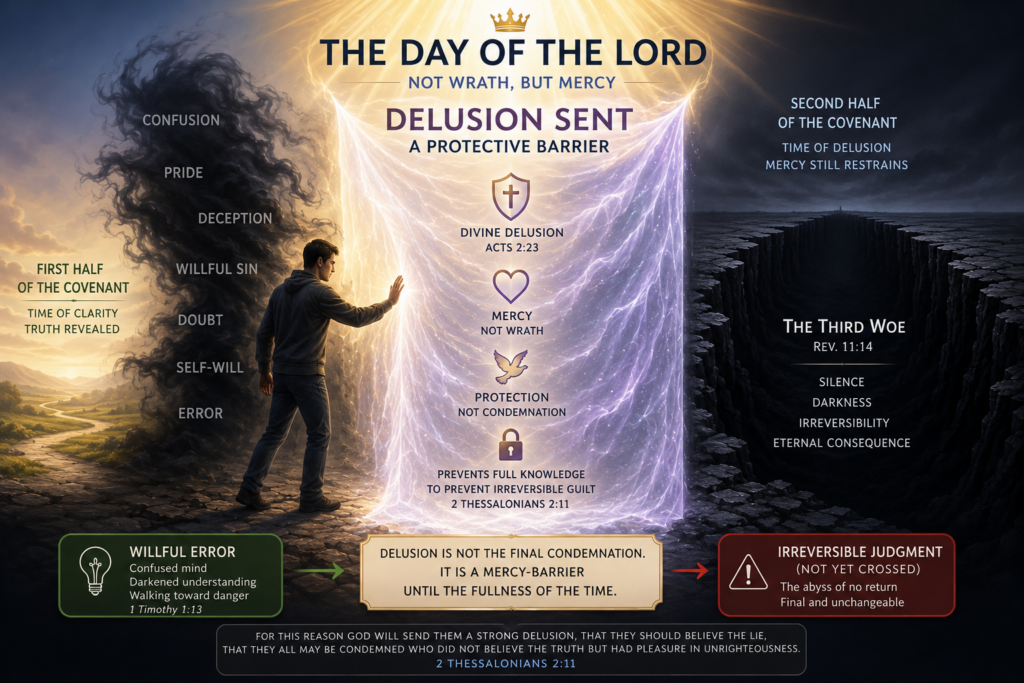
The Day of the Lord begins with a merciful barrier of delusion — a protective dimming that restrains full knowledge and prevents a sinner from crossing into irreversible guilt.
A Crucial Distinction: Ignorance vs. Illumination
This distinction is why Jesus’ words on the cross — “Father, forgive them, for they know not what they do” — are so decisive for understanding the administration of the Day. In that moment, Jesus identifies the category of sin that remains within the reach of mercy: sin committed in ignorance. The crowds, the soldiers, even the leaders acted without full illumination; their blindness placed them within the sphere of forgivable ignorance. But Judas did not. His betrayal was not the darkness of the uninformed but the rebellion of the fully enlightened. Jesus’ prayer covers those who “know not,” and Judas stands outside that prayer precisely because he did know.
This is the hinge between immediate reaping and covenant‑regulated reaping.
8. But for the Believer, the Pattern Is Different
Believers also reap what they sow — Paul affirms the universal principle:
“Whatever a man sows, that shall he also reap.”
Yet Christ governs the reaping for His people.
Instead of immediate reciprocity, the believer enters a slowed, tempered, covenant‑regulated reaping designed to:
- teach them to deny ungodliness
- abandon willful sin
- return to the daily sacrifice
- be restored through discipline
This is why the Day is not destruction for the believer — it is correction.
9. The Second Half of the Covenant Week in the Believer
The second half begins when:
- The daily sacrifice collapses (Heb 10:26)
- willful sin emerges
- internal order breaks
- God initiates discipline
The believer begins to reap — but not as the heathen reap.
Their reaping is measured, covenantal, restorative.
10. Passing Under the Rod = Controlled Reaping
Ezekiel 20:37 describes the covenant mechanism:
“I will cause you to pass under the Rod, and I will bring you into the bond of the covenant.”
The Rod is wrath but regulated reaping.
- The heathen reap immediately
- The believer reaps under the Rod — slowly, proportionally, redemptively
11. Paul Again Imitates This Pattern
Paul’s question in 1 Corinthians 4:21 is covenantal:
“Shall I come to you with a Rod, or in love and a spirit of gentleness?”
He is invoking Ezekiel’s pattern:
- Rod → exposure, correction, discipline
- Gentleness → restoration, covenant peace
Paul is copying God’s own covenant method.
12. Unified Pattern
- The heathen: blindness → nearness of the Day → immediate reaping → judgment
- The believer: collapse → slowed reaping → Rod → covenant bond → cleansing
- Paul: Rod or gentleness
- Daniel’s week: second half → exposure → dawn
The Day is universal, but its administration differs.
Christ governs the reaping for His people so that discipline leads to restoration, not destruction.
In the end, the whole pattern reveals one covenant truth: the Day of the Lord is not the destruction of His people but the disciplined mercy of the Lion of the tribe of Judah.
But the unbelieving—who never enter the covenant reach the end Jesus described in John 3:16: they perish.
Scripture shows what this means. They pass into non‑existence, because the truths of God were never given to them (Matt 13:11–12).
They lived their entire lives in merciful unawareness of the reality they resisted, and their end is the quiet disappearance Obadiah describes: “as though they had never been.”
Yet the same Day that ends the unbeliever in non‑existence becomes, for the believer, the Rod that restores, the delusion that protects, and the discipline that brings them back into the bond of the covenant.
In this way, darkness becomes the doorway to dawn, and the Lion who tears is the One who heals.
Ho 5:14 For I will be unto Ephraim as a lion, and as a young lion to the house of Judah: I, even I, will tear and go away; I will take away, and none shall rescue him.
Ho 6:1 ¶ Come, and let us return unto the LORD: for he hath torn, and he will heal us; he hath smitten, and he will bind us up.