🕒 9 min read · 📝 1751 words
🎯 The Goal of the Age
The Bible teaches that the telos — the end goal — of our faith is the salvation of our souls (1 Peter 1:9). Armageddon, often thought of as the final battle, is better seen as a journey toward a greater goal: the growth of Christ’s nature within His people.
⚔️ The Battle Defined
Revelation 16:16 names Armageddon as the gathering place for the great battle. Yet Joel 3:14 calls it the Valley of Decision. This shows us that Armageddon is internal — it is the continuing conflict in the believer’s heart when they are involved with willful sin.
The Bible illustrates that the Devil is allowed to tempt people, but the Lord’s prayer teaches us to ask that we not be led into that temptation.
🌱 The Gradual Driving Out
Deuteronomy 7:22 explains that God drove out Israel’s enemies “little by little.” In the same way, He drives out the sinful nature progressively, so we are not overwhelmed.
Sanctification is a process, not an instant event.
✅ Certainty Through Obedience
In John 7:17, Jesus said, “If anyone desires to do His will, they will know whether my teaching comes from God or from myself.” Obedience is the true test of faith. As believers follow His commands, they realize that Christ’s words are genuine, and overcoming sin shows that His nature/image is growing within us.
🔥 Certainty Through Victory Over Sin
Joshua 3:10 (NLT): “Today you will know that the living God is among you. He will surely drive out the Canaanites, Hittites, Hivites, Perizzites, Girgashites, Amorites, and Jebusites ahead of you.”
👉 Clarifier: Joshua 3:10 shows that the proof of God’s presence is the actual overcoming of sin.
God’s/Jesus’ presence is available to a Christian regardless of their current sinfulness; evidence of this divine presence is found in their continuous effort and progress in overcoming sin.
Gog & Magog: The Deceiving Spirit and the Deceived Believers
Gog & Magog: The Adversarial Spirit and the Unbelieving Nations
Gog and Magog portray the conflict between God and the unbelieving nations. In Revelation 20:7–9, Satan is released and deceives “Gog and Magog,” a phrase used throughout Scripture to symbolize the nations in rebellion against God, not believers.
In the symbolic system of Scripture:
- Gog represents the adversarial spiritual ruler (Satan), the same hostile force seen opposing God’s people in Ezekiel 38–39 and deceiving the nations in Revelation 20:8.
- Magog represents the unbelieving nations who are deceived by Gog. These nations are the ones who polluted God’s name (Ezekiel 39:7) and are judged by fire (Ezekiel 39:6).
The Coastlands represent believers who have drifted into complacency. They are not destroyed but refined by God’s corrective fire (Ezekiel 39:6; Isaiah 41:1; 42:4; 49:1).
Israel represents God’s covenant people who were scattered among the nations as discipline (Ezekiel 39:26–28) but are ultimately restored and gathered back.
When Gog deceives Magog, the nations “surround the beloved city.” This is not a physical siege but a symbolic picture of the world’s hostility toward God’s people. The beloved city represents the covenant‑faithful people of God, whom He protects and vindicates.
Scripture shows that God’s fire falls on:
- Magog (the unbelieving nations) — in judgment
- The Coastlands (complacent believers) — in refinement
This fire is not annihilation but God’s corrective and judicial action, consistent with:
- Ezekiel 39:6
- Joel 1:15
- 1 Corinthians 11:32
- 2 Thessalonians 2:8
Thus the Gog–Magog conflict is not an inner battle within believers, but the final symbolic confrontation between God, the nations, and His covenant people:
- Gog = adversarial spiritual ruler
- Magog = unbelieving nations
- Coastlands = believers under refinement
- Beloved City = covenant‑faithful people
- Fire = God’s judgment and purification
- Outcome = vindication of God’s people and the defeat of the nations’ rebellion
After the fire, God restores His people (Ezekiel 39:28–29), gathers them, and makes His name known among them again.
The Ram, the South, and the Horns: How Daniel 8 & 11 Reveal the Inner Covenant Battle
Daniel 8 and Daniel 11 use different symbols to describe the same internal covenant process. Every character except the believer is a spiritual agent.
The covenant-faithful spirit is the “South” in Daniel 11 and the “Ram” in Daniel 8.
The corrupting spirit is the “North” in Daniel 11 and the “Goat” in Daniel 8.
These Spirits are contending for dominance within the believer’s heart.
The horns illustrate the believer’s strengths and the stages of collapse when temptation is entered into.
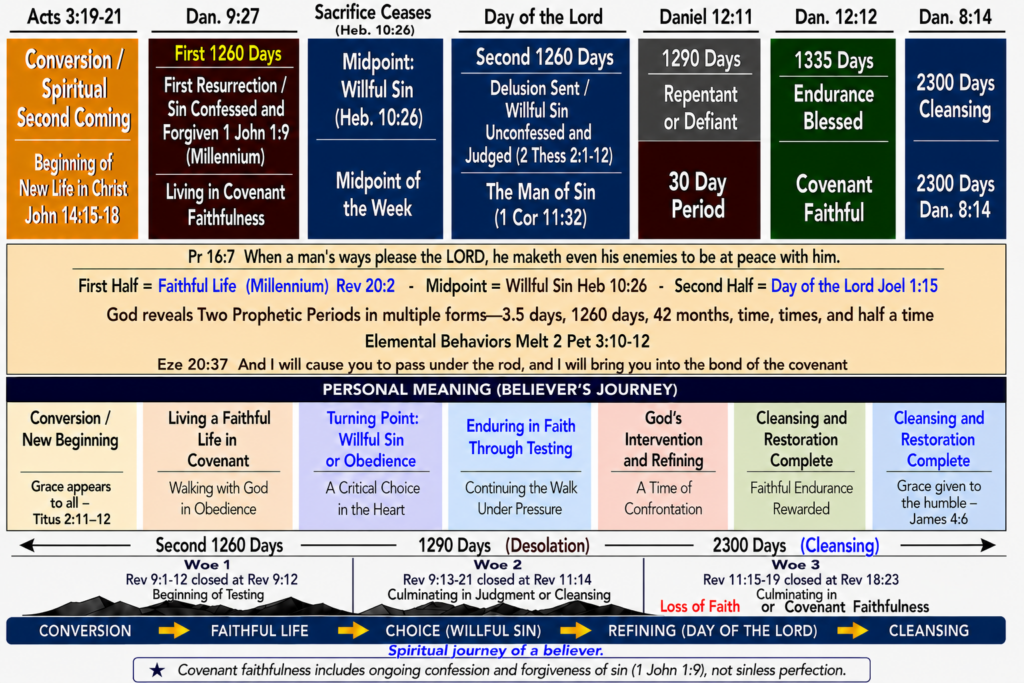
This symbolic system explains the inner Armageddon battle and the fork between the 1335 blessing and the 1290 desolation.
Content:
In Daniel 11, the king of the South represents the believer’s covenant identity.
This is the obedient part of the heart, the one aligned with God, the one offering the daily sacrifice of confession of sin. The South is the believer during His times of covenant faithfulness.
In Daniel 8, the Ram represents the same believer. The Ram’s two horns symbolize the believer’s moral and spiritual strength.
The Goat attacks the Ram with choler, (boiling anger) 8:7.
The Goat in Daniel 8 and the king of the North in Daniel 11 represent the corrupting spirit.
This is the pressure, deception, and temptation that tries to lead the believer into violating the covenant.
This is the inner Armageddon battle described on this page.
In Daniel 11:11 Choler (extreme aggression) is present but attributed to the Ram resisting temptation.
The battle is engaged. God sees the willful sin and in an effort to cleanse the believer, the Devil is allowed to decieve the believer (delusion is sent) so that the believer can be judged and hopefully cleansed per 2 thess 2:8 and 2 Thess 2:11-12, and 1 Cor 11:32).
But in Dan 11:31, the daily sacrifice is abolished (willful sin not recognized or confessed), the sanctuary (believer) is desecrated, and the abomination is set up when the 1290 hardened state per Dan 12:11.
This is the moment temptation is entered into. This is willful sin. This is the collapse of the believers choler and the triumph of the goats choler.
Daniel 8:12 and 11:31 are the same point.
After the Ram’s horns are broken, the Goat’s great horn breaks and four horns rise in its place.
The goat broke the bigger horn seen in 8:3 and four smaller ones came up these four horns symbolize the internal consequences wherein the believer is inclined towards rebellion against heaven, Dan 8: 8.
In 8:9 the horn expands its rebellion toward the south, east, and the pleasant land. This little one causes many believers to fall as is mentioned in 2 Thess 2:3
Out of these rises the little horn, which represents willful sin fully formed.
It casts truth down, desecrates the sanctuary, and removes the daily sacrifice.
This is the same event as Daniel 11:31.
Daniel 11:32 is the Man in Linen explaining the covenant fork. The believer either knows their God, becomes strong, and takes action (the 1335 blessing), or forsakes the covenant and enters desolation (the 1290 point).
The outcome depends on whether choler holds or collapses.
This unified insight shows that the Ram in Daniel 8 and the South in Daniel 11 are the same believer fighting the same internal battle.
The Goat and the North are the same corrupting spirit.
The horns illustrate the believer’s strengths and the stages of collapse.
The little horn is inclination towards rebellion and sin. And Daniel 11:32 is the decisive moment where the believer either triumphs or falls in the inner Armageddon.
The following chart visually summarizes the covenant process described above, showing how Daniel’s prophetic periods mirror the believer’s inner journey.
🛠️ Losing Your Life: The Definite Work of Grace
- Joshua 3:10 — God’s presence is proven by driving out sin
- Jesus’ Call (Luke 9:23) — We must lose our lives daily
- Titus 2:11–12 — Grace teaches us, but we must obey
- Christians are saved by The Grace of God (Eph 2:8), which is given to those who humble themselves before Him, James 4:6
- Once again, the question is, “Who is in charge—the individual or God?” Job 41:34 shows that this was the central issue in Job’s story, and in 2 Thessalonians 2:4.
- This becomes a central issue in a Christian’s life as well.
- Colossians 1:27 — Christ appears in us when we obey
👉 Grace is resistible, 1 Thess 5:19, Heb 10:29. God drives out sin, but only those who choose to lose their lives shall find eternal life, John 12:25. Bitterness can cause a person to fall short of God’s grace – Heb 12:15 and Rev 18:23.
🗝️ Faith Unlocks Grace
Ephesians 2:8 reminds us: “For by grace you have been saved through faith.” Faith is the key that unlocks grace. Without faith, unbelievers cannot access the cleansing power of God. This is why the very thing unbelievers criticize — the departure from sin — is the evidence that Christianity is real.
✨ The Appearing of Christ’s Nature
The battle culminates in Christ in you, the hope of glory (Colossians 1:27). The nature of sin is driven out, obedience confirms truth, God’s presence assures victory, and faith unlocks grace. The result is the appearance of Christ’s life within His people — the true victory of Armageddon. This is symbolically pictured in 2 Thess 2:8 and Revelation 20:9. Where Jesus descends spiritually (The Day of the Lord comes as a thief) and consumes the “wickedness from the believers life, 1 Corinthians 5:5.
1 Cor 5:5 To deliver such an one unto Satan for the destruction of the flesh, that the spirit may be saved in the day of the Lord Jesus.
🙌 Final Word
The battle is the Lord’s (2 Chronicles 20:15). Our role is simple: maintain faith throughout, Jn 6:28-29. As we trust Him, He cleanses us, drives out sin, and reveals His nature within us.
This is the end result of every believer’s personal Armageddon — not fear of destruction (Rev 18:23), but hope of glory, 1 Corinthians 1:6-8.
1 Cor 1:6 Even as the testimony of Christ was confirmed in you:
1Cor 1:7 So that ye come behind in no gift; waiting for the coming of our Lord Jesus Christ:
1 Cor 1:8 Who shall also confirm you unto the end, that ye may be blameless in the day of our Lord Jesus Christ.
We are not waiting for the Second Coming of Christ, that happens in Acts 3:20 when we repent of our unbelief. In these verses we are waiting to be conformed by the Day of the Lord’s action in our lives, as Jesus comes as a thief to teach us to deny ungodliness.
God is bringing us into the bond of the covenant Ez 20:37.
He is circumcising our hearts Deut 30:6.
The Grace of God given to the humble (James 4:6) is teaching us to deny ungodliness, Titus 2:11-12.