
🕒 13 min read · 📝 2463 words
Introduction
The Book of Job isn’t just a story about suffering. It shows what the Day of the Lord looks like inside a believer — how God steps in, exposes hidden sin, brings judgment, and restores His people.
Job’s experience follows the same pattern we see in Paul before he was saved, in the influence of Gog, in the nations of Magog, and in the two halves of Daniel’s 70th week.
All of these show how God keeps working in His people throughout their lives — exposing what’s hidden, judging it, and removing it so they can walk closer with Him.
When you read Scripture, you start to notice something: Everyone who truly sought God went through the same spiritual cycle.
Different people, different times, different situations — but the same pattern keeps showing up:
obedience → willful sin → God’s judgment → confession → restoration → deeper obedience
1. Job Begins the Book Already Under Delusion
Job doesn’t start the story spiritually neutral. He begins in a state the Bible calls delusion — not open rebellion, but blindness caused by a hidden willful sin.
Job’s condition at the start:
- He couldn’t see his own inner condition.
- He believed he was righteous in himself.
- He couldn’t see the hidden pride mentioned in Job 32:1.
- He was under judicial blindness — God allowed him to be blind to his own sin so that He could be judged and cleansed per 2 Thessalonians 2:11-12.
2Th 2:11 And for this cause God sendeth them a working of error, that they should believe a lie:
12 that they all might be judged who believed not the truth, but had pleasure in unrighteousness.
Job 32:1 says:
“He was righteous in his own eyes.”
This is the self‑righteousness God saw from the beginning — the “man of sin” sitting inside Job’s heart, unseen by Job but fully seen by God.
Job misunderstood righteousness
Job didn’t realize that his right‑standing with God came only through the sacrifice. He thought he was righteous in himself. But without atonement, his “righteousness” was just pride.
Scripture says:
“All our righteousnesses are as filthy rags.” (Isaiah 64:6)
Job didn’t reject the idea of sacrifice — he simply needed a deeper understanding of why he required the atonement.
On some level, he believed he had righteousness—right-standing with God—without the need for atonement.
Job’s confidence in his own righteousness revealed that his vision of God’s majesty was incomplete. Even the apostle John—devout, faithful, and beloved—collapsed “as though dead” when confronted with the unveiled glory of the risen Christ. If a man like John could not stand before the true holiness of Jesus, Job’s assumption that he possessed right‑standing apart from the sacrifice shows how deeply he misunderstood God’s absolute holiness. This is why Lucifer’s pride was so abhorrent: as a spirit being, he did understand the blazing holiness of the Son, yet rebelled in full knowledge. Job’s error was ignorance; Lucifer’s was defiance. Job’s blindness came from not yet seeing who God truly is.
God exposes this through His judgment in the book.
This matches 2 Thessalonians 2:11–12
- A hidden sin
- Blindness to that sin
- God allowing the blindness
- Accountability even though he didn’t see it
Job’s willful sin wasn’t conscious rebellion. It was the self‑exalting posture of the heart — the inner Gog‑like ruler sitting in God’s place.
He was accountable, but not condemned.
This pattern of hidden sin, blindness, and delayed accountability is not unique to Job — Paul lived the same structure before Christ confronted him.
This puts Job in the same spiritual category Paul was in before salvation.
Believers often cling to wrong ideas because God uses limited understanding — and sometimes even delusion — as a form of protection, keeping them from becoming knowingly defiant. Paul was shown mercy in his ignorance, and later needed a thorn to restrain him once he had more light. Job’s blindness kept him safe until God exposed his hidden pride. Even Judas and Lucifer did not have full knowledge; no created being ever does, and sin corrupts perception at every level. They simply acted against the light they did have without any restraint to stop them. This is why Scripture warns against placing a stumbling stone before another believer — giving someone more knowledge than they can bear can increase their accountability and harm them. True love distributes knowledge carefully, revealing truth in the measure a person can safely receive, because God only holds people accountable for the light they actually have and only increases that light when their heart is ready for the responsibility that comes with it.
2. Job’s Ignorance Does Not Remove Accountability — It Allows Mercy
Paul said:
“I obtained mercy because I acted ignorantly in unbelief.”
This is the key to understanding Job.
Both Job and Paul sinned:
- Job: hidden self‑righteousness
- Paul: persecuting Christ’s people
Both were unaware of their sin:
- Job truly believed he was righteous
- Paul truly believed he was serving God
Both were accountable:
- God judged Job
- Jesus confronted Paul
Both received mercy because their sin was ignorant, not rebellious
Ignorance doesn’t remove God’s judgment — it removes condemnation.
Paul’s giving principle is actually a covenant principle — God never judges a person for what they lack, only for what they possess.
This is why ignorance allows mercy but never removes accountability.
Paul taught this same principle in another context
“If there be first a willing mind, it is accepted according to that a man hath, and not according to that he hath not.” (2 Corinthians 8:12)
This shows that God evaluates a person based on what is present — not what is absent.
Job lacked understanding; Paul lacked understanding.
God judged them for what they had (their actual sin) but did not condemn them for what they did not have (full knowledge).
This is the same mercy‑logic behind Job’s restoration and Paul’s conversion.
This difference is the foundation of the whole pattern.
This same covenant logic—hidden sin exposed through mercy‑filled judgment—now expands into the full pattern Scripture calls the Day of the Lord.
3. Job’s Story Shows the Day of the Lord Inside a Believer
Job’s experience follows the same steps Scripture uses to describe the Day of the Lord.
A. Hidden sin exists
Job 32:1 — self‑righteousness.
B. Judicial blindness is present
Job couldn’t see it.
C. God begins His judgment
The heavenly court scene mirrors Joel 1:15 and Isaiah 13.
D. God exposes the hidden sin through His judgment
2 Thessalonians 2:8 says the Lord destroys the “man of sin” by His appearing. Isaiah 19:1 and 1 Corinthians 5:5 show how God uses outside events to expose what’s inside.
In Job:
- God appears in the whirlwind
- Job’s self‑righteousness collapses
- Job finally sees more of the truth
- Job confesses
- Job repents
E. Restoration follows confession
1 John 1:9 — “If we confess our sins…”
Job responds:
“I abhor myself, and repent in dust and ashes.”
This is the Day of the Lord inside a believer — God exposing the inner rebellion and removing it.
Amos warns those who desire the Day of the Lord while living in sin (Amos 5:18), assuming God will favor them despite their rebellion. For them, the Day becomes darkness and judgment. Peter, however, tells obedient believers to hasten the Day of the Lord (2 Peter 3:11–12), because their repentance and submission help bring about the covenant conditions that reveal God’s refining work. Amos addresses the rebellious; Peter addresses the obedient — two opposite heart‑postures toward the same Day.
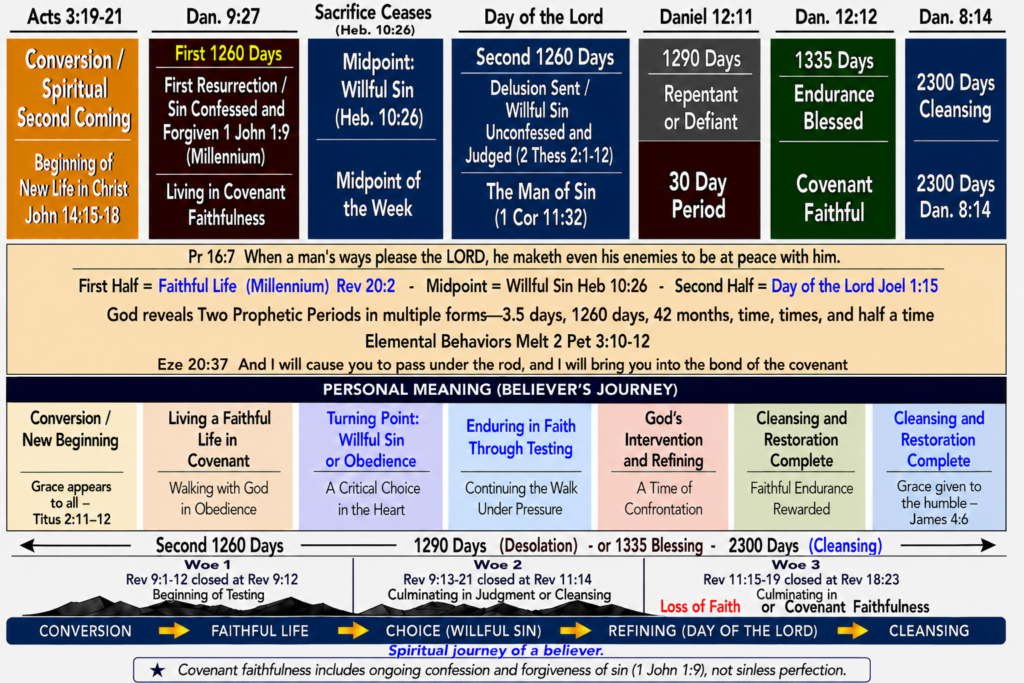
This chart shows how the same pattern seen in Job — hidden sin, exposure, repentance, and restoration — also appears in the prophetic timelines of Daniel and in the lifelong spiritual journey of a believer. It visually connects the Day of the Lord to both prophecy and personal experience.
Even though Amos addresses rebellious people who wrongly desire the Day of the LORD (Amos 5:18), his woe‑saying still fits the same covenant‑judgment pattern that Revelation later expresses in its woe sequence.
Amos also says that these Israelites “turn judgment to wormwood” (Amos 5:7), meaning they treat God’s justice as something bitter, poisonous, and cursed. They invert righteousness because they hate the exposure that judgment brings. This is the opposite of obedient believers, who love God’s justice because it restores righteousness and aligns the heart with Him. The Israelites in Amos feared judgment because it confronted their hypocrisy, while obedient Christians welcome it because it cleanses and heals.
This same Day‑of‑the‑Lord pattern inside Job now widens into the larger prophetic structures of Scripture, where the inner rebellion resembles the Gog–Magog conflict and follows the same covenant logic seen in Daniel’s 70th week.
4. The Gog–Magog Pattern and Daniel’s 70th Week
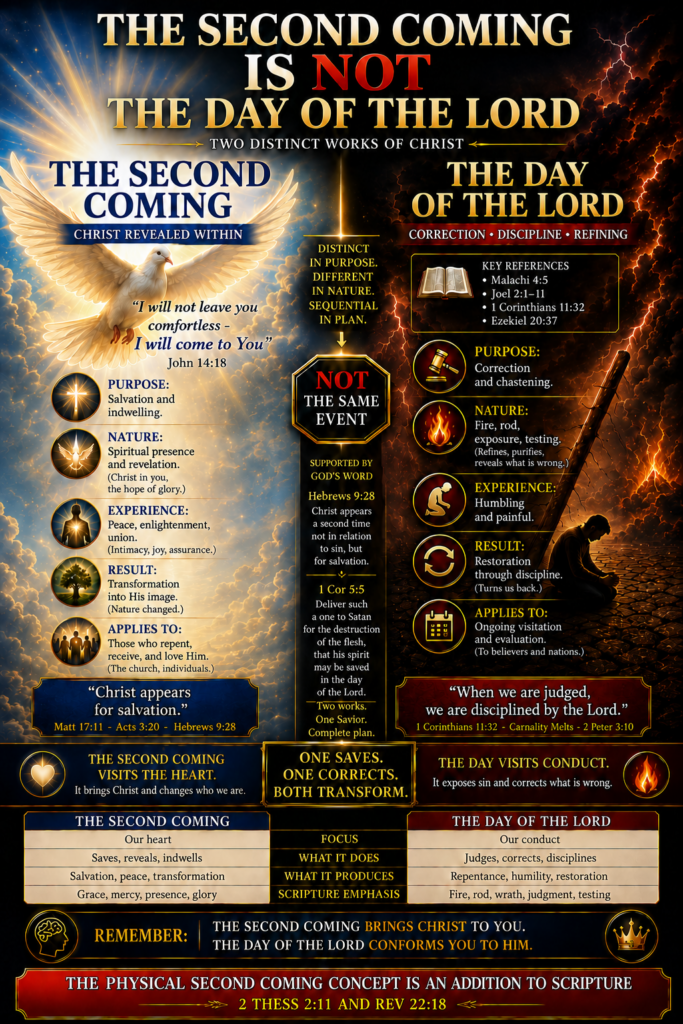
This graphic shows the difference between Christ’s spiritual second coming (salvation and indwelling) and the Day of the Lord (correction and refining). Understanding these two distinct works of Christ makes the Gog–Magog pattern and Daniel’s 70th week much clearer.
A. The Gog–Magog Structure
Gog–Magog shows up in two different ways in Scripture.
1. External Gog–Magog (Ezekiel 38–39; Revelation 20)
- Gog = satanic influence
- Magog = unbelieving nations
- Magog is never believers
- Magog is never covenant people
2. Internal Gog‑like pattern (inside a believer)
- Gog‑like = the self‑exalting inner ruler
- Not Magog
- Not unbelievers
- It only resembles rebellion — it’s not the literal unbelief, Matt 24:51
- This is what God exposes and removes in Job
Matthew 24:51 connection
Jesus said a believer can be “assigned a portion with the hypocrites.” This doesn’t mean the believer is a hypocrite — only that his hidden posture resembles theirs.
In the same way, the Gog‑like pattern inside a believer resembles rebellion, so God places the believer in a disciplinary category until His judgment exposes and removes the hidden condition.
Just as Jesus told the disciples their faith was real but not operating at the level needed (Matt 17:20), He also said a believer can be placed with the hypocrites when their inner posture resembles hypocrisy (Matt 24:51). In both cases, it is correction, not condemnation.
When Jesus said John the Baptist would “precede the Day,” He meant that the call to repentance comes before the correction of the Day. John announces the Day and prepares the heart, but the repentance itself happens inside the Day when God exposes the hidden condition. This is why Jesus said John would “restore all things” — repentance restores what God reveals during His judgment, Acts 1:6.
3. Exiled believers
- These are covenant people
- They match the “coastlands” in Ezekiel 39:6
- They receive refining fire, not destruction
- They are disciplined, not condemned
- Gog = satanic spirit
- Magog = unbelievers
- Exiled believers = covenant people under discipline
- Inner rebellion = Gog‑like self‑exaltation
Job’s self‑righteousness is this inner Gog‑like structure. Paul’s pre‑conversion zeal is the same thing.
Both are removed by the Day of the Lord.
This same pattern is what Scripture later calls Armageddon — not an external battlefield, but the final confrontation between the self‑exalting inner ruler and the appearing of Christ within the believer. Gog–Magog, the man of sin, and the Day of the Lord all describe the same covenant moment when God exposes hidden rebellion and destroys it by His presence. Armageddon is simply the climax of this inward pattern, the point where the self falls and Christ reigns.
Daniel’s 70th Week: Job Shows Both Halves
Job’s entry into the Day of the Lord reflects the state of the man of sin 2 Thess 2:3—a willfully sinful believer already in the second half of Daniel’s 70th week, where Christ comes as a thief and reveals His cleansing presence that destroys the inner rebellion by the brightness of His appearing (2 Thess 2:8), using the refining fire of 1 Cor 5:5 and the fire associated with the devil and his angels in Matt 25:41 as instruments of discipline—and Job’s repentance at the end of the book then illustrates the first half of the week, where sin is confessed and forsaken, releasing the believer from the devil’s presence and into the joy of the Lord (Matt 5:26; Matt 25:21, 23).
Job 41:34 says:
“He beholdeth all high things: he is a king over all the children of pride.”
This shows Leviathan — pride — ruling over Job’s inner condition. Job’s confession in chapter 42 shows that God exposed and removed it.
Second Half of Daniel’s 70th week — Sin but no Confession = Heb 10:27
This includes:
- Job’s hidden sin
- Job’s blindness
This second half is when God exposes the hidden sin through His judgment, Job recognizes it, confesses it, and receives forgiveness.
First Half of Daniel’s 70th week — Judgment + Restoration = Covenantal right-standing
This includes:
- The whirlwind
- God’s appearing
- The removal of the inner rebellion
- Job’s restoration
- Job’s renewed understanding
This First half is God’s judgment removing the hidden rebellion and restoring the believer.
C. Believers Move Through These Two Halves Continually
This is the practical part.
Titus 2:11–12 says:
- Grace appears
- Grace teaches
- Grace exposes ungodliness
- Grace removes it
- Grace restores righteousness
But grace does this one layer at a time.
The pattern keeps repeating:
- God deals with the most urgent sin first
- Lesser sins wait their turn
- Each exposure is God revealing hidden sin through His judgment
- Each confession is the first half
- Each restoration is the second half
Every believer goes through this cycle again and again as God removes deeper layers of ungodliness.
Job is the example of this lifelong process.
All of these patterns—Job’s refining, Paul’s confrontation, the Gog–Magog structure, and Daniel’s prophetic timelines—converge into a single unified covenant rhythm that prepares the heart for the final truth the Conclusion brings together.
Conclusion
Job’s story shows how God works inside His people:
- Hidden sin
- Blindness
- Delusion
- God exposing the hidden condition
- Confession
- Removal of the inner rebellion
- Restoration
- Repeating the cycle throughout life
Job, Paul, Gog–Magog, Daniel’s 70th week, and Titus 2 all point to the same truth:
The Day of the Lord is God’s ongoing work inside His people — exposing and removing the self that tries to sit on the throne, so Christ can reign.
And so the pattern continues, as the Lord faithfully unveils what we cannot see, removes what we cannot conquer, and forms within us the life we could never produce on our own — until Christ in you, the hope of glory, stands where the self once stood.