
🕒 10 min read · 📝 1902 words
Daniel’s 70th week presents a covenant rhythm that plays out in the life of every believer.
The first half, or 1260, reflects the Millennium—seasons of obedience, stability, and walking in covenantal obedience.
Covenantal obedience means that when a sin is committed, it is confessed to Jesus, 1 John 1:9.
But when that sacrifice “ceases” through a sustained act of willful sin (Heb 10:26), the midpoint is reached, and the pattern shifts.
The second half of Daniel’s 70th week represents the Day of the Lord, a period of corrective discipline due to covenantal disobedience, echoing Deut 28, Joel 1:15, 1 Corinthians 11:32, and 1 Corinthians 5:5.
This movement—from covenant faithfulness, to the cessation of the tamid (Daily Sacrifice), to divine correction—forms the backdrop for Revelation’s three‑stage woe pattern that follows.
At the moment the sacrifice ceases through willful sin, God initiates the same process seen in Job and described by Paul in 2 Thessalonians 2.
He sends a delusion that blinds the believer to the very sin that caused the fall.
This divinely‑permitted blindness is the first act of judgment — the doorway into the Day of the Lord.
It exposes what was hidden, begins the refining fire, and sets in motion the covenant discipline that unfolds in the three woes.
Although Job’s entire situation was rooted in the Leviathan‑pride the Lord exposed (Job 41:34), he did not at first confess this self‑righteousness as sin (Job 32:1).
But when confronted by the Lord, Job finally acknowledged it, saying, “I abhor myself, and repent in dust and ashes” (Job 42:6), and in that confession the cleansing work described in 1 John 1:9 began.
The chart below shows how this covenant pattern unfolds in the believer’s life.
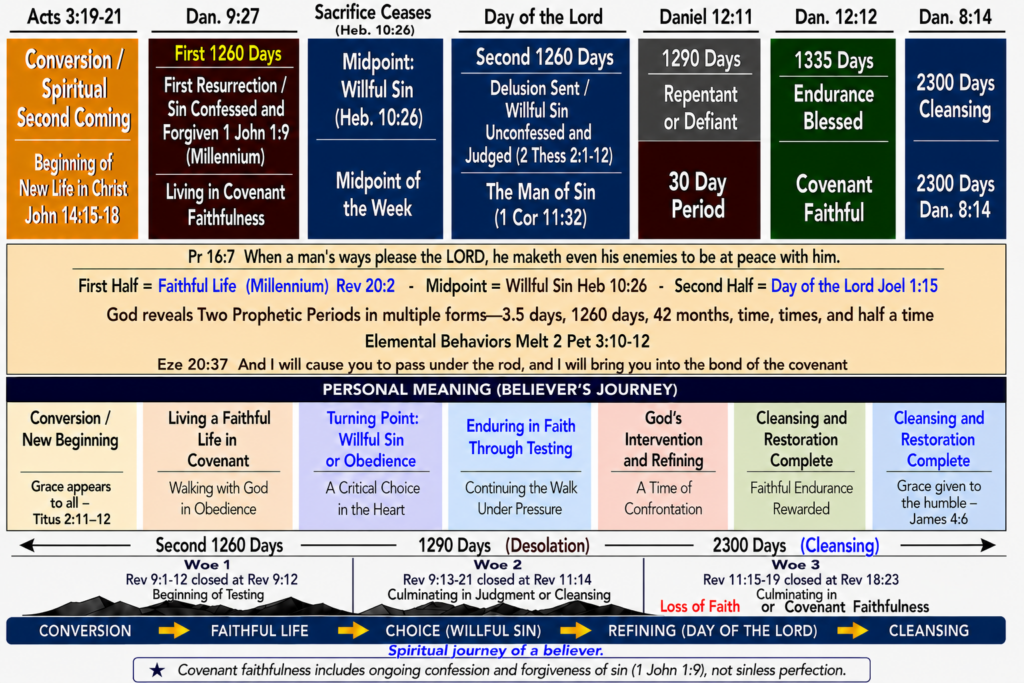
As the chart shows, Daniel’s 1290 and 1335 are not numerical extensions but covenantal outcomes.
The Hebrew numbers in Daniel were not originally mathematical digits but concept‑icons—symbolic letter‑forms whose covenantal meanings are the real concepts beneath the numerals.
The 1290 represents the desolation that follows continued willful sin.
Repentance is still possible, but the heart is hardened at this point.
The 1335 represents the blessed endurance of those who remain steadfast through the pressure.
These two endpoints frame the movement of the three woes (Rev 8:13), revealing how God’s covenant dealings separate the faithful from the defiant.
⭐ 1. WOE ONE — THE FIRE BEGINS (Daniel’s second 1260)
Woe One begins when a believer stops walking in obedience and refuses to confess their sin (1 John 1:9).
This is the moment when the continual sacrifice—the daily turning to Jesus—ceases (Dan 9:27; Heb 10:26).
What follows is an inner fire: conviction, unrest, and spiritual pressure.
Delusion is sent (2 Thessalonians 2:11), but it remains internal — not yet a public claim or firmly held belief.
God allows this fire (Matt 24:51; 25:41) as a form of discipline, continuing until correction is reached (Matt 5:26), not destruction (1 Cor 11:32).
This is the same fire Paul describes in 1 Corinthians 3:15—where the believer’s works are burned, he suffers loss, yet he himself is saved “as through fire.”
See also Hebrews 12:5–11 and Malachi 3:2–3, where God’s refining fire purifies His people rather than destroying them.
At the Woe one stage, God allows the demonic influence to nurture the inward delusion — this judgment Scripture calls the “Day of the Lord” (2 Peter 3:10).
During this period, the elemental, fleshly behaviors begin to melt away under the pressure of conviction.
Jesus does not instruct obedient believers to separate from willfully sinful believers at this point (Matthew 24:16), and repentance is still entirely possible.
Because at this stage the delusion is still inward and unspoken, the person has not yet rejected the truth; the heart is troubled, not hardened.
This is why Woe One is the stage of “fire without separation.”
⭐ 2. WOE TWO — THE JUDGMENT IS PROLONGED (1290 or 1335)
Woe Two is the stage where spiritual death becomes possible. This is when the inward drift can harden into open unbelief.
At the end of the second 1260 days, a person reaches Day 1290, the moment when “the abomination is set up.”
This is when the inward lie described in 2 Thessalonians 2:10–12 becomes an outward truth‑claim.
For what the heart embraces in secret, the mouth eventually proclaims in public; inward deception always matures into outward confession, Matt 12:34.
What was once hidden is now publicly affirmed. Jesus calls this the moment to flee (Matt 24:15–16).
Revelation 11 connects this same moment with the sounding of the Seventh Trumpet — the point where the heart’s direction becomes visible.
At this stage, Daniel shows that there are two possible outcomes, not a sequence:
- 1290 = Desolation The person embraces the delusion, refuses repentance, and moves toward spiritual ruin.
- 1335 = Endurance and Blessing The person resists the pressure, holds to the truth, and remains faithful under testing.
These two numbers represent a fork in the road.
The 1290 reveals the heart that hardens.
The 1335 reveals the heart that endures.
Woe Two is therefore the prolonged season where the heart’s choice becomes clear — either toward desolation or toward faithful endurance.
⭐ 3. WOE THREE — FINAL UNBELIEF (THE HARDENED STATE)
Woe Three begins with the Seventh Trumpet (Rev 11:15) and reveals the final outcome of the heart’s choice.
Scripture teaches that lifelong unbelief does not result in continued existence, but in non‑existence.
In biblical terms, the wicked do not live eternally as conscious rebels; they simply do not remain (John 3:16).
This “ceasing to exist: is the final end of those who never find faith, and of those who abandon it.
At this point, the delusion is no longer forming — it is embraced. The person has moved from drifting, to resisting, to settled unbelief.
This is the fire Jeremiah describes — a wind “not to fan, nor to cleanse” (Jer 4:11), a judgment that goes beyond correction and does not purify.
This is the stage where the covenant relationship ends, Rev 18:23.
At this point the loss is total—the light once received is gone, the voice is silent, and the heart stands in the full reality of the hardened state.
As Peter later affirmed, Judas ‘was numbered with us and had obtained a part in this ministry’ (Acts 1:17), yet after walking in the light reserved for disciples he descended into delusion, hardened, and ultimately forfeited the faith he had possessed; this is why Jesus declared, ‘It would have been better for that man if he had not been born’ (Matt 26:24), for his end stands as a tragedy of the highest order.
Judas is not an isolated case but the clearest revelation of what the hardened state becomes when the light is lost and the delusion is fully embraced.
Revelation 18:23 describes it as the moment when “the voice of the Bride and Bridegroom is no longer heard.” The heart has fully chosen its direction, and no repentance remains.
Woe Three is the unveiling of the hardened state.
⭐ THE PATTERN (Condensed)
Woe One (1260): Sacrifice ceases → internal fire → delusion sent but unproclaimed → repentance still possible.
Woe Two (1290 or 1335): Delusion matures → becomes public at 1290 → separation commanded → endurance or desolation.
Woe Three: Delusion embraced → hardened state revealed → no repentance → voice ceases.
Judas stands as the clearest embodiment of this irreversible collapse of the covenant.
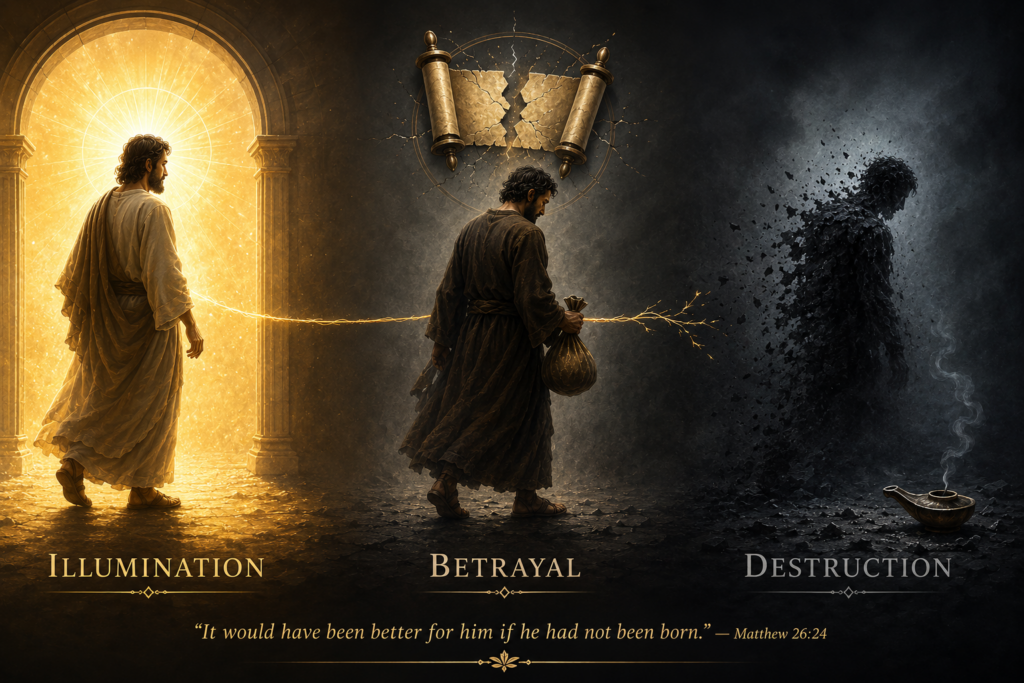
And with Judas as Scripture’s clearest warning, the pattern turns toward us, confronting the condition of the church today.
For the same progression that overtook Judas now unfolds wherever private compromise ripens into public confession, revealing the true direction of the heart.
This three‑stage illustration mirrors Daniel’s prophetic structure: the left panel corresponds to the first 1260 days of illumination and covenant faithfulness; the middle and right panels depict the latter 1260 days of betrayal and desolation, culminating in the 1290—the point of irreversible collapse where the abomination is fully enthroned.
Judas’ progression visually embodies this entire sequence.
This pattern is not abstract prophecy or distant symbolism; it is the spiritual anatomy of how a heart drifts, hardens, and collapses.
Understanding it is essential for discernment in our generation, for the same covenant rhythm that shaped Israel, Daniel, and Judas is the rhythm that shapes every believer today.
⭐ THE PRESENT CHURCH (Conclusion)
What Scripture calls delusion is no longer merely entertained in private; it is now recognized, affirmed, and proclaimed as truth.
The same progression that overtook Judas now unfolds within the church, as private compromise ripens into public doctrine and the delusion once hidden in the heart is now spoken as truth.
This public doctrine is the very proclamation Revelation describes—the moment when inward delusion matures into speech, and the heart begins to declare its deception openly (Rev 13:14).
This is the 1290 condition—the moment when inward departure becomes public doctrine, when the delusion once whispered in the heart is spoken as truth and embraced without shame.

At the 1290, the fallen believer’s inward delusion solidifies into an outward identity—the emergence of the “beast‑man,” the covenant person now bearing the full imprint of hardened unbelief (Rev 13:18).
At the 1290, the beast‑man proclaims the delusion openly, revealing the hardened identity symbolized by the number 666.
It reveals that many are already standing at the fork between endurance and desolation, and the heart’s true direction is now emerging in plain sight.
When private compromise becomes public creed, the inward drift of the heart stands revealed—and Jesus warned that salvation belongs to those who endure to the end (Matt 24:13).
To see this covenant pattern clearly, we must also distinguish the inward appearing of Christ from the corrective visitation Scripture calls the Day of the Lord — two works often confused but never treated as the same in Scripture.
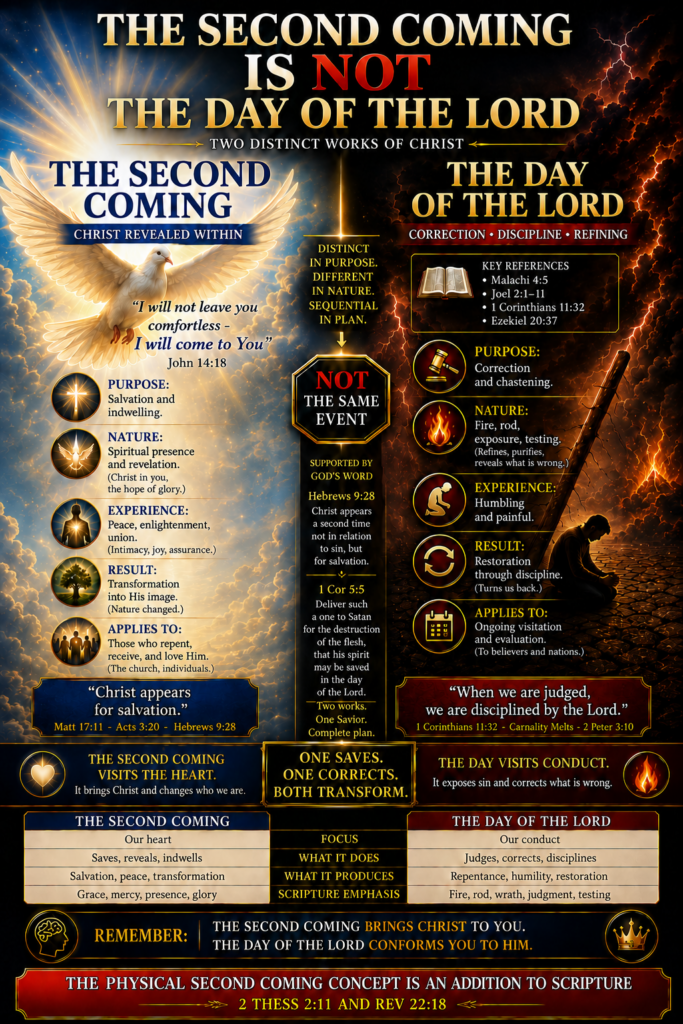
And when this distinction is understood, the present condition becomes clear: the same covenant rhythm is unfolding around us, and the church now stands within its final stages.
In a generation where delusion is preached as truth, the call of Christ remains unchanged: endure, remain faithful, and let His appearing within restore what the Day of the Lord exposes.
And so the call is clear: as delusion becomes doctrine and doctrine becomes identity, endurance alone leads through the fire, and only those who remain faithful will stand in the blessing of the 1335.
May the Lord keep our hearts awake to His appearing, and steady us to endure in His grace.
“For whom the Lord loves He chastens, and scourges every son whom He receives.” (Hebrews 12:6)