
🕒 21 min read · 📝 4066 words
1. Daniel – Human Activity Across the Book
- Daniel 1:8–21 — Purposes not to defile himself; requests alternative diet; excels in wisdom.
- Daniel 2:14–23 — Responds with prudence; seeks time; prays; receives the mystery; blesses God.
- Daniel 2:27–30 — Declares that wisdom comes from God, not himself.
- Daniel 4:19, 27 — Interprets Nebuchadnezzar’s dream; urges repentance.
- Daniel 5:13–23 — Rebukes Belshazzar; interprets the writing.
- Daniel 6:10–23 — Prays three times daily; remains faithful; survives lions’ den.
- Daniel 7:15–16, 28 — Troubled by visions; seeks interpretation.
- Daniel 8:15–27 — Seeks understanding; becomes exhausted; resumes king’s business.
- Daniel 9:2–19 — Studies Jeremiah; prays confession and intercession.
- Daniel 10:2–3, 7–17 — Mourns; fasts; sees the Man in Linen; collapses; is strengthened.
- Daniel 12:5–9, 13 — Asks questions; told to rest.
2. Kings & Human Rulers
Nebuchadnezzar
- Daniel 1:1–2 — Conquers Jerusalem.
- Daniel 2:1–12, 46–49 — Demands dream interpretation; promotes Daniel.
- Daniel 3:1–30 — Builds image; persecutes faithful; acknowledges God.
- Daniel 4:1–37 — Receives dream; becomes proud; judged; restored; praises God.
Belshazzar
- Daniel 5:1–4 — Holds feast; profanes temple vessels.
- Daniel 5:5–31 — Terrified; summons Daniel; is judged; kingdom falls.
Darius the Mede
- Daniel 6:1–28 — Appoints satraps; is manipulated; regrets decree; honors Daniel’s God.
Cyrus the Persian
- Daniel 10:1 — His reign frames Daniel’s final visions.
3. Human Groups
- Daniel 1:6–7 — Judean youths taken captive; renamed.
- Daniel 2:2–13 — Chaldeans and wise men fail to interpret dream; threatened with death.
- Daniel 6:4–9 — Satraps and presidents plot against Daniel.
4. Spiritual Beings & Their Activities
A. The Man in Linen (Christ‑like figure)
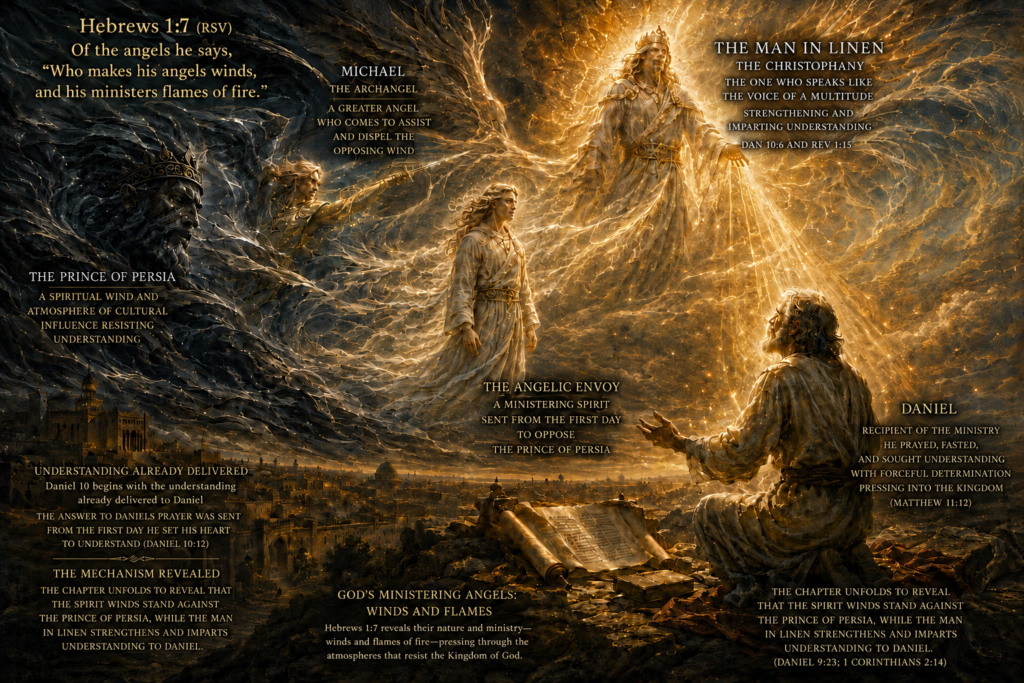
- Daniel 10:5–6 — Appears in glory.
Why “A Voice Like a Multitude” Proves the Man in Linen Is Divine (Daniel → Revelation)
Daniel 10:6 describes the Man in Linen’s voice as “like the sound of a multitude.” This acoustic description is one of Scripture’s strongest divine identity markers. It is never applied to angels. It is consistently applied to YHWH and to the glorified Christ. This makes it a canonical link between Daniel’s Man in Linen and Revelation’s divine speaker.
- Daniel’s Man in Linen Has a Divine Voice
Daniel 10:6:
“His voice was like the sound of a multitude.”
No angel in Scripture is ever described this way.
Angels speak plainly; divine figures speak with overwhelming, multi‑layered resonance.
- Ezekiel Uses the Same Description for YHWH
Ezekiel 43:2:
“His voice was like the sound of many waters.”
This is the same acoustic category as Daniel’s “multitude.”
Ezekiel applies it only to YHWH.
- Revelation Uses the Same Description for the Glorified Christ
Revelation 1:15:
“His voice was like the sound of many waters.”
Revelation 14:2:
“a voice like many waters… like loud thunder.”
Revelation 19:6:
“the voice of a great multitude.”
These are the same descriptors Daniel uses.
Revelation applies them only to Christ and heavenly divine manifestations.
- Angels Never Receive This Description
Throughout Scripture:
- angels speak
- angels explain
- angels interpret
- angels deliver messages
But angels are never described as:
- many waters
- thunder
- multitude
- roaring sound
This acoustic signature is exclusively divine.
- This Marker Links Daniel’s Speaker to Revelation’s Speaker
The Man in Linen:
- appears in glory (Dan 10:5–6)
- speaks with a divine voice (Dan 10:6)
- raises both hands (Dan 12:7)
- swears the eternal oath (Dan 12:7)
- seals the prophecy (Dan 12:9)
The Glorified Christ:
- appears in glory (Rev 1:13–16)
- speaks with a divine voice (Rev 1:15)
- raises His hand (Rev 10:5)
- swears the eternal oath (Rev 10:6)
- unseals the scroll (Rev 5–10)
The voice is the canonical bridge between the two.
- Why This Proves the Man in Linen Is Not an Angel
The “multitude / many waters” voice is a divine acoustic signature.
It is used only for:
- YHWH
- the Son of Man
- the Man in Linen
- the Glorified Christ
Therefore:
- Daniel’s Man in Linen cannot be Gabriel
- He cannot be Michael
- He cannot be any angelic messenger
His voice identifies Him as divine.
- Final Conclusion
The “voice like a multitude” is one of Scripture’s clearest identity markers.
It links Daniel 10 directly to Ezekiel 43 and Revelation 1, 14, and 19.
It proves the Man in Linen is not an angel but the pre‑incarnate Son — the same divine speaker who seals in Daniel and unseals in Revelation.
Why Gabriel Explains the Vision but the Man in Linen Gives Understanding (Daniel 8 vs. Daniel 10)
A key difference in the Hebrew grammar explains why Gabriel only “makes known” the vision in Daniel 8, while the Man in Linen actually “gives understanding” in Daniel 10. This distinction is essential for identifying the roles of the spiritual beings in Daniel’s visions.
- Daniel 8:16 — Gabriel Receives an Imperative (Command)
The command uses the Hiphil imperative of bîn:
“Cause this man to understand.”
Hebrew: habbēn (הַבֵּן)
In Hebrew, an imperative can be obeyed partially when the action exceeds the ability of the commanded agent. Gabriel obeys the command as far as an angel can:
- He switches to yadaʿ (יָדַע), “make known / explain” (Dan 8:19).
- He delivers information and interpretation.
- He does not give Daniel true understanding.
This is why Daniel concludes the chapter:
“No one understood it.” (Dan 8:27)
Gabriel fulfills the angelic portion of the command, but the full divine action of bîn is not completed.
- Daniel 10:14 — The Man in Linen Uses an Infinitive of Purpose
The Man in Linen says:
“I have come to make you understand.”
Hebrew: lehābîn (לְהָבִין)
This is the Hiphil infinitive construct, introduced by l‑ (“to”), meaning:
- “for the purpose of giving understanding”
- “with the intent to open your perception”
Unlike an imperative, an infinitive of purpose expresses the speaker’s mission, not a command. And He fulfills it completely:
- Daniel’s strength returns.
- Daniel’s speech returns.
- Daniel’s perception returns.
- Daniel finally understands the revelation.
This is the full divine action of bîn. Angels never perform this verb in Scripture; only God gives understanding (Dan 2:21–22).
- Why This Matters for Identifying the Man in Linen
The Man in Linen:
- gives understanding (bîn)
- strengthens Daniel spiritually
- reveals the future
- seals and unseals the book (Dan 12:4, 9)
- raises His hands and swears the divine oath (Dan 12:7)
These are divine actions, not angelic ones.
Gabriel:
- explains (yadaʿ)
- interprets
- delivers messages
- is delayed by Persia
- is helped by Michael
Gabriel never gives understanding. The grammar itself separates their roles.
- Novice‑Friendly Summary
In Daniel 8, Gabriel is commanded to help Daniel understand, but angels can only explain.
In Daniel 10, the Man in Linen comes specifically to give understanding — and He actually does it.
This shows the Man in Linen is doing something only God does, not something an angel can do. - The Core Distinction
- Daniel 8:16 — Imperative (command)
→ Gabriel obeys partially by explaining. - Daniel 10:14 — Infinitive of purpose (mission)
→ The Man in Linen fully gives understanding.
This is the linguistic hinge that reveals the identity and role of the Man in Linen.
🧩 The Man in Linen speaks in Dan 12:7-13:
The Man in Linen appears in Daniel 10:5–6, but He does not speak there. His first actual speech comes much later, in Daniel 12:7, when He stands above the river, raises both hands, swears by the eternal God, and gives the “time, times, and half a time” answer. This is the first moment in the entire vision where He speaks directly.
He is also speaking in Daniel 12:8–13. Daniel asks his question in verse 8, and the Man in Linen responds with the final interpretation, the sealing command, the explanation of who will understand, the blessing for the one who waits, and Daniel’s promised resurrection. This entire closing portion is spoken by the same figure.
All speech from Daniel 10:10 through the end of chapter 11 belongs to the angelic messenger who touched Daniel, strengthened him, was delayed by the prince of Persia, and needed Michael’s help. None of that speech is from the Man in Linen.
Therefore, the Man in Linen speaks only in Daniel 12:7–13. He frames the revelation visually in Daniel 10:5–6 and verbally in Daniel 12:7–13, but He does not speak anywhere between those two points.⭐ 1. Daniel 12:7 — Explicit speaker identification
This is the only verse in Daniel 12 where the speaker is explicitly named:
“the man clothed in linen… said…”
This identifies the speaker beyond any doubt.
⭐ 2. Daniel 12:8 — Hebrew continuity marker (שָׁמַעְתִּי, “I heard”)
Daniel says:
“I heard, but I did not understand.”
The verb shāmaʿ (“I heard”) is a Hebrew speaker‑continuity marker.
It means:
Daniel is still hearing the same speaker
No new speaker has been introduced
No narrative marker signals a switch
If the angelic envoy had begun speaking, the text would introduce him explicitly, as it does in Daniel 10.
But no such introduction appears.
⭐ 3. Daniel 12:8 — Daniel addresses the same speaker
Daniel asks:
“My lord, what shall be the end of these things?”
Daniel never calls the angelic envoy “my lord.”
He does use this term for exalted figures — including the Man in Linen.
This confirms Daniel is still addressing the Man in Linen.
⭐ 4. Daniel 12:9 — וַיֹּאמֶר (vayyōmer, “And he said”)
This Hebrew formula indicates continuation of the same speaker, not a new one.
If the speaker changed, the text would say:
“And the angel said…”
“And he who stood by said…”
“And the one who touched me said…”
But instead it uses:
וַיֹּאמֶר — “And he said”
This is the same speaker from verse 7 — the Man in Linen.
⭐ 5. Daniel 12:9–13 — The content matches only the Man in Linen’s authority
The speaker in 12:9–13:
commands the sealing
sets the duration
determines who will understand
gives the blessing
sends Daniel to his rest
speaks with divine authority
The angelic envoy never performs these actions anywhere in Daniel.
Only the Man in Linen:
gives understanding (10:16–19)
seals and unseals (12:4, 9)
swears the oath (12:7)
determines who will understand (12:10)
The content itself proves the speaker is the Man in Linen.
⭐ Final Answer
✔️ Daniel 12:7 — Man in Linen speaks
✔️ Daniel 12:8 — Daniel hears the same speaker
✔️ Daniel 12:9 — “And he said” = same speaker
✔️ Daniel 12:10–13 — content matches only the Man in Linen’s authority
⭐ Therefore:
Daniel 12:7–13 is the only place in Daniel 10–12 where the Man in Linen speaks — and He speaks continuously through all those verses.
No other speech in Daniel 10–12 belongs to Him.
- Daniel 10:10–21 — Strengthens Daniel; reveals conflict with Persia and Greece.
- Daniel 12:5–7 — Stands above the waters; gives time prophecy.
Why the Man in Linen Is the One Who Seals and Later Unseals the Prophecy (Daniel 12:7–10)
Daniel 12 shows that the Man in Linen is the one who commands the sealing of the prophecy, controls the duration of the sealing, and determines who will understand when the prophecy is unsealed. Although Daniel does not explicitly say “the Man in Linen sealed the book,” the text makes this the only possible conclusion.
- The Man in Linen Is the Speaker Who Commands the Sealing (Daniel 12:9)
Daniel 12:9 says:
“Go your way, Daniel, for the words are shut up and sealed until the time of the end.”
This command is spoken by the same figure who:
- stands above the waters (12:5)
- raises both hands (12:7)
- swears the eternal oath (12:7)
- continues speaking without interruption (12:8–10)
There is no change of speaker.
Therefore, the Man in Linen is explicitly the one who orders the sealing.
- The Man in Linen Controls the Duration of the Sealing
He says the words are sealed until the time of the end.
The one who sets the duration of the sealing is the one who controls the moment of unsealing.
Biblical sealing always works this way:
- the one who seals
- is the one who determines when the seal is broken
- and is the one who reveals what was sealed
There is no biblical example where sealing and unsealing are divided between different beings.
- Daniel 12:8 Shows Daniel Is Hearing the Same Speaker
Daniel says:
“I heard, but I did not understand.”
The verb shāmaʿ (“I heard”) is a continuity marker.
It shows Daniel is still listening to the Man in Linen — the same speaker from verse 7.
Daniel hears:
- the oath
- the timeline
- the condition
- the sealing command
- the explanation of who will understand
There is no interruption and no new figure introduced.
The Man in Linen is the sole speaker throughout.
- The Man in Linen Determines Who Will Understand the Unsealed Words (Daniel 12:10)
He says:
“The wise will understand.”
Understanding comes after the unsealing.
The speaker who determines who will understand is the same speaker who sealed the words.
This matches Daniel 10:14, where the Man in Linen says He came “to give understanding.”
The same figure:
- gives understanding
- seals the prophecy
- determines the time of unsealing
- determines who will understand
- declares the end
- swears the divine oath
This is a unified role.
- Why This Means He Is the Implied Unsealer
Daniel never names any other agent who:
- seals the book
- unseals the book
- reveals the meaning
- gives understanding
The Man in Linen is the only figure with:
- divine authority
- revelatory authority
- eschatological authority
- sealing authority
- interpretive authority
Therefore, He is the only possible sealing agent — and the only possible unsealing agent.
- Novice‑Friendly Summary
The Man in Linen is the one who tells Daniel the prophecy is sealed.
He also says how long it will stay sealed and who will understand when it is opened.
Since He gives the sealing command and controls the timing, He is the one who sealed it — and He is the one who will unseal it. - The Core Distinction
- Daniel 12:9 — He commands the sealing
- Daniel 12:9 — He sets the time of unsealing
- Daniel 12:10 — He determines who will understand
- Daniel 10:14 — He gives understanding
- How Revelation Completes Daniel’s Sealing Pattern
Daniel shows the Man in Linen commanding the sealing of the prophecy and determining the time of its unsealing. Revelation shows the same divine figure completing that process.
In Revelation 5, the Father holds a sealed scroll, and only the Lamb (the Son) is worthy to open it. In Revelation 10, a mighty Christ‑figure raises His hand, swears the eternal oath, and declares that “there will be no more delay,” signaling the moment of unsealing. This figure matches the Man in Linen in Daniel 12:
- both stand in sovereign positions
- both raise their hands
- both swear by the eternal God
- both announce the final phase of God’s plan
- both control sealed revelation
Daniel presents the sealing moment; Revelation presents the unsealing moment.
The same divine person — the pre‑incarnate Son — acts in both books.
This means:
- Daniel 12:9 — the Son seals the prophecy
- Revelation 5–10 — the Son unseals the prophecy
- Daniel 10:14 & 12:10 — the Son gives understanding when the time arrives
Daniel and Revelation together show the full arc:
the Son seals, the Son unseals, and the Son reveals.
This makes the Man in Linen both the sealer and the implied unsealer of the prophecy.
B. Gabriel
- Daniel 8:16–26 — Explains the vision; touches Daniel; gives interpretation.
- Daniel 9:21–27 — Arrives swiftly; gives 70‑weeks prophecy.
C. Michael
- Daniel 10:13, 21 — Helps against the prince of Persia.
- Daniel 12:1 — Stands for God’s people; time of trouble; deliverance.
D. Angelic Messengers
- Daniel 6:22 — Angel shuts lions’ mouths.
- Daniel 7:16 — Interpreting angel explains the vision.
- Daniel 8:13 — Holy ones discuss the 2,300 evenings‑mornings.
E. Hostile Spiritual Powers
- Daniel 10:13, 20 — Prince of Persia resists; prince of Greece follows.
- Daniel 7:8, 20–25; 8:9–12, 23–25 — Little Horn persecutes saints; opposes the Prince of princes.
Why the Man in Linen Cannot Be an Angel (Summary of Scriptural, Textual, and Linguistic Evidence)
Across Daniel 8–12, the identity of the Man in Linen is revealed through a consistent pattern of actions, grammar, authority, and continuity that no angel in Scripture ever possesses. The evidence is cumulative and decisive.
- Linguistic Evidence: The Verbs Separate Angels from the Man in Linen
Daniel uses two different Hebrew verbs to distinguish the roles of Gabriel and the Man in Linen:
- Gabriel uses yadaʿ — “to make known, explain.”
- The Man in Linen uses bîn — “to give understanding.”
Angels can explain; only God gives understanding.
Daniel 10:14 explicitly states the Man in Linen came “to give understanding” — something no angel ever does.
- Grammatical Evidence: Imperative vs. Infinitive
Daniel 8:16 uses an imperative (“cause him to understand”), which Gabriel obeys only partially by explaining.
Daniel 10:14 uses an infinitive of purpose (“to make you understand”), which the Man in Linen fully accomplishes.
The grammar itself proves the Man in Linen performs a divine action.
- Textual Evidence: The Man in Linen Performs Divine Acts
Throughout Daniel 10–12, the Man in Linen:
- strengthens Daniel
- restores Daniel’s speech
- restores Daniel’s perception
- gives understanding
- reveals the future
- stands above the waters
- raises both hands
- swears the eternal oath
- commands the sealing of the prophecy
- determines the time of unsealing
- determines who will understand
- declares the end of the age
No angel in Scripture performs these actions.
These are divine prerogatives.
- Narrative Evidence: Continuous Speaker Identity
Daniel 12:7–10 shows one uninterrupted speaker:
- Daniel hears Him (“I heard”)
- Daniel does not understand Him
- Daniel asks Him for meaning
- He responds with the sealing command
- He explains who will understand at the end
There is no change of speaker.
The Man in Linen is the sole authoritative voice.
- Sealing Authority: Only the Man in Linen Commands and Controls It
Daniel 12:9 shows the Man in Linen commanding the sealing.
Daniel 12:9 shows Him determining the duration of the sealing.
Daniel 12:10 shows Him determining who will understand when it is unsealed.
Angels do not seal prophetic books.
Angels do not control eschatological timing.
Angels do not determine who will understand divine revelation.
This is divine authority.
- Canonical Evidence: Revelation Completes Daniel’s Pattern
Daniel shows the Man in Linen sealing the prophecy.
Revelation shows the Son unsealing the scroll.
The same divine figure:
- raises His hand
- swears the eternal oath
- announces the end
- controls sealed revelation
Daniel presents the sealing moment; Revelation presents the unsealing moment.
The Son seals; the Son unseals; the Son reveals.
- Christological Evidence: The Man in Linen Matches the Glorified Christ
The description in Daniel 10:5–6 matches:
- the Son of Man in Daniel 7
- the glorified Christ in Revelation 1
- the mighty Christ‑figure in Revelation 10
No angel is ever described this way.
- Final Conclusion
The Man in Linen cannot be Gabriel.
He cannot be Michael.
He cannot be any angelic messenger.
Linguistically, textually, narratively, and canonically, He performs only divine actions.
He speaks with divine authority.
He reveals divine mysteries.
He seals and unseals divine prophecy.
He gives divine understanding.
Therefore, the Man in Linen is not an angel.
He is the pre‑incarnate Son — the divine revealer of Daniel’s visions.
5. God’s Direct Activity
- Daniel 1:2, 17 — Gives Jehoiakim into Nebuchadnezzar’s hand; gives knowledge to Daniel.
- Daniel 2:28–45 — Reveals mysteries; establishes eternal kingdom.
- Daniel 4:31–37 — Judges and restores Nebuchadnezzar.
- Daniel 5:24–28 — Sends the hand that writes judgment.
- Daniel 6:22 — Sends angel to protect Daniel.
- Daniel 7:9–14 — Ancient of Days judges; gives kingdom to Son of Man.
- Daniel 9:24–27 — Decrees 70 weeks.
- Daniel 12:1–3, 10 — Delivers, resurrects, purifies.
6. Chapter‑by‑Chapter Character Map (Quick Reference)
Daniel 1
Humans: Daniel, Hananiah, Mishael, Azariah, Nebuchadnezzar, Ashpenaz. Spiritual: God giving favor and wisdom.
Daniel 2
Humans: Nebuchadnezzar, Daniel, Arioch, wise men. Spiritual: God reveals mystery.
Daniel 3
Humans: Nebuchadnezzar, Shadrach, Meshach, Abednego. Spiritual: Fourth man in the fire.
Daniel 4
Humans: Nebuchadnezzar, Daniel. Spiritual: Watcher decrees judgment.
Daniel 5
Humans: Belshazzar, Daniel. Spiritual: God sends the hand.
Daniel 6
Humans: Darius, Daniel, satraps. Spiritual: Angel shuts lions’ mouths.
Daniel 7
Humans: Daniel. Spiritual: Ancient of Days, Son of Man, interpreting angel.
Daniel 8
Humans: Daniel. Spiritual: Gabriel; holy ones; symbolic powers.
Daniel 9
Humans: Daniel. Spiritual: Gabriel; God decrees 70 weeks.
Daniel 10
Humans: Daniel. Spiritual: Man in Linen; Michael; prince of Persia; prince of Greece.
Daniel 11
Humans: Kings of north/south (symbolic). Spiritual: Angelic (The Angel needing Michael’s help and not Gabriel) revelation implied.
DANIEL 11 — CHARACTER ACTIVITY SUMMARY
Human (Symbolic Only in Chapter 11):
The Kings of the South and North are symbolic covenant offices/influences, not literal historical rulers.
The South represents covenant‑faithful influence within the believer, while the North represents covenant‑breaking influence.
The believer is the only actual human in the chapter; all king‑actions describe internal covenant movement rather than external political events.
Spiritual Beings: The speaker throughout Daniel 10:11–11:45 is the unnamed angelic messenger who was opposed by the prince of Persia and assisted by Michael.
This angel delivers the entire Daniel 11 revelation and continues speaking without interruption from chapter 10.
Michael appears as the covenant‑faithful prince who restrains wickedness so revelation can be given.
The Man in Linen appears in Daniel 10:5–6 and speaks again only in 12:7; He does not speak in Daniel 11.
Thus, Daniel 11 contains symbolic human offices (South and North) and active spiritual agents (the angelic messenger and Michael), forming a unified covenant‑conflict narrative.
Humans (Symbolic Only): Daniel 11 contains no literal human actors. The Kings of the South and North are symbolic covenant offices representing internal movements within the believer.
The South symbolizes covenant‑faithful influence, while the North symbolizes covenant‑breaking influence.
All “human” actions in the chapter describe the believer’s internal covenant conflict rather than external historical rulers.
Are the Kings of the North and South Human?
No Fixed Locators Require That Interpretation
- Daniel 11 never identifies the kings of the north or south as human. The chapter provides no genealogy, nationality, historical anchor, or earthly descriptor that would tie these kings to literal monarchs. The only identifiers given are directional titles (“north” and “south”), which function symbolically, not geographically.
- Daniel 10 establishes the category of the conflict as spiritual, not human. The beings in conflict are the prince of Persia, prince of Greece, Michael, and the Man in Linen — all spiritual rulers. Daniel 11 continues the same conflict with no shift to human kings.
- The speaker of Daniel 11 is the same angelic being from Daniel 10. He continues his explanation seamlessly into chapter 11, never introducing human rulers or transitioning to earthly politics. The narrative category remains spiritual.
- The kings of the north and south perform actions no human king can perform. They contend across eras, interact with spiritual princes, and the final king of the north is destroyed “without hand,” a phrase Daniel uses exclusively for supernatural judgment.
- Daniel consistently uses “king” symbolically in chapters 7 and 8. Horns, beasts, and composite powers are all called “kings.” Daniel 11 continues this symbolic usage. The term does not require a human referent.
- Directional identifiers mark roles in the spiritual conflict, not human geography. “North” and “south” function like “horn,” “beast,” or “prince” — symbolic markers within the vision’s spiritual framework.
- Daniel 10–12 is a single continuous vision with no category change. The spiritual rulers of Daniel 10, the kings of Daniel 11, and the climactic events of Daniel 12 all belong to the same conflict. There is no textual break where the narrative switches from spiritual to human.
Therefore, the kings of the north and south in Daniel 11 are symbolic spiritual rulers, not human kings. Daniel provides no fixed locators requiring a human interpretation, and the continuity of the vision supports a fully spiritual reading.
Why the Kings of Daniel 11 Cannot Be Human
- They operate inside the same spiritual conflict introduced in Daniel 10. Daniel 10 features the prince of Persia, prince of Greece, Michael, and the Man in Linen — all spiritual beings. Daniel 11 continues this conflict with no textual shift to human rulers.
- They contend across eras and generations (Daniel 11:40). The kings of the north and south act across extended prophetic periods, something no human king can do. Only symbolic or spiritual powers operate across eras.
- They interact with spiritual princes. The narrative links the kings of Daniel 11 directly to the angelic princes of Daniel 10. Human kings do not fight or resist heavenly beings, but these kings do — placing them in the same category as the spiritual rulers of chapter 10.
- The final king of the north is destroyed “without hand” (Daniel 11:45). In Daniel, “without hand” always means supernatural destruction (Daniel 2:34, 44–45; 8:25). Human kings die by natural or political means, not by direct divine intervention.
- Their actions match the Little Horn, not historical monarchs. The kings exalt themselves, invade sacred territory, oppose the covenant, and fall under divine judgment — traits identical to the Little Horn of Daniel 7–8, a spiritual‑political power, not a human king.
- Their movements are visionary, not geographical. They “overflow,” “pass through,” and sweep through symbolic territories in ways that match the movements of beasts and horns in Daniel’s visions, not literal armies led by human rulers.
- Their rise and fall is governed by prophetic decree. Daniel 11 uses formulaic prophetic language (“he shall arise,” “he shall fall,” “he shall come to his end”) that matches symbolic powers in Daniel 2, 7, and 8 — not historical succession patterns of human kings.
- They participate in a cosmic narrative that ends in resurrection (Daniel 12). The conflict of Daniel 11 flows directly into the resurrection and final judgment of Daniel 12. Human kings do not trigger cosmic eschatology; spiritual powers do.
Therefore, the kings of the north and south in Daniel 11 are symbolic spiritual rulers, not human kings. Daniel provides no fixed locators requiring a human interpretation, and the continuity of the vision supports a fully spiritual reading.
Daniel 12
Humans: Daniel. Spiritual: Man in Linen; Michael; resurrection activity.