🕒 7 min read · 📝 1250 words
SHORT INTRODUCTION
This study explains what Scripture teaches about the destiny of the unbelieving and the restoration of the faithful. It begins with the boundary God set in Genesis 3:22, showing that fallen humans cannot live forever unless God grants life.
It then traces the pattern through Adam, Christ, the covenant structure of Daniel’s week, the enmity God placed between the two groups, and the Gog–Magog cycle.
Each section builds on the last to show how God uses discipline, conflict, and even hostility to refine His people, convert some who oppose them, and bring the faithful into the bond of the covenant.
The final conclusion is simple and consistent: eternal life belongs only to those who believe, and the unbelieving do not continue in conscious existence.
Scripture presents death as the end of life, not the continuation of it.
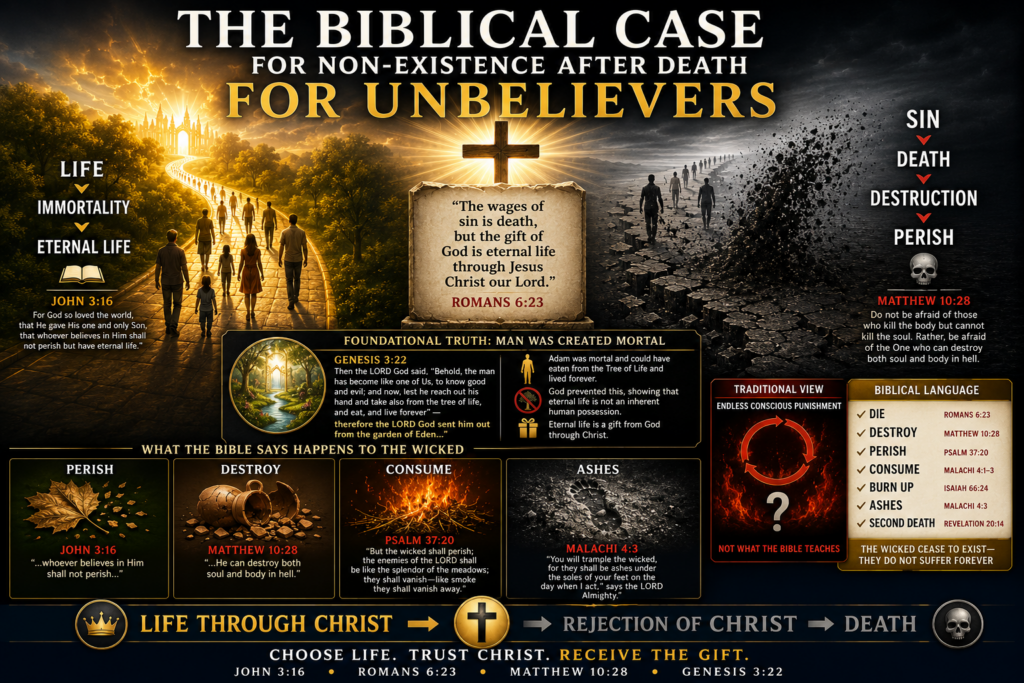
THE BIBLICAL CASE FOR NON‑EXISTENCE AFTER DEATH FOR UNBELIEVERS
Grounded in Genesis 3:22, the Faith of Adam, the Pattern of Christ, the Covenant Structure of Daniel’s Week, and the Gog–Magog Cycle
1. Genesis 3:22 Establishes the Boundary of Human Destiny
“Behold, the man has become like one of Us, knowing good and evil. Now, lest he reach out his hand and take also of the tree of life, and eat, and live forever…”
This verse establishes the first and most important truth about the destiny of fallen humanity: God prevents sinful humans from living forever.
Eternal conscious existence in a fallen state is impossible unless God grants life.
Genesis 3:22 is the first biblical denial of eternal conscious torment.
It teaches the opposite: fallen humans cannot live forever.
2. Eternal Life Is a Gift Given Only Through Faith
Scripture consistently teaches that eternal life is not inherent to humanity. It is always something God gives, sustains, or removes. Unbelievers never possess eternal life and never enter it.
If God does not grant life, the person cannot continue to exist.
3. Unbelief Is a Self‑Judgment Against Life
Acts 13:46 states that those who reject the gospel “judge themselves unworthy of eternal life.” Unbelief is not merely failure to believe — it is self‑exclusion from life. Those who refuse faith refuse life, choose death, which is non‑existence.
4. The Meaning of “Perish” in Light of Genesis 3:22
Because Genesis 3:22 establishes that fallen humans cannot live forever, every later use of perish must be interpreted within that boundary.
This means that “perish” actually means “to cease to exist,” not “to continue in torment.”
Because God blocks eternal life from fallen humanity (Gen 3:22), the Day of the LORD functions as the moment when a person reaps what they have sown (Obad 1:15). For the unbelieving, this reaping is not corrective but destructive: God turns His face away, and the person collapses into the death they have chosen. Wrath in Scripture is not sustained torment but the final exposure and dissolution of the wicked — the return of their own deeds upon their own head, ending in non‑existence.
5. Why Eternal Torment Is Impossible
Unbelievers never had spiritual life. They cannot live forever in any form. Conscious torment requires conscious existence.
Because God blocks eternal life from the fallen, the idea of eternal torment assumes a form of immortality that Scripture explicitly denies.
6. Adam Was Not Deceived
Scripture distinguishes Adam from Eve. Eve was deceived; Adam was not. Adam acted knowingly and deliberately.
7. Adam Chose to Partake in Eve’s Banishment
Adam chose to join Eve in her fallen condition rather than remain separate. He entered her death and exile — the earliest picture of a husband identifying with his bride.
8. Adam as a Prototype of Christ
Adam’s choice foreshadows Christ’s:
- Adam entered Eve’s death; Christ entered ours.
- Adam could not save; Christ saves completely.
9. Adam Expressed Faith After the Fall
Adam naming his wife Eve was an act of faith in God’s promise of life through the woman.
10. Adam Sinned, but Did Not Enter Unbelief
Adam did not believe the serpent’s lie. His sin was disobedience, not unbelief. His faith remained intact.
11. Adam’s Faith and His Identification with Eve Fit Together
Adam believed God’s promise and entered Eve’s condition, trusting God to bring life out of death — the same resurrection‑logic later seen in Abraham.
12. Adam’s Identification Preserved Eve Under God’s Discipline
Adam’s faith kept Eve from being abandoned in unbelief. His identification placed her under God’s corrective discipline rather than leaving her isolated.
13. Jesus Was Made Lower Than the Angels for the Suffering of Death
Hebrews 2:9 teaches that Jesus entered the full human condition, including vulnerability to death, so He could taste death for all.
14. The Realm of Fallen Angels and Human Discipline
Scripture shows that humans who resist God are delivered to Satan for the destruction of the flesh, while Jesus entered this realm to conquer it.
15. Grace Teaches Through the Pattern of Daniel’s Covenant Week
The second half of Daniel’s week is the period where grace teaches those who maintain faith. Exposure, separation, and final judgment refine the faithful and confirm them in the covenant.
16. God Places Enmity Between Two Groups and Uses It Redemptively
The enmity of Genesis 3:15 becomes the arena where believers are refined and some unbelievers are awakened and converted.
17. The Gog–Magog Cycle: Encirclement, Correction, and Restoration
The Gog–Magog pattern is the large‑scale version of this same process. God permits hostile forces to surround His people. This encirclement is not destruction but exposure — it reveals the condition of the heart. The pressure that follows brings God’s people into repentance and correction. Through this same process, God also awakens and evangelizes some of the unbelievers who were formerly driven by hostility. The final outcome is restoration: God vindicates His people, renews them, and brings some of the opposing group into the covenant. The Gog–Magog cycle is therefore a pattern of encirclement, correction, and restoration — the same pattern seen in Adam, in Israel, in the church, and in the final conflict.
18. Christ Cleanses His Bride with the Washing of the Word
Christ enters the condition of His bride and purifies her — the fulfillment of the pattern Adam only foreshadowed.
19. The Final State of the Unbelieving
The wicked perish, vanish, and become as though they had never been. The lake of fire is the second death — not eternal life in torment.
20. Summary
Genesis 3:22 blocks eternal life from fallen humanity. Only those in Christ receive immortality. God uses discipline, conflict, and enmity to refine believers and convert some unbelievers. The Gog–Magog cycle shows this on a global scale: encirclement, correction, and restoration. The final end of the unbelieving is non‑existence.
CLOSING EXHORTATION
God does not permit fallen humanity to live forever apart from Him, yet He continually works to restore those who believe. Through discipline, conflict, and even hostility, He confirms His people into the image of Christ and brings some who oppose the truth into the covenant. Hold fast to faith. Those who trust God receive life, cleansing, and restoration. Those who reject Him judge themselves unworthy of eternal life.