
🕒 11 min read · 📝 2091 words
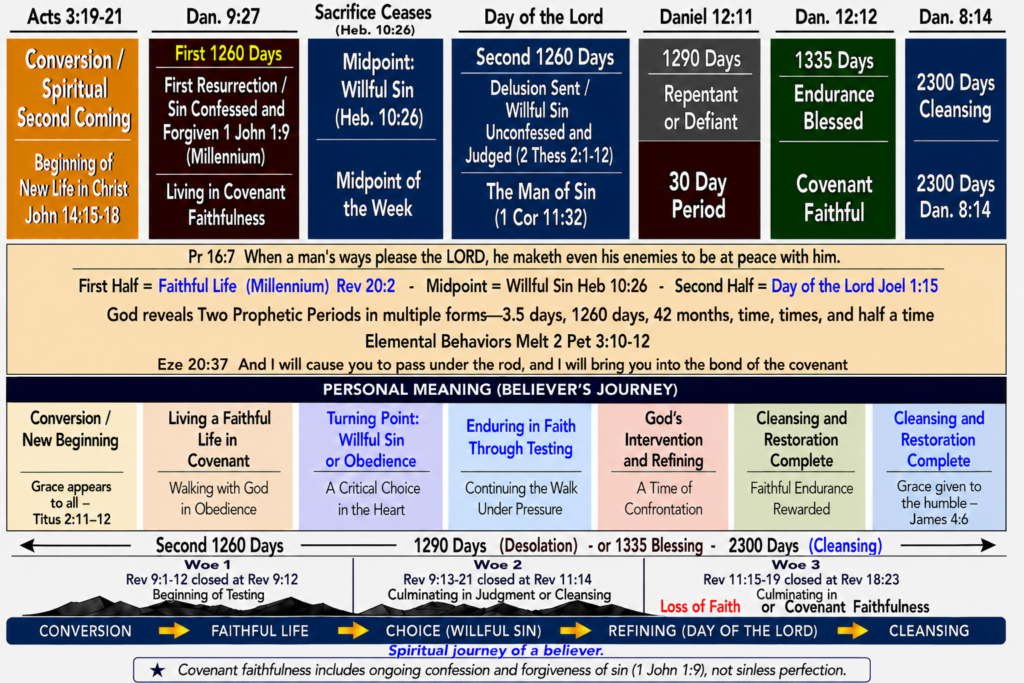
The Christian life is a covenant-confirmation process in which grace teaches, discipline corrects, and hidden sin is ultimately consumed.
Grace teaches → obedience develops → failure may occur → discipline may follow → restoration results → covenant is confirmed.
Dan 9:27 And he shall confirm the covenant with many for one week: and in the midst of the week he shall cause the sacrifice and the oblation to cease, and for the overspreading of abominations he shall make it desolate, even until the consummation, and that determined shall be poured upon the desolate.
Daniel’s 70th week is the believer’s covenant-confirmation process.
The first half represents an obedient response to grace, also called the Millennium.
The midpoint is marked by willful covenant violation, Heb 10:26.
The second half is the Day of the Lord, when God exposes, judges, and consumes hidden wickedness through discipline.
Jesus commands us to leave believers as they backslide in Matthew 24:16.
Then, at His appointed time, He brings the disobedient back into contact with the obedient, provided they maintain their faith through the judgment.
This is similar to Job’s friends gathering around Him.
This is Armageddon, when the covenantally alienated come into contact with the covenantally obedient and through God’s involvement and their testimony (Luke 21:13) the backslider is restored to covenant obedience (Ezek 39:3), completing the covenant-confirmation process.
First Half of Daniel’s 70th week:
Grace first teaches the believer obedience and faithfulness to God’s covenant.
Some believers remain responsive to grace, confessing their sins and continuing in covenant obedience.
This is the Millennium period as seen in Revelation 20, when the Devil is bound (Proverbs 16:7).
Pr 16:7 ¶ When a man’s ways please the LORD, he maketh even his enemies to be at peace with him.
This is referred to in Col 3:1 and Rev 20:5 as the First Resurrection.
It is the Obedient Christian life while on earth.
When a believer sins during this half of the representative week, they recognize and confess the behavior as being sinful and are forgiven 1 Jn 1:9.
Confession restores fellowship with God (1 John 1:9), and mercy may be extended where sin has been committed in ignorance (1 Tim. 1:13). Yet forgiveness does not nullify the principle that a man reaps what he sows (Gal. 6:7), nor does it immediately remove every effect of sin. Since accountability corresponds to the measure of revelation received (Luke 12:47-48), God’s dealings with His children may continue even after forgiveness has been granted. Consequently, God may employ discipline and correction, not to secure forgiveness already bestowed, but to expose, judge, and remove the underlying causes of sin and to produce holiness in those He loves (Heb. 12:6-11; 2 Cor. 12:7-10).
So long as the believer remains responsive to grace through confession, the corrective work proceeds within restored fellowship.
This is what happens during the first half of Daniel’s 70th week.
The Midpoint is the beginning of willful sin (Heb 10:26) and the appearance of the Man of Sin (2 Thess 2). This is the fallen believer who has fallen into willful sin.
When sin becomes willful and repentance is resisted (Heb. 10:26), the covenant-confirmation process enters a second more severe phase in which hidden wickedness is exposed through judgment, discipline, and testing until confession and restoration occur.
Second Half of Daniel’s 70th week
Believers enter this period of willful covenant violation.
To correct willful sin God sends delusion leading to judgment 2 Thess 2:12.
2Th 2:10 (TCNT) to the ruin of those who are on the path to destruction, because they have never received and loved the Truth to their own Salvation.
2Th 2:11 (TCNT) That is why God places them under the influence of a delusion, to cause them to believe a lie;
2Th 2:12 (TCNT) So that sentence may be passed on all those who refuse to believe the Truth, but delight in wickedness.
This is willful sin without confession, and since there is no confession there is judgment and not forgiveness 1 Jn 1:9.
The judgment is designed by God to promote repentance 1 Cor 11:32.
Before God removes hidden wickedness, He hides or conceals His presence so that the sin becomes apparent to the person Ezek. 39:23-29.
The delusion does not create the wickedness but helps the believer see the sin’s effect.
It becomes more noticeable and clear to the person when God hides His presence, and the weight of the sin is felt more intensely Ezek. 39:23-29.
Job could not initially see his pride, yet through God’s dealings the hidden issue was brought into the light and removed.
Likewise, God sends strong delusion (2 Thess 2:11) so that what is concealed within the heart may be recognized and ultimately judged.
Delusion brings the awareness of hidden wickedness, judgment exposes it, and discipline removes it.
Job became aware of His pride during one of these time periods and then repented during the Armageddon confrontation.
- 1. God placed a hook in Job’s jaw (Job/Magog influenced by Gog’s prideful spirit, Ezek. 38:4)
The hooks placed into the jaws of Gog (Ezek. 38:4) are not merely instruments of judgment but instruments of divine gathering. Ezekiel describes those who had been associated with a condition of waste, desolation, and scattering being visited by God and brought upon the mountains of Israel (Ezek. 38:8; 39:2). Within the covenant-confirmation process, this portrays the covenantally alienated believer being drawn from covenantal desolation into covenant firmness as God gathers the scattered, turns back the erring, and brings them into covenant confrontation so that hidden wickedness may be exposed, removed, and the covenant confirmed. This gathering culminates in the encirclement of the camp of the saints (Rev. 20:9), where the disobedient are brought into covenant contact with those who remain faithful.
- 2. He was brought into contact with other believers, illustrating the encirclement principle of Rev. 20:9.
- 3. Elihu’s testimony didn’t accuse Job of the hidden sins imagined by the three friends but instead defended God’s righteousness. Unlike them, Elihu wasn’t rebuked by God and pointed out that Job’s self-justification was the real issue (Job 32:2).
- 4. God then removed the weapons of wickedness from Job’s hands, pride in this case, and restored him.
God then summarizes Job’s entire affliction period using these words: Leviathan is king of the proud Job 41:34.
Job 41:34 He beholdeth all high things: he is a king over all the children of pride.
As in Job’s case, some believers have hidden sin which they are not even aware of, such as self-righteousness or pride (Job 32:1).
The judgment period begins after willful sin is chosen.
The progression of the Day of the Lord discipline may be summarized as follows:
Willful Sin → Delusion → Separation (Hell/Magog) → Encirclement → Armageddon → Disarming → Repentance → Restoration
The second half of Daniel’s 70th week is the beginning of the Day of the Lord and the battle of Armageddon.
It happens after the sacrifice ceases and the believer chooses to sin willfully, this begins the second half of the week.
Here is the progression: A believer falls into willful sin per 2 Thess 2:3.
God sees this and, per the action of Grace in Titus 2:11-12, wants to cleanse the believer.
He sends the fallen believer delusion to begin the process (2 Thess. 2:11-12).
He sends delusion so the believer does not ask for forgiveness and then hides His presence to make the sin more apparent to the believer.
Jesus tells obedient believers to flee from the presence of these willfully sinful believers as they see this day approaching Matt 24:15 and 28.
The errant believer represents Magog in symbolic terms. He is the believer under the spiritual influence of Gog, who represents Satan and his angels. This is reflective of Jesus delivering a believer into the realm associated with the Devil and his angels for corrective judgment (Matt. 25:41). However, Jesus also indicated the possibility of release following judgment, stating, “you will by no means get out of there till you have paid the last penny” (Matt. 5:26). Thus, within the covenant-confirmation process, Hell functions as a place of corrective judgment and covenantal separation, from which release ultimately occurs once God’s disciplinary purpose has been accomplished.
In the covenant-confirmation process, those believers who remain responsive to grace are the kings who reign in life through Jesus Christ (Rom. 5:17), walking in obedience as a royal priesthood before God.
Around them are gathered the nations, representing those who have become covenantally alienated through disobedience and deception, as Israel was when God hid His face because of their uncleanness and transgressions (Ezek. 39:23-24).
They remain estranged from covenant fellowship until God completes His work of correction and restoration.
Thus the encirclement of the camp of the saints and the beloved city (Rev. 20:9) portrays the gathering of the covenantally alienated around those who continue in faithful obedience. Yet God’s purpose is not destruction but restoration. Through the testimony of the faithful, the discipline of the Day of the Lord, and the consuming fire of God’s judgment against wickedness, the rebellious are humbled and brought again into the bond of the covenant (Ezek. 20:37).
Thus, after the covenantally alienated have surrounded the camp of the saints and the beloved city (Rev. 20:9), God at His appointed time brings the disobedient and obedient into direct contact so that the work of reconciliation may begin.
In concert with the testimony of the faithful (Luke 21:13), He disarms the unfaithful (Ezek. 39:3).
This is the Armageddon conflict.
Keep in mind that this is all spiritual in nature. It is happening all around us every day as God teaches His people to deny ungodliness Titus 2:11-12.
The interaction between covenantally obedient and covenantally alienated people, and the spiritual influences affecting them, is symbolized by the Beast imagery in Revelation.
God disciplines everyone He accepts as a son, so we will all be disciplined in some way, and must determine in advance to maintain faith.
During this time of Armageddon, they are brought into contact with covenantally obedient believers, and the testimony of the faithful plays a part in their becoming obedient again Luke 21:13 and Ezek. 39:3.
This is a time when they are disarmed, and their weapons of wickedness become ineffective 2 Thess 2:8.
When the sin is repented of (Job 42:6) the obedient believers can resume fellowship with the formerly backslidden 1 Thess 4:17.
God’s corrective discipline has brought them back into the bond of the covenant Ezek. 20:37.
Ezek. 20:37 And I will cause you to pass under the rod, and I will bring you into the bond of the covenant:
This is known as the Day of the Lord and also the discipline of the three-woe process of Revelation.
Zep 1:12 And it shall come to pass at that time, that I will search Jerusalem with candles, and punish the men that are settled on their lees: that say in their heart, The LORD will not do good, neither will he do evil.
It is a process of judgment based on willfully sinful behavior, intended to guide the believer back to obedience, as referenced in 1 Corinthians 11:32.
The believer’s journey through Daniel’s 70th week follows a recurring covenant-confirmation pattern:
Grace → Obedience → Millennium → Willful Sin → Man of Sin → Delusion → Hidden Wickedness Exposed → Magog → Encirclement → Armageddon → Disarming → Repentance → Bond of the Covenant → Resurrection/Gathering.
Throughout Scripture, God does not merely judge covenant failure; He exposes and removes the wickedness causing it.
The symbolic language of Daniel’s 70th week, Gog and Magog, Armageddon, the Day of the Lord, and the consuming fire of God all portray different aspects of God’s covenant-confirmation process whereby hidden sin is revealed, judged, and removed from His people.
2 Peter 3:10 But the day of the Lord will come as a thief in the night; in the which the heavens shall pass away (Believers fall away 2 thess 2:3) with a great noise, and the elements shall melt with fervent heat the earth also and the works that are therein shall be burned up (Gal 4:3).
Thus, God remains faithful to complete His covenant-confirmation work in His people.
Paul summarizes this restoration process in covenantal resurrection language:
1Co 5:5 To deliver such an one unto Satan for the destruction of the flesh, that the spirit may be saved in the day of the Lord Jesus.
1 Thess 4:16-17 For the Lord himself shall descend from heaven with a shout… and the dead in Christ shall rise first…
Those who had fallen into covenantal sleep are raised through God’s restoring work, while those who remained obedient and responsive to grace are gathered together with them unto the Lord.
Thus the resurrection and gathering language describes the completion of God’s covenant-confirmation process in all His people.