🕒 15 min read · 📝 2842 words
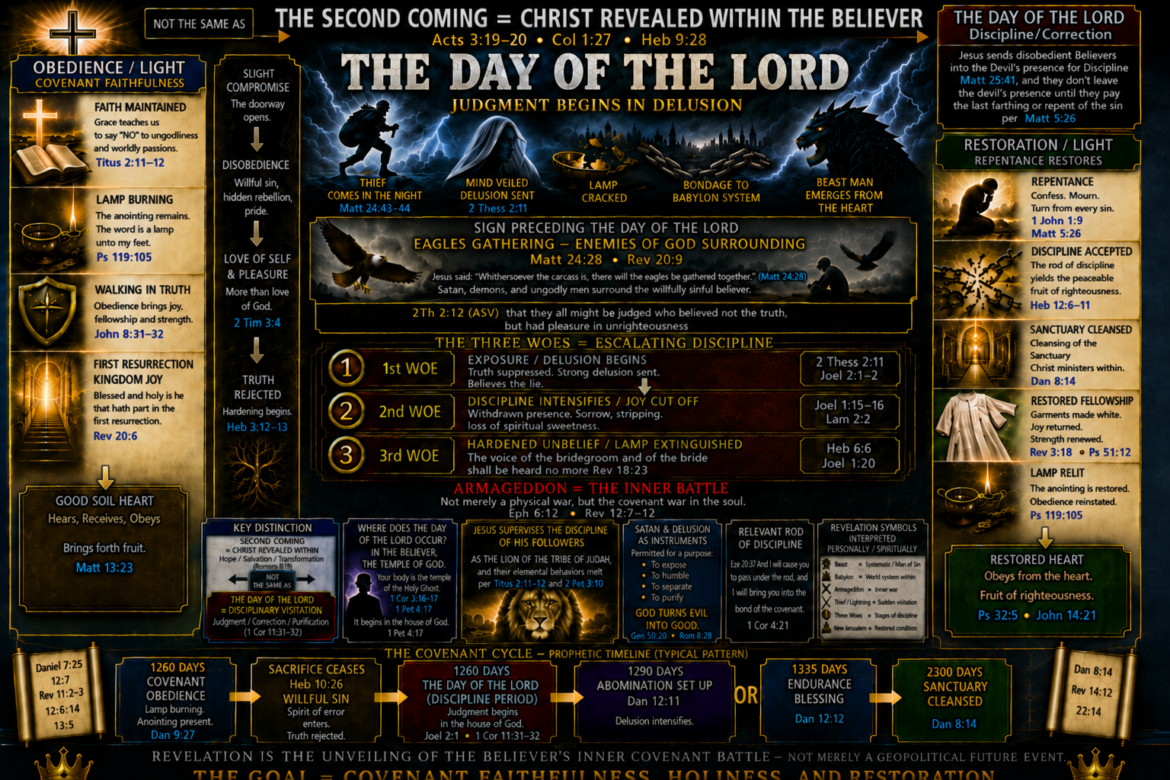
This study traces the recurring disciplinary pattern (The Day of the Lord) revealed across Scripture, beginning with Matthew 24.
⚡ Doctrinal Disclaimer: Flee to the Mountains
The admonitions of Jesus in Matthew 24:15–16, Paul in 1 Thessalonians 4:15 and 1 Corinthians 5:11, and the heavenly call of Revelation 18:4 are directed toward covenantal believers—those who confess sin and receive forgiveness. These warnings concern our posture toward willfully sinful brethren: believers who sin but refuse confession and persist in obstinacy. Scripture teaches that obedient believers are not to “go before” (1 Thess 4:15) or remain in close fellowship with those who have hardened themselves in willful sin. Jesus’ command to “flee to the mountains” is a covenantal call to withdraw from fellowship when such sin becomes hardened unbelief—the stage symbolized by the abomination being “set up.” This separation does not apply to every instance of willful sin. All believers experience seasons of discipline, for the Lord disciplines every son He receives. Grace teaches us to deny ungodliness, and confession restores forgiveness (1 John 1:9). Therefore, this admonition applies only when willful sin becomes established, unconfessed, defended, and set up in the life of a professing believer. Until the point symbolized by the 1290th day—the vultures gathering around a dead body in Matthew 24:28 and Luke 17:37, also reflected in Revelation 20:9—when willful sin hardens into abomination, obedient believers are not instructed to withdraw. The call to separation concerns only those who have set up hardened unbelief in their lives through persistent refusal of repentance.
📜 What We’ve Been Taught—And Why It’s Worth Rethinking
Embedded Doctrinal Drift: A Historical Snapshot
Darby (1830s): Introduced dispensationalism and pre-tribulation rapture, shifting prophecy away from allusions towards personal transformation and toward distant predictions.
John Nelson Darby mistakenly viewed the revelation of Jesus as an external, future event rather than an internal reality for believers.
The passages in John 14:23 and Colossians 1:27, however, teach that through love and obedience, Christians experience the indwelling of the Father and the Son, and that “Christ in you” is the “hope of glory”.
Brookes (1830–1897): A Presbyterian minister and early dispensationalist, Brookes mentored C.I. Scofield and helped shape American pretribulational thought. His verse-by-verse expositions and leadership in the Niagara Bible Conference laid the groundwork for institutionalizing futurist eschatology.
Scofield (1909): Amplified Darby’s views via the Scofield Reference Bible, embedding them into American evangelical study habits.
Branham (1946–1965): Merged dispensational themes with charismatic revivalism, claiming prophetic authority and end-time revelation.
Seminary Adoption (1950s–present): These interpretations became institutionalized through theological education and popular media.
These views, once fringe, became mainstream— not through Scripture alone, but through repetition, institutional endorsement, and emotional appeal—often distorting the original context of prophetic texts.
In verse 1, the disciples draw Jesus’ attention to the temple buildings, but He responds that every stone will be thrown down.
This sets the tone: what appears outwardly secure will be dismantled when God disciplines His own, just as Hebrews 12:6 affirms that every son He receives is chastened.
When the disciples ask when these things will occur, Jesus does not satisfy curiosity immediately — He first issues a warning.
He cautions them against deception and describes escalating turmoil among nations.
“Nation against nation” can also symbolize the conflict between two kingdoms operating within the covenant community: the heavenly kingdom of obedience and faith, and the kingdom of the power of the air that works in the disobedient (Ephesians 2:2).
In this sense, Jesus describes an internal conflict—Spirit against flesh, light against darkness, faithful against unfaithful—within the people of God themselves.
This aligns with the broader disciplinary pattern of Matthew 24, where the covenant community is divided between those walking in the Spirit and those drifting into willful sin.”
He identifies these events as “the beginning of birth pains” (v. 8), invoking the same disciplinary‑labor imagery Paul uses in Galatians 4:19, 1 Thessalonians 5:3, and Romans 8:22.
Throughout this section, Jesus speaks not to nations but to individual disciples. He tells them they will be handed over to affliction, and in verse 13, He declares that only the one who endures to the end will obtain salvation, echoing 1 Peter 1:9.
“Why “salvation” here does not mean “eternal life.”
What “Salvation” Means in This Passage

Many believers assume that “salvation” and “eternal life” are the same thing, but Scripture uses these terms differently.

Understanding the distinction helps clarify Jesus’ words in Matthew 24:13.

Salvation in this passage refers to being saved from God’s wrath.

Paul teaches that God’s wrath is revealed against all ungodliness (Romans 1:18).

However, God's grace which “brings salvation” teaches believers to deny ungodliness (Titus 2:11–12).

In this sense, God teaches us to be saved from His wrath against sin, but we maintain our grasp on eternal life throughout the process, as we maintain our faith in Jesus.

Eternal life is something different than being saved from wrath. Eternal Life is the life of God received and held by faith,John 17:3.

John 17:3 “And this is life eternal, that they might know thee the only true God, and Jesus Christ, whom thou hast sent.”

Scripture consistently ties eternal life to ongoing faith:

• “He who has the Son has life” (1 John 5:11–12).
• Eternal life is knowing God (John 17:3).
• Believers “lay hold on eternal life” by holding fast to faith (1 Timothy 6:12).

Putting it together:

• Holding onto faith = holding onto eternal life.
• Enduring to the end = being saved from God’s wrath as we are taught to deny ungodly behavior.

Jesus’ statement in Matthew 24:13 is about remaining faithful in the midst of God’s corrective wrath, as it falls on the believer who drifts into willful sin.
At some point in life, we all face challenges, and the key is to recognize them and keep our faith strong as we work through them, just as James 1:2-4 reminds us.
Jesus is deliberately redirecting the conversation away from external events and toward the inner spiritual condition of His followers.
In verse 15, Jesus references the abomination that causes desolation, corresponding to the 1290th day in Daniel 12:11. The second half of Daniel’s covenant‑confirmation week represents the period after a believer ceases confession, enters willful sin, and remains hardened in that state—the very condition Daniel identifies as the setting up of desolation.
The Judgment Sequence: 1260 → 1290 → 1335 → 2300
Judgment begins the moment the sacrifice ceases. This is the initial collapse point—when the “daily” is removed and the person enters the first stage of spiritual judgment. The woe‑pattern begins here: the consequences are real but not yet severe, and the person is still reachable.
Judgment then increases through the woe pattern. As the person refuses confession and continues in willful sin, the judgment intensifies. This is the 1260‑day period—the long arc of deterioration where the conscience callouses and the will stiffens. The abomination is forming but not yet installed.
The 1290‑day point marks the hardened state. After prolonged willful sin, the abomination becomes “set up,” and the person enters the fixed posture of desolation. This is the point of no return unless divine judgment intervenes. At this stage, Jesus’ command to separate (Matt 24:15–16), Paul’s warning not to “go before them” in the judgment cycle (1 Thess 4:15), the instruction not to associate with a professing brother hardened in sin (1 Cor 5:11), and the heavenly call to “come out of her” (Rev 18:4) all become symbolically active, because the hardened state is spiritually dangerous to the faithful.
Blessing is promised to those who endure to 1335. Between 1290 and 1335, the environment is spiritually toxic, but the believer who remains faithful and separate is blessed. This is not the cleansing—it is the vindication of endurance.
The entire pattern culminates at 2300. Here, the sanctuary is cleansed, the abomination removed, the hardened state judged, and the faithful restored. This is the final resolution of the whole covenant‑violation cycle.
In verse 16, Jesus commands those in Judea—symbolizing the covenant‑faithful—to flee upward, away from the danger about to fall when they see a brother has reached the 1290-day point in Daniel’s illustration of the Christian life, Dan 12:11.
This reflects Paul’s instruction not to “go before” or associate with a brother persisting in willful sin (1 Thessalonians 4:13; 1 Corinthians 5:11) and echoes John’s call in Revelation 18:4 to “come out of her, My people.”
Re 18:4 And I heard another voice from heaven, saying, Come out of her, my people, that ye be not partakers of her sins, and that ye receive not of her plagues.
“Come Out” and the Melting of Carnal Elements
**Scripture consistently calls God’s people to separate themselves from environments of willful sin so they do not share in the discipline appointed for their errant brethren.
Revelation 18:4 says, “Come out of her, My people, that you be not partakers of her sins, and that you receive not of her plagues,” echoing Isaiah 52:11, Jeremiah 51:45, and 2 Corinthians 6:17.
Scripture also describes the “elements” (stoicheia) of the world—the carnal, flesh‑driven behaviors of the old nature (Galatians 4:3; Colossians 2:20). Peter says these “elements” will be “melted” (2 Peter 3:10), portraying God’s disciplinary fire consuming the believer’s remaining carnal patterns. This is the internal counterpart to Jesus’ external command to flee: both point to separation from willful sin before discipline falls.**
In verse 19, Jesus invokes the progressive Woes pattern of Revelation and again frames it in childbirth imagery. These combined symbols underscore the urgency of escaping the disciplinary judgment that will soon fall upon believers who persist in deliberate sin.
In verse 20, Jesus urges His obedient disciples to pray that these times of flight not fall during seasons of spiritual dormancy—times when they are not growing, are resting, or have ceased to remain spiritually awake.
Such moments demand readiness to withdraw from the fellowship of believers who have entered willful sin, and that separation becomes far more difficult when one is spiritually sluggish or inattentive.
Jesus’ warning assumes continual alertness: only those who stay awake, watchful, and responsive to the Spirit will be able to flee when discipline approaches.
In verse 21, He warns that those who continue in willful sin will face a tribulation never intended for them, reflecting the warnings of Joel 1:15 and 1 Corinthians 11:32, where discipline comes to prevent final condemnation.
Paul describes this same condition in 2 Thessalonians 2 as the rise of the “Man of Sin.”
In Paul’s framework, this figure is not an external tyrant but a believer who has fallen into willful sin, resisted correction, and entered the delusion God permits in order to bring judgment and restoration.
This “man of sin” is the hardened self‑nature enthroned in the inner temple, revealed only when restraint is removed.
Job experienced this same unveiling: when his friends ceased speaking because “he was righteous in his own eyes” (Job 32:1), the Lord confronted the hidden self‑righteousness within him. And just as Paul says the Lord destroys the Man of Sin “with the brightness of His coming,” Job was corrected by the Lord’s presence and responded, “I abhor myself, and repent in dust and ashes” (Job 42:6).
Both passages reveal the same pattern: God exposes the enthroned self, judges it by His appearing, and restores the fallen believer through repentance.
⭐ The Angel‑of‑Light Delusion and the Rise of the False Prophet (Matthew 24 Connection)
- How the “Angel‑of‑Light” Delusion Produces the False Prophet Identity
When God initiates the Aleph‑state by withdrawing His protective presence, Satan is permitted to operate “as an angel of light” (2 Cor 11:14). This means he offers false illumination—deception that feels like revelation. Error feels like insight, misreading feels like clarity, and prophetic fantasy feels like spiritual discernment.
This false light begins the Aleph‑state delusion:
• deception feels like revelation • error feels like insight • misreading feels like clarity • fantasy feels like prophecy • self‑confidence feels like faithfulness
The person is not malicious—they are mis‑illuminated.
B. Mem‑State: The Delusion Hardens Under Pressure
As pressure increases, the person:
• doubles down • reinterprets Scripture to protect the delusion • rejects correction • gathers followers • feels “called” to defend their insight • believes they are helping the church • becomes emotionally invested in the system
This is where the false‑prophet identity begins to form. Not from malice, but from the inability to repent of the false light they have embraced.
“God sends them a strong delusion.” (2 Thess 2:11)
C. Qoph‑State: The False Prophet Rises
At this stage:
• the delusion becomes a prophetic identity • the person becomes a “mouth” (Rev 9:19; 13:5–6) • they speak confidently in God’s name • they teach the delusion as truth • they recruit others • they reinterpret all Scripture through the false light • they believe they are defending God • they cannot see their own danger
This is the biblical false prophet:
• not a cartoon villain • not a pagan sorcerer • but a deluded covenant insider • animated by false illumination • functioning prophetically in the wrong direction
- Matthew 24 and the Deluded Groups Inside the Covenant Community
Jesus’ warnings in Matthew 24 are directed not at pagans but at deluded covenant insiders who have embraced false illumination. These are the very groups Jesus commands His faithful ones to separate from:
• false christs — offering counterfeit revelation • false prophets — speaking confidently from false illumination • misled brethren — following the delusion • betrayers — turning against the faithful • the many who fall away — hardened under pressure
This is the same Aleph → Mem → Qoph pattern: false illumination begins the delusion (Aleph), pressure hardens it (Mem), and the false‑prophet identity rises within the community (Qoph).
Jesus’ command to “flee” is a call to covenantal separation from these deluded groups, not a geographical escape. The danger is internal, not external—the false light spreads within the covenant body, and the faithful must discern and withdraw.
Verse 22 reveals that this discipline—the pruning of God’s people—is administered by the Lion of Judah in a measured and restrained manner, so that even the willfully sinful believer can endure it, be purified by it, and ultimately bear more fruit.
This discipline refers to the second half of Daniel’s 70th week, known as the Day of the Lord. According to the linked Daniel summary, it begins with the Hebrew symbol Aleph, signifying that God initiates the discipline of His people.
In verse 27, Jesus warns that these signs signal judgment for deliberate sin, and His followers must avoid entering that condition.
Verse 28 explains how to recognize when this discipline is near: the believer is surrounded—spiritually or physically—by God’s adversaries, consistent with 2 Peter 3:10.
This same disciplinary pattern appears in Revelation 20, where the devil is bound during seasons of obedience but released during seasons of disobedience in a believer’s life, culminating in the picture of Revelation 20:9.
Paul teaches that believers should restore fellowship with a brother once the willful‑sin period has ended and repentance has begun, as reflected in 1 Thessalonians 4:17.
In summary, Jesus outlines the entire disciplinary cycle in Matthew 24, Paul expounds it in 1 Thessalonians, and John portrays the same dynamic in Revelation 20.
The Disciplinary Pattern in Scripture: Matthew 24 and Beyond
The Disciplinary Pattern in Scripture: Matthew 24 and Beyond
This study examines the recurring disciplinary pattern God applies to His people, beginning with Jesus’ teaching in Matthew 24 and echoed throughout Scripture.
1. The Warning of Discipline (Matthew 24:1–8)
When the disciples admire the temple, Jesus declares that not one stone will remain, signaling that outward stability offers no protection when God disciplines His own (Hebrews 12:6). When they ask when, Jesus redirects them from curiosity to spiritual vigilance, warning of deception, upheaval, and the beginning of birth pains—the same labor‑imagery Paul uses for spiritual correction and formation (Galatians 4:19; Romans 8:22; 1 Thessalonians 5:3).
2. Endurance Under Affliction (Matthew 24:9–13)
Jesus speaks to individual disciples, not nations. He warns of affliction and betrayal, and insists that only the one who endures to the end will receive salvation (1 Peter 1:9). The focus is not world events but the inner spiritual condition of His followers.
3. Willful Sin and the Installed Desolation (Matthew 24:15–22)
Jesus references the abomination of desolation, corresponding to the 1290th day in Daniel 12:11. This marks the period when a believer ceases confession, enters willful sin, and remains hardened, allowing desolation to become set up. In such seasons, the faithful must separate themselves from persistent disobedience (vv. 16–20; 1 Corinthians 5:11; Revelation 18:4). Jesus stresses the need to remain awake, for spiritual sluggishness makes obedience far harder.
4. Discipline as Pruning by the Lion of Judah (Matthew 24:21–28)
Those who persist in willful sin enter a tribulation never intended for them (Joel 1:15; 1 Corinthians 11:32). Yet even this discipline is measured and restrained (v. 22). The Lion of Judah prunes His people so that—even in their willful disobedience—they may endure, be purified, and ultimately bear more fruit. Jesus teaches His disciples to discern when discipline is near, often marked by being surrounded by spiritual adversaries (v. 28; 2 Peter 3:10).
5. The Pattern Across Scripture
Paul describes the restoration of fellowship after the willful‑sin period ends (1 Thessalonians 4:17). John portrays the same cycle in Revelation 20: obedience brings restraint; disobedience brings release; discipline brings restoration.
Conclusion
Matthew 24 presents the full disciplinary cycle: warning, willful sin, affliction, pruning, endurance, and restoration. Paul and John expand this pattern, emphasizing vigilance, separation from willful sin, and the redemptive purpose of God’s discipline. The message is clear: only those who remain spiritually awake, faithful, and responsive to the Spirit will navigate the discipline appointed for God’s people.