🕒 4 min read · 📝 771 words
1 John 5:6-8 contains added wording (the Comma Johanneum), and this is this exact clause:
“In heaven, The Father, The Word, And the Holy Ghost: And these three are one. And there are three that bear witness in earth,”
This is the Full, precise wording of the scribal addition.
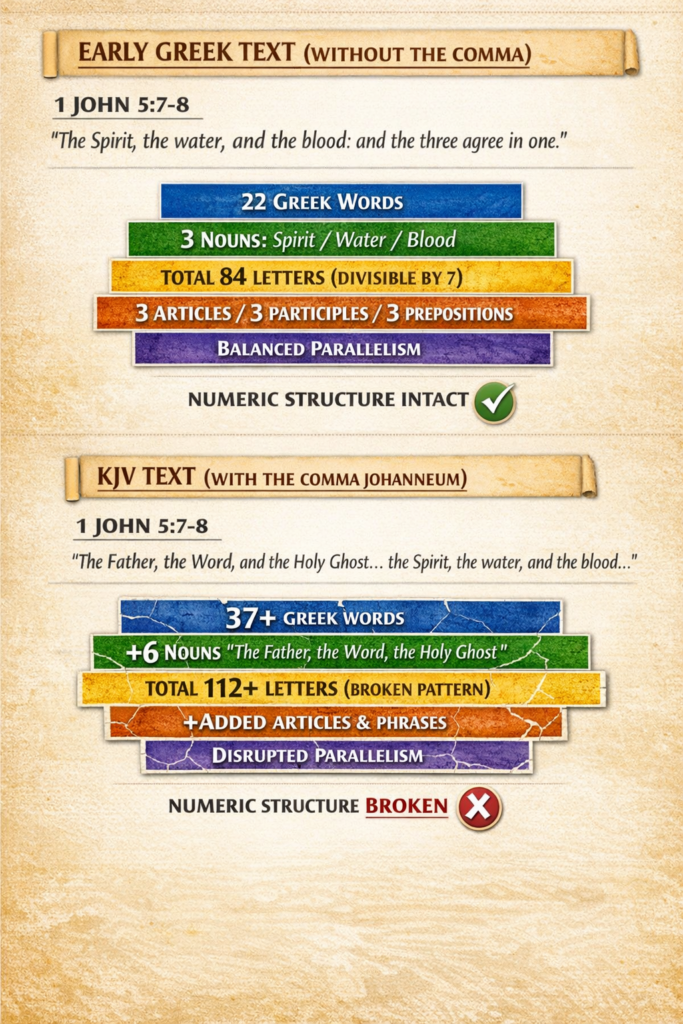
Latin scribes originated the Comma Johanneum of 1 John 5:7–8 illustrated below.
1Jo 5:6 ¶ This is he that came by water and blood, even Jesus Christ; not by water only, but by water and blood. And it is the Spirit that beareth witness, because the Spirit is truth. (KJV)
7 For there are three that bear record in heaven, the Father, the Word, and the Holy Ghost: and these three are one. (KJV)
8 And there are three that bear witness in earth, the Spirit, and the water, and the blood: and these three agree in one. (KJV)
Without the Comma, the text simply reads:
“For there are three that testify: the Spirit, the water, and the blood; and these three are in agreement.”
Jesus is said to come by water and blood in 1 Jn 5:6, and He is joined to the Father by the Spirit while He is on the earth, Heb 10:5 and John 17:5.
1Jo 5:6 This is he that came by water and blood, even Jesus Christ; not with the water only, but with the water and with the blood. (ASV)
This following describes some of the scriptural reality obscured by the added Scribal text.
This summary distills the core insight: the Comma Johanneum introduces a structure that John never wrote.
By adding a separate heavenly witness formula, the Comma reshapes the flow of testimony in 1 John 5 and breaks the unity of the original text.
The diagrams below show the difference between the original Johannine structure and the altered structure created by the Comma.
Original Johannine Structure (Without the Comma)
In the text John actually wrote, the testimony is unified, earthly, and centered on Jesus receiving the Spirit.
There is no heavenly testimony illustrated.
(Original Johannine Structure)

│    UNIFIED EARTHLY Testimony       │
│     Spirit – Water – Blood         │
    “These three testify as one”

(No heavenly testimony, no separation between realms - heaven bears witness to Jesus by the Spirit when He is on Earth)
The Altered Structure (With the Comma Johanneum)
The Comma introduces a second, heavenly testimony and duplicates the Spirit (where the Spirit is present in heaven and Earth), creating a structure foreign to Johannine theology.
Instead of a unified witness pattern, the testimony becomes divided between heaven and earth.
(With the Comma Johanneum)


│  HEAVENLY Testimony      │
│  Father – Word – Spirit  │
│    “These three are one” │

             ▲
             │  (The connection between Jesus and The Holy Spirit is not clearly seen)
             │

│   EARTHLY Testimony      │
│  Spirit – Water – Blood  │
│    “These three agree”   │
Meaning of the Two Diagrams
The contrast between the two structures highlights the theological impact of the Comma:
- Two separate realms — the Comma creates a heavenly testimony and an earthly testimony.
- The Spirit is duplicated — appearing in both heaven and earth, breaking the unity of the original text.
- No bridge between heaven and earth — Jesus is removed as the connector between heaven and earth.
- Foreign to John’s theology — Johannine thought consistently unifies heaven and earth through the Spirit’s testimony in Jesus.
In the original text, the witness of of God in verses 9 and 10 is the Spirit.
The Spirit is God’s affirmation, uniting Jesus (during His time on earth as noted in Heb 10:5 and John 17:5) and, through their faith, His followers with the Father.
Though the Comma arose within the Latin Western Church and was later defended in the Catholic tradition because it appeared in the Vulgate, its insertion breaks John’s original unity by introducing a heavenly scene he never wrote.
Adding later human interpretations only clouds the clarity of the inspired text. The Comma reflects a Latin scribal tradition, not the words John originally wrote under the Spirit’s guidance.
Human additions, however well‑intended, only blur the inspired message.
The Comma reflects a later Latin scribal tradition rather than the Spirit‑guided words John originally wrote.
The added Comma shifts the whole meaning of the passage. Instead of showing Jesus coming to believers through the Spirit here and now, it moves the testimony up into heaven and turns it into a distant, physical scene.
That change pulls readers away from John’s original message — that Christ comes spiritually, presently, and inwardly — and pushes them toward expecting a future physical return instead.
The mathmatical pattern discovered by Ivan Panin illustrates this –
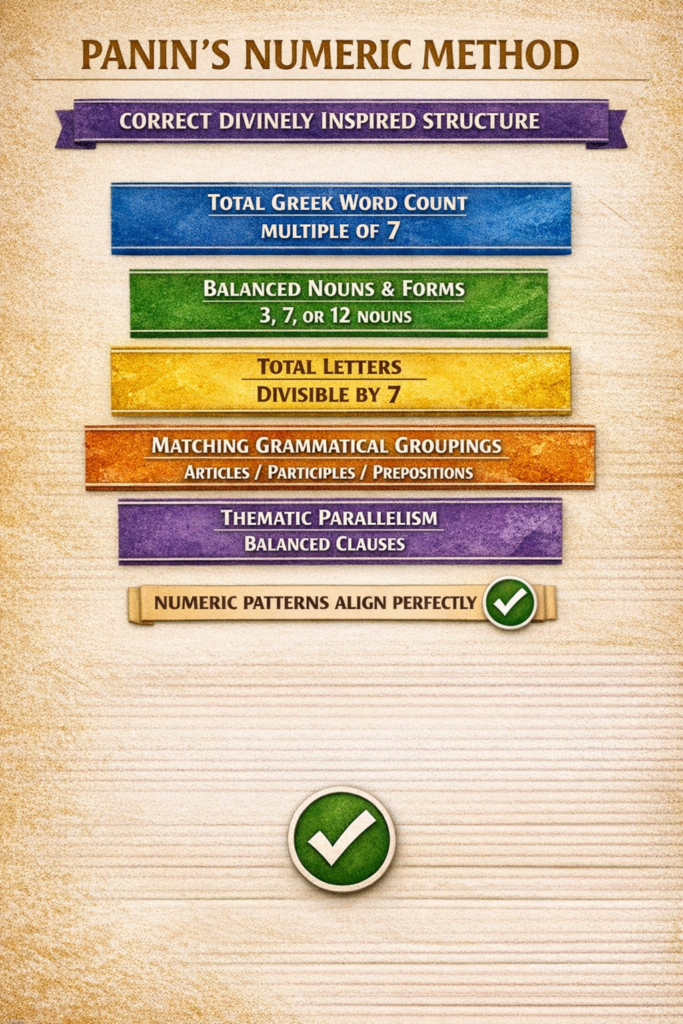
The following image shows that the “Comma,” or Catholic scribal addition to 1 John 5:6-8, does not contain this scriptural mathematical pattern.