
🕒 23 min read · 📝 4434 words
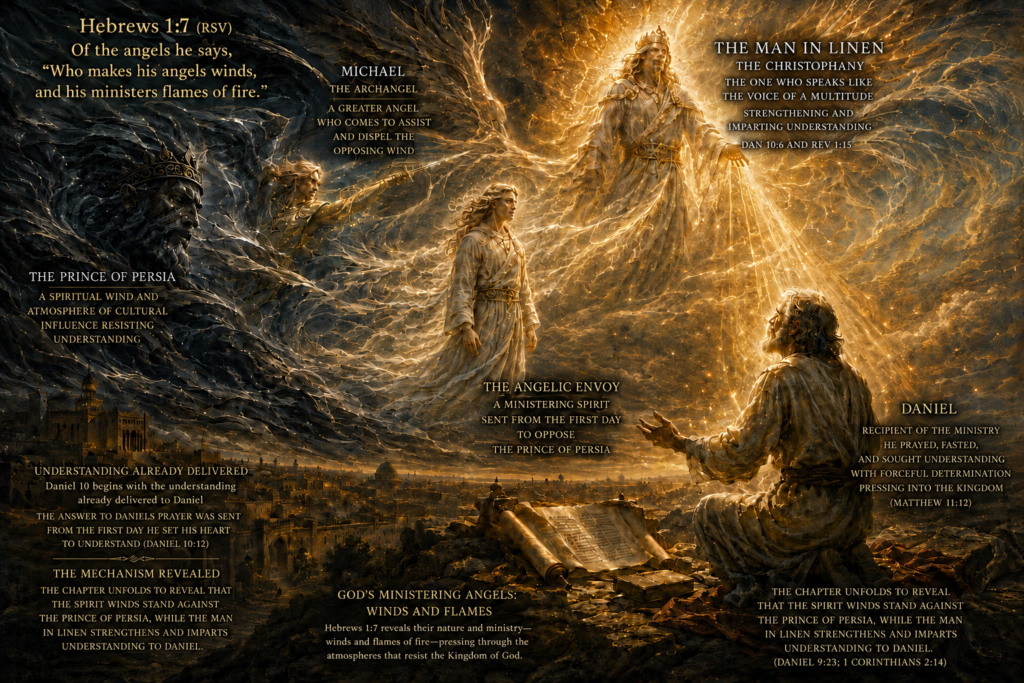
1. Daniel’s Struggle in Chapter 10 is about Understanding Scripture and the inherent, unseen Spiritual resistance.
Daniel’s struggle in chapter 10 is not about heavenly warfare but about the difficulty of receiving revelation while living under a spiritually resistant atmosphere.
Daniel 10 opens with Daniel’s prayer for understanding already having been granted.
As the chapter unfolds, it illustrates how the answer to His prayer reached him.
The angel says he was sent “from the first day” Daniel set his heart to understand, yet Daniel does not gain clarity until after the three‑week fast, when the Man in Linen appears and strengthens him to perceive the revelation.
Biyn and Yada are two Hebrew words for “knowing”
An illustration
Imagine someone gives you a complicated map.
With yada’, you know the map exists and recognize what it is.
With biyn, you understand how to read it and know where it leads.
A Simple Explanation of Daniel 10
At the beginning of Daniel 10 (verse 1), we’re told that Daniel eventually understood the vision God gave him. The Hebrew word used is bîn, which means to understand or grasp the meaning of something.
However, the rest of the chapter explains how Daniel came to that understanding.
On the first day that Daniel prayed, God immediately heard his prayer and sent an answer (Daniel 10:12). At that point, Daniel knew something was happening, but he did not yet understand what it all meant. The Hebrew word for this kind of knowing is yādaʿ, which means to know, be aware of, or recognize.
For the next three weeks (21 days), Daniel waited while a spiritual conflict took place behind the scenes. During this time, he had awareness that God was answering, but he still lacked understanding of the message.
Near the end of the chapter, the angel asks Daniel, “Do you know (yādaʿ) why I have come to you?” (Daniel 10:20). The question is simply checking whether Daniel is aware of what is happening. It is not giving him the explanation.
Before that, in Daniel 10:19, the Man in Linen strengthens Daniel. According to this interpretation, this is the point where Daniel finally receives the understanding (bîn) that he had been seeking.
So the chapter can be viewed as a two-step process:
- Day 1: Daniel receives awareness (yādaʿ) that God has heard his prayer and that an answer is on the way.
- Day 24 (after three weeks): Daniel receives understanding (bîn) of the vision’s meaning.
The statement in Daniel 10:1 (“Daniel understood the message”) tells us the final result. The rest of the chapter then explains the journey that led to that result.
In simple terms:
- Yādaʿ = “I know something is happening.”
- Bîn = “Now I understand what it means.”
The main idea is that Daniel first became aware that God had answered his prayer, but only later did he fully understand the message God was giving him.
According to this interpretation, the three-week delay was not Daniel gradually figuring things out; it was a period of waiting until God revealed the full meaning of the vision.
This connects directly to Daniel 9, where Daniel was reading Jeremiah and praying for insight.
The entire context is Daniel’s difficulty in grasping the meaning of the prophetic writings.
The struggle in chapter 10 is not about angels fighting demons in the sky, but about Daniel’s internal battle to perceive the meaning of Scripture.
Daniel’s forceful pursuit of understanding is what initiates the entire heavenly process.
Daniel’s forceful pursuit of understanding is what initiates the entire heavenly response in Daniel 10. The angel explicitly says he was sent “from the first day” Daniel set his heart to understand, showing that nothing in this chapter begins until Daniel asks for clarity. This matches Jesus’ statement that the “forceful man presses into the kingdom” (Matt. 11:12): not aggression, but determined pursuit of covenant understanding. Faith comes by hearing (Rom. 10:17), yet hearing itself requires covenant perception, and Daniel’s perception is obstructed by the Persian spiritual atmosphere. His three‑week persistence activates the process in which Michael counteracts the oppressive influence, the messenger clarifies Scripture, and the Man in Linen removes the veil that prevents understanding. Thus Daniel 10 shows that spiritual breakthrough begins when the human seeks understanding, is ministered to by angels, is opposed by spiritual atmospheres, and is completed only when Christ—who is the Word—removes the veil and restores perception.
Speaker Changes in Daniel 10 (Mapped Verse by Verse)
Overview
Daniel 10 contains four individuals:
- Daniel (human narrator)
- Man in Linen (pre‑incarnate Christ)
- Michael (archangel)
- Angelic envoy (unnamed angel)
Only two of these beings speak:
- Angelic envoy
- Man in Linen
Michael never speaks. Daniel narrates but does not interpret.
The confusion comes from the fact that the chapter switches speakers twice without announcing the switch.
This block shows exactly where those switches occur.
Speaker Map (Verse by Verse)
vv. 1–4 — Daniel narrates
Daniel sets the scene.
vv. 5–6 — Man in Linen appears
No speech yet. Daniel collapses under the glory.
His initial appearance overwhelms Daniel, and speech is withheld until Daniel is strengthened enough to receive it
vv. 7–9 — Daniel narrates
Daniel loses strength and falls into deep sleep.
⭐ Speaker Switch #1 — v. 10
v. 10 — The Angelic envoy touches Daniel
Daniel perceives only a hand.
This is the unnamed angel, not the Man in Linen.
vv. 11–14 — The Angelic envoy speaks
He says:
- “O Daniel, man greatly beloved…”
- “The prince of Persia withstood me…”
- “Michael came to help me…”
- “I remained there with the kings of Persia…”
- “I have come to make you understand…”
Although the envoy says he came “to make you understand,” this does not mean he is the one who gives Daniel understanding. It means he came because Daniel was seeking understanding, and his mission was to clear away the spiritual resistance that was preventing Daniel from receiving it. The actual understanding is given later by the Man in Linen, after the envoy — reinforced by Michael’s intervention — has cleared the obstruction that was preventing Daniel from receiving what the Man in Linen imparts.
This entire section is one speaker:
The Angelic envoy.
v. 15 — Daniel silent
Daniel bows his face to the ground.
⭐ Speaker Switch #2 — v. 16
vv. 16–19 — Man in Linen speaks
A new figure appears:
- “One having the similitude of the sons of men touched my lips…”
This is the Man in Linen, returning from vv. 5–6.
He:
- touches Daniel’s lips
- restores speech
- strengthens Daniel
- speaks peace
- removes the veil
- enables understanding
This is not the Angelic envoy.
This is Christ.
vv. 20–21 — The Angelic envoy resumes speaking
The chapter switches back again.
He says:
- “Do you know why I have come to you?”
- “I will return to fight with the prince of Persia…”
- “The prince of Greece will come…”
- “Michael your prince…”
This same pattern applies to the ‘Prince of Greece,’ whose future influence represents the next spiritual atmosphere that will oppose covenant understanding in the unfolding prophetic timeline.
This is the same angel from vv. 10–14.
Not Michael. Not the Man in Linen.
Summary Table
| Verse Range | Speaker | Identity |
|---|---|---|
| vv. 1–4 | Daniel | Human |
| vv. 5–6 | Man in Linen (appearance only) | Christ |
| vv. 7–9 | Daniel | Human |
| v. 10 | Angelic envoy (touch only) | Angel |
| vv. 11–14 | Angelic envoy | Angel |
| v. 15 | Daniel | Human |
| vv. 16–19 | Man in Linen | Christ |
| vv. 20–21 | Angelic envoy | Angel |
Total Individuals
- 3 spiritual beings
- Man in Linen (Christ)
- Michael (archangel)
- Angelic envoy (angel)
- 1 human
- Daniel
Only two speak:
- Angelic envoy
- Man in Linen
Note: Daniel speaks within the narrative (vv. 7–9, 15, 17), but he does not deliver revelation. Only the Angelic envoy and the Man in Linen speak as the heavenly interpreters in the chapter.
The Prince of Greece as the Next Atmospheric Opposition
Summary (Prince of Greece as the Next Atmospheric Opposition)
⭐ The envoy’s statement in Daniel 10:20 that “the prince of Greece will come” introduces the next realm‑representative spiritual atmosphere that will oppose covenant understanding.
⭐ Just as the “Prince of Persia” represents the present oppressive influence hindering Daniel’s perception, the “Prince of Greece” represents the future ideological and spiritual atmosphere that will obstruct understanding in the next phase of the prophetic timeline. Linguistic Explanation
⭐ The Hebrew grammar reinforces this parallel. The identical use of the term sar (“prince”) for both Persia and Greece shows that the same category of realm‑representative authority is in view.
⭐ The envoy’s wording is predictive — sar yavan ba’ (“the prince of Greece is coming”) — marking Greece as a future atmospheric resistance rather than a present one.
⭐ This mirrors the realm‑sequence already established in Daniel 8, where Persia’s dominance is followed by Greece’s rise and its corresponding spiritual influence.
⭐ Importantly, the text does not introduce any new vocabulary to describe Greece’s influence. The same conceptual framework applies: a ruling spiritual atmosphere whose exercised dominion affects human perception.
⭐ The envoy’s reference to Greece therefore signals the next ideological obstruction that will challenge covenant understanding, just as Persia’s atmosphere challenges Daniel in the present moment. Summary Sentence
⭐ The “Prince of Greece” represents the next spiritual atmosphere that will oppose covenant perception in the unfolding prophetic sequence, paralleling the present atmospheric resistance produced by the “Prince of Persia.” Ultra‑Summary
⭐ The Prince of Greece is the future realm‑representative atmosphere that will obstruct understanding in the next prophetic phase, just as Persia’s atmosphere obstructs Daniel now.
⭐ History confirms this pattern: after Persia’s atmosphere, Greek cultural influence rose and became the dominant worldview of the ancient world, introducing philosophical, ideological, and interpretive contaminants that reshaped Jewish thought and formed the next major obstruction to covenant understanding.
The Resumption of the Envoy’s Speech in vv. 20–21
This section clarifies why the speaker in Daniel 10:20–21 is the same angelic envoy who spoke in vv. 11–14, resuming his message after the strengthening interlude from the Man in Linen.
1. No Speaker‑Change Marker Appears. Hebrew narrative always signals a new speaker with a fresh subject or descriptive clause. Verse 20 contains none, meaning the voice continues seamlessly from the previous speaker — the envoy.
2. The First‑Person “I Came to You” Matches v. 14 The question “Do you know why I came to you?” directly recalls the envoy’s earlier statement, “I have come to make you understand” (v. 14). No other figure in the chapter ever says he “came” to Daniel.
3. The Content Continues the Envoy’s Earlier Narrative. Only the envoy discusses:
- The Prince of Persia,
- Michael’s assistance,
- the prince of Greece,
- his own return to conflict. Verse 20 picks up these same themes, proving continuity of speaker.
4. The “Prince” (שַׂר) Vocabulary Is Exclusive to the Envoy. The envoy alone uses “sar” terminology. The Man in Linen never uses it, and Michael obviously does not narrate other princes. Verse 20’s vocabulary therefore points back to the envoy.
5. The Chapter’s Structural Pattern Requires the Envoy to Resume Daniel 10 follows a clear pattern: Envoy speaks → Daniel collapses → Man in Linen strengthens → Envoy resumes speaking. Verses 20–21 fit precisely into the resumption phase.
6. Hebrew Literary Resumption Device: Verses 16–19 are an interruption by the Man in Linen. Verses 20–21 are a textbook example of resumption, returning to the previous speaker without re‑introducing him.
7. The Envoy’s Unique Role Continues Unbroken. Only the envoy explains delays, conflicts, assignments, and future events. Verse 20 continues this role, confirming the speaker’s identity.
Summary Every structural, grammatical, and narrative indicator shows that vv. 20–21 resume the envoy’s speech. No feature of the text suggests that Michael or the Man in Linen is speaking
—
Having mapped the speakers, we can now examine the nature of the resistance described in the chapter.
Additional Linguistic Referent: Why Daniel 10:14 Cannot Be Spoken by the Man in Linen, linguistic analysis
- Summary – Daniel 10:14 cannot be spoken by the Man in Linen because the Hebrew grammar shows no speaker change, no independent pronoun “I,” and no causative verb indicating imparted understanding. The verb biyn is non‑causative and means “to understand,” not “to make understand,” so the envoy is saying he came because Daniel sought understanding, not that he gives it. Only the Man in Linen (vv. 16–19) imparts perception, strength, and clarity, making it linguistically impossible for him to be the speaker in verse 14.
- Hyper‑literal Hebrew gloss of Daniel 10:14: ûbāʾtî ləhābînəkā = “and‑came I to‑give‑understanding‑to‑you.” The Hebrew contains no independent pronoun “I.” English inserts “I” because English requires explicit subjects. Hebrew does not. The speaker remains the same unless the text signals a change. No such signal appears in verse 14. Therefore, the speaker continues to be the envoy.
- The verb biyn (בין) in Daniel 10:14 is non‑causative. The causative form of biyn would be hēbîn (Hiphil), meaning “to cause to understand.” Daniel 10:14 uses the Hiphil infinitive construct hābîn, which functions idiomatically as a purpose clause: “I came for the purpose of understanding you,” meaning “I came because you were seeking understanding.” It does not mean “I impart understanding.” The envoy’s mission is contextual, not interpretive. He comes because Daniel seeks understanding, not to give it. Only the Man in Linen imparts understanding in verses 16–19.
- Speaker continuity: From verses 11 through 14, the envoy is speaking. Hebrew narrative always signals speaker changes explicitly. Verse 14 contains no such signal. The Man in Linen does not appear or speak until verse 16. Daniel’s physical posture (face to the ground) matches envoy speech, not the overwhelming appearance of the Man in Linen. Therefore, verse 14 cannot be spoken by the Man in Linen.
- The Man in Linen’s speech has a distinct linguistic profile in verses 16–19: strengthening verbs, perception verbs, peace‑giving verbs, and covenant‑authority markers. None of these appear in verse 14. Verse 14 matches the envoy’s linguistic profile, not the Man in Linen’s.
- Summary: Daniel 10:14 cannot be spoken by the Man in Linen because (a) there is no independent pronoun “I” in Hebrew, (b) the verb morphology shows continuity with the envoy, (c) biyn is non‑causative and does not indicate imparting understanding, (d) the narrative structure shows no speaker change until verse 16, (e) the Man in Linen’s linguistic profile is absent from verse 14, and (f) Daniel’s physical posture matches envoy speech. Therefore, Daniel 10:14 is linguistically, grammatically, narratively, and structurally the envoy, not the Man in Linen.
- ⭐ The Hebrew verb biyn (בִּין) is NOT causative
- Here is the exact, literal meaning of biyn:
- biyn = to perceive, to discern, to understand internally
- It is an internal cognitive verb, not an external causative verb.
- It does not mean:
- “to make someone understand”
- “to cause understanding”
- “to impart understanding”
- “to give perception”
- Those meanings belong to Hiphil causatives, but biyn is not used that way in Daniel 10:14.
- ⭐ Why English translations say “to make thee understand”
- Because English requires an explicit subject and often prefers causative phrasing for clarity.
- But Hebrew does not.
- The Hebrew phrase in Daniel 10:14 is:
- לְהָבִינְךָ — ləhābînəkā
- This is:
- Hiphil infinitive construct
- functioning as a purpose clause, not a causative action
- The envoy is saying:
- “I came for the purpose of your understanding.”
- NOT:
- “I came to cause you to understand.”
- This distinction is absolutely crucial.
- ⭐ Hyper‑literal gloss
- Here is the exact morphological gloss:
- ûbāʾtî ləhābînəkā = “and‑came‑I for‑understanding‑you”
- Notice:
- No independent pronoun “I” in Hebrew
- No causative verb
- No imparting of understanding
- No strengthening
- No veil‑removal
- No perception‑restoration
- All of those belong to the Man in Linen, not the envoy.
- ⭐ So what does biyn literally mean in Daniel 10:14?
- Here is the exact, literal meaning:
- “to understand,” not “to make understand.”
- The envoy is saying:
- “I came because you were seeking understanding.”
- He is not saying:
- “I came to give you understanding.”
- That is why:
- v. 14 cannot be the Man in Linen
- v. 14 cannot be the one who imparts understanding
- v. 14 cannot be the one who strengthens Daniel
- v. 14 cannot be the one who removes the veil
- v. 14 cannot be the one who restores perception
- The grammar itself forbids it.
- ⭐ Final clarity
- So: No — biyn does NOT literally mean “to make thee understand.”
- That is an English causative insertion. The Hebrew verb biyn is non‑causative and means to understand, not to cause understanding.
- This is one of the strongest linguistic proofs that:
- Daniel 10:14 cannot be spoken by the Man in Linen.
- Ultra‑Summary: Daniel 10:14 cannot be the Man in Linen because the Hebrew shows no speaker change, no independent “I,” and no causative biyn, proving the envoy came due to Daniel’s pursuit of understanding—not to impart it.
- Daniel 10:14 is the envoy because biyn is non‑causative and the Hebrew shows no speaker change, meaning he came to clear the obstructing atmosphere—not to impart understanding, which only the Man in Linen gives in vv. 16–19.
2. The “Prince of Persia” Represents the Spiritual Atmosphere Hindering Daniel’s Perception.
Daniel is living in Persia, a realm marked by idolatry and spiritual heaviness.
The “prince of the kingdom of Persia” is best understood as the spiritual influence or atmosphere of that realm, which creates resistance to Daniel’s ability to understand the Scriptures. This so-called atmosphere that the Prince of Persia produces is the opposition referred to by the word “withstood” in Daniel 10:13.
The angel’s language describes the difficulty of revelation reaching Daniel’s mind, not a physical conflict in heaven.
The angel’s assignment is to hold back the Persian resistance so that the Man in Linen can impart the actual understanding to Daniel.
Daniel 10:13 states that “the prince of the kingdom of Persia” withstood the messenger who was bringing understanding to Daniel.
This resistance is best understood in light of Daniel’s location.
Daniel was living in Persia at the time, fully immersed in a culture shaped by pagan religion, imperial ideology, and spiritual assumptions foreign to the covenant.
The “kingdom of Persia” represents the dominant spiritual atmosphere of that realm, an environment that exerted pressure on Daniel’s perception and hindered his ability to grasp the meaning of the Scriptures he had been studying.
The Angelic envoy is the one who says he was ‘withstood’ for twenty‑one days, mirroring Daniel’s three‑week struggle to gain understanding.
Michael’s intervention, therefore, is not a picture of celestial combat but of covenant authority breaking through the oppressive spiritual atmosphere that surrounded Daniel.
—
The Sar/Sarar Concept in Daniel 10
The Hebrew word sar (שַׂר, Strong’s H8269), used in Daniel 10:13 and 10:21, means “prince,” “ruler,” or “chief.”
It belongs to the same root family as the verb sarar (שָׂרַר, Strong’s H8323), which means “to rule” or “to exercise dominion.”
This shared root emphasizes the idea of exercised authority rather than merely identifying an individual person.
In Daniel 10, the Persian sar represents a spiritual ruler whose dominion produces an oppressive atmosphere that hinders Daniel’s understanding, while Michael, the covenant sar, represents the spiritual authority God assigns to His people.
Recognizing the relationship between sar and sarar shows that Daniel 10 depicts real spiritual beings whose exercised dominion affects human perception—and whose influence must be displaced for revelation to reach Daniel clearly.
In Daniel 10, the terms sar and sarar help us understand how the spiritual world interacts with the physical.
The Hebrew word sar means a “ruling spirit” or “realm‑representative,” and sarar describes the action of that spirit exercising dominion.
Thus the “prince of Persia” (sar, Daniel 10:13) is the spiritual ruler expressing Persia’s oppressive atmosphere, while Michael, called “your prince” (sar, Daniel 10:21), represents the covenant spirit assigned to God’s people.
These are real spiritual beings whose influence is felt in the physical world, and Daniel’s three‑week struggle (Daniel 10:2–3) shows how one spirit can obstruct understanding while another (The Angel Michael) intervenes.
Recognizing the sar/sarar pattern helps us see that Daniel 10 is describing spiritual resistance to revelation, not physical combat, and that Christ’s appearance as the Man in Linen (Daniel 10:5–6, 10–12) is the decisive act that delivers the understanding and restores Daniel’s perception.
When Michael “came to help,” the obstruction over Daniel’s mind was lifted, and the appearance of the Man in linen completed the breakthrough, restoring Daniel’s clarity so he could finally receive the interpretation.
—
Additional Note on the Nature of the Resistance in Daniel 10:13
The Hebrew wording in Daniel 10:13 contains no vocabulary indicating physical restraint or celestial combat.
The phrase translated “withstood me” is ʿōmēd lenegdi—literally “stood against me”—a common Hebrew expression for non‑physical opposition, ideological resistance, or perceptual obstruction.
It never refers to grabbing, wrestling, or physically restraining another being.
This means the “prince of the kingdom of Persia” did not physically block a heavenly messenger but represents the spiritual‑ideological atmosphere of Persia standing in opposition to Daniel’s ability to perceive revelation.
This aligns with the broader biblical pattern in which cultural spiritual resistance takes the form of obscured perception and in which clarity comes only when God removes the fog and reveals truth (1 Cor 13:12).
Daniel’s breakthrough occurs when the Angelic envoy, reinforced by Michael’s covenant authority, finally overcomes the Persian obstruction—setting the stage for the Man in Linen to restore Daniel’s perception and deliver the understanding.
—
3. The Three Weeks Represent Daniel’s Period of Spiritual Difficulty, Not an Angelic Stalemate.
Daniel mourns and fasts for three weeks.
During this same period, the angel says he was “withstood.”
These are the same three weeks.
The resistance is not a literal battle in the heavens but Daniel’s own struggle to receive clarity.
His weakness, mourning, and inability to perceive are not symptoms of the encumbrance but the covenant posture that allows angelic intervention to begin clearing the oppressive atmosphere.
Daniel recognized the strength of God more fully as he recognized his own weakness, illustrating the covenant pattern that divine strength operates most fully where human strength collapses.
Daniel’s three‑week devotion is the covenant pursuit Jesus later describes as “forcefully pressing into the kingdom” (Matt. 11:12). His fasting was not ritual self‑affliction—Isaiah 58:4 warns that such fasting accomplishes nothing—but a sincere, covenant‑aligned seeking of understanding. This persistent devotion created the conditions under which angelic intervention could operate, enabling the envoy and Michael to displace the oppressive Persian atmosphere so that the Man in Linen could finally enable Daniel to perceive the revelation.
—
Having seen how Daniel’s weakness became the covenant posture that enabled angelic intervention, we can now follow the moment when that intervention breaks through the encumbrance, and the Man in Linen delivers the understanding.
4. The Angelic envoy and Michael break through the Encumbrance, and the man in Linen delivers the understanding.
Daniel’s collapse and inability to perceive the revelation parallel Jesus’ statement to His disciples: “I have many things to say to you, but you cannot bear them now” (John 16:12).
Daniel’s 21‑day obstruction is not rebellion or refusal but protective limitation—he simply could not bear the weight of the revelation until strengthened.
Daniel’s breakthrough occurs when angelic assistance, reinforced by Michael’s covenant authority, withstands the Persian obstruction—after which the Man in Linen strengthens Daniel and delivers the understanding.
This shows that God gives revelation and understanding based on each person’s ability to receive them.
The appearance of the Man in linen overwhelms Daniel, strengthens him, and strengthens him so he can hear and understand.
Angelic representatives clear the spiritual fog that has been hindering Daniel.
The man in linen marks the pivotal moment when Daniel finally receives the interpretation of scripture he had been earnestly seeking through prayer.
—
Now that we’ve seen how the angels clear the spiritual fog and how the Man in Linen strengthens Daniel to receive the understanding and then gives him the meaning he was seeking, we can look at how Daniel 10 uses the idea of “conflict” to describe the struggle of receiving revelation in a spiritually heavy environment.
5. The Angelic “Resistance” Is a Metaphor for the Difficulty of Receiving Revelation in a Hostile Spiritual Environment.
Daniel 10 uses the language of conflict to describe the struggle for understanding.
The resistance is not physical but spiritual and perceptual.
Daniel’s environment, his location in Persia, and the spiritual forces associated with that realm create a barrier to his understanding.
The angel’s explanation describes the challenge of delivering revelation to a prophet under spiritual pressure.
—
Seeing how Daniel 10 uses the idea of conflict to describe the struggle for understanding, we can now look more closely at how this spiritual heaviness actually slows or blocks perception until God steps in to clear it.
6. Daniel 10 Shows That Spiritual Encumbrance Can Hinder Understanding Until God Intervenes.
Daniel’s experience illustrates how spiritual influences can obscure perception and delay understanding.
The Man in linen’s intervention demonstrates that clarity ultimately comes from God’s action.
Daniel’s three‑week struggle, the resistance attributed to the realm of Persia, and the final breakthrough all show that understanding Scripture can be hindered by spiritual factors beyond mere intellect.
—
Because this raises important questions about how spiritual resistance works in Scripture, it’s helpful to pause and clarify what this interpretation affirms and what it does not.
Doctrinal Note
This interpretation does not deny the reality of angels, spiritual resistance, or demonic influence.
Scripture often uses representative “princes” to describe the spiritual character of entire realms, and Daniel regularly blends political and spiritual realities into symbolic figures.
Understanding the “prince of Persia” as the oppressive spiritual atmosphere of Persia is consistent with Daniel’s style and with the broader biblical pattern in which spiritual resistance often takes the form of hindered perception rather than physical obstruction.
This reading remains fully within the bounds of biblical doctrine and honors the text’s own emphasis on Daniel’s struggle to understand rather than on heavenly combat.
With these doctrinal boundaries in place, we can now return to the main point of Daniel 10 and see how the chapter ultimately reveals the pattern of spiritual understanding.
—
Conclusion
Daniel 10 presents a profound picture of the struggle for spiritual understanding.
The chapter is not about cosmic battles but about the difficulty of receiving revelation in a spiritually resistant environment.
Daniel’s experience shows that spiritual encumbrance can hinder perception and that God’s intervention is necessary to bring clarity.
This prepares Daniel for the interpretation that follows in chapters 11 and 12, where the covenant pattern is finally revealed to him.
In the end, Daniel 10 reminds us that understanding comes not from our strength but from God’s faithful action to lift what we cannot overcome on our own.