
🕒 9 min read · 📝 1670 words
A Unified Interpretation of Revelation 6:10, Revelation 11:18, Revelation 19:2, Daniel’s Woe‑Pattern, and the Armageddon/Gog–Magog Confrontation
1. Introduction
Across Scripture, a single covenant pattern emerges: God reveals corruption, confronts compromise, corrects the disobedient, restores the fallen, and purifies His covenant land/people.
In covenant passages, blessing and curse fall on behavior, not geography — so ‘land’ represents the obedient life.
This study unifies three major strands of biblical prophecy:
- the martyrs’ cry in Revelation 6:10
- the covenant land controversy in Revelation 11:18
- the Armageddon and Gog–Magog pattern as Jesus personalizes the Day of the Lord
Together they reveal one coherent structure: the covenant lawsuit, the exposure of misrepresented Christianity, and the restoration of God’s faithful people.
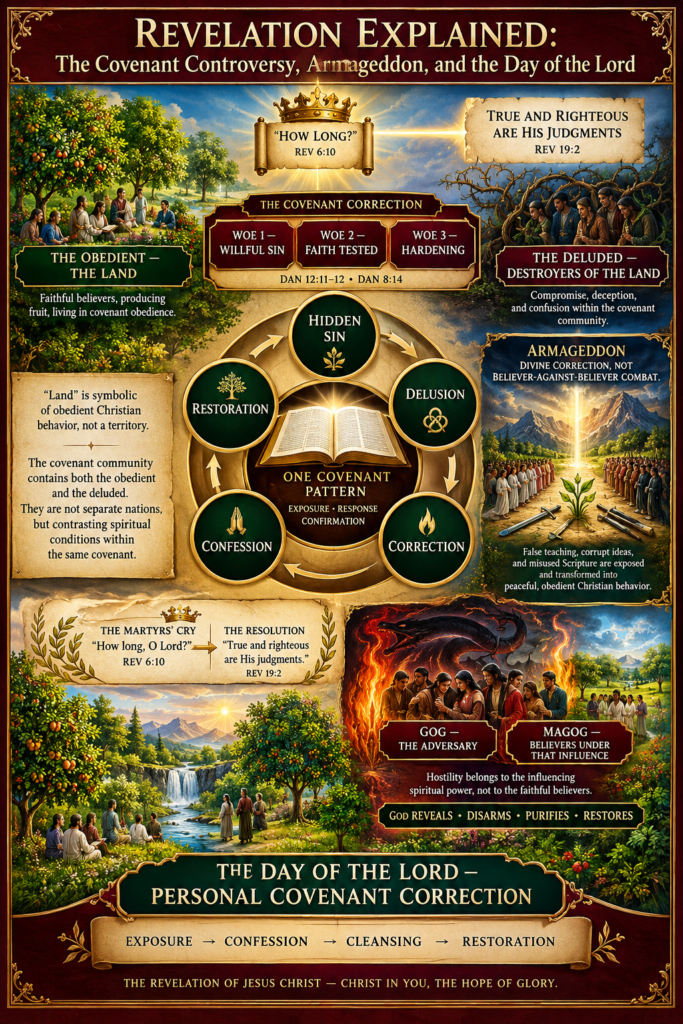
Visual summary of the unified covenant pattern explored in this study.
2. Revelation 6:10 → Revelation 19:2: The Question and the Answer
The Question (Revelation 6:10)
“How long, O Master, holy and true, until You judge and avenge our blood on those who dwell on the land?”
This cry opens the covenant lawsuit. The martyrs are not asking for revenge — they are asking for covenant correction, the removal of corruption that silenced their witness.
Covenant correction is God’s act of revealing and confronting the backslidden believers whose misrepresentation of Christ has “shed the blood” of the obedient by diluting their example of the crucified life, and then restoring His covenant community to proper order.
The Answer (Revelation 19:2)
“For true and righteous are His judgments, because He judged the great harlot… and He has avenged the blood of His servants.”
Revelation 19:2 is the explicit narrative resolution of 6:10. Everything between these verses is the process by which God corrects the corruption the martyrs cried out against.
3. The Meaning of “Land” in Revelation 11:18
Revelation 11:18 uses the Greek word gē, meaning earth, soil, or land. In covenant passages, “land” means covenant territory, not global geography.
Symbolically:
- The land = obedient Christian behavior (spiritual Israel)
- Destroyers of the land = deluded Christians who corrupt the faithful and distort the gospel
When Revelation speaks of the land being destroyed, it describes spiritual damage done to the faithful by those who claim covenant but do not keep it.
This forms the two sides of the covenant controversy:
1. The obedient (the land itself)
Peaceful, faithful, pleasing to God (Prov 16:7).
2. The deluded (destroyers of the land)
They corrupt the faithful, disrupt their peace, and commit spiritual bloodshed (Isa 34:8; Rev 16:6).
These two groups do not fight each other. God brings them into proximity, reveals the delusion, and removes the ability of the disobedient to harm the faithful.
This is the Armageddon pattern.
4. The Covenant Lawsuit Structure
The prophetic lawsuit unfolds in four movements:
- Isaiah 34:8 — The controversy is declared.
- Revelation 16:6 — The offense is defined: spiritual bloodshed.
- Revelation 11:18 — The two parties are identified:
- the obedient (rewarded)
- the destroyers of the land (corrected)
- Revelation 16:16 — The resolution at Armageddon: God gathers both groups disarms the backsliders and purifies His land.
Translating “earth” as land makes this structure visible.
5. The Three Woes: God’s Correction of the Martyrs’ Cry
The martyrs’ plea in Revelation 6:10 initiates the woe‑pattern of Daniel’s 70th week.
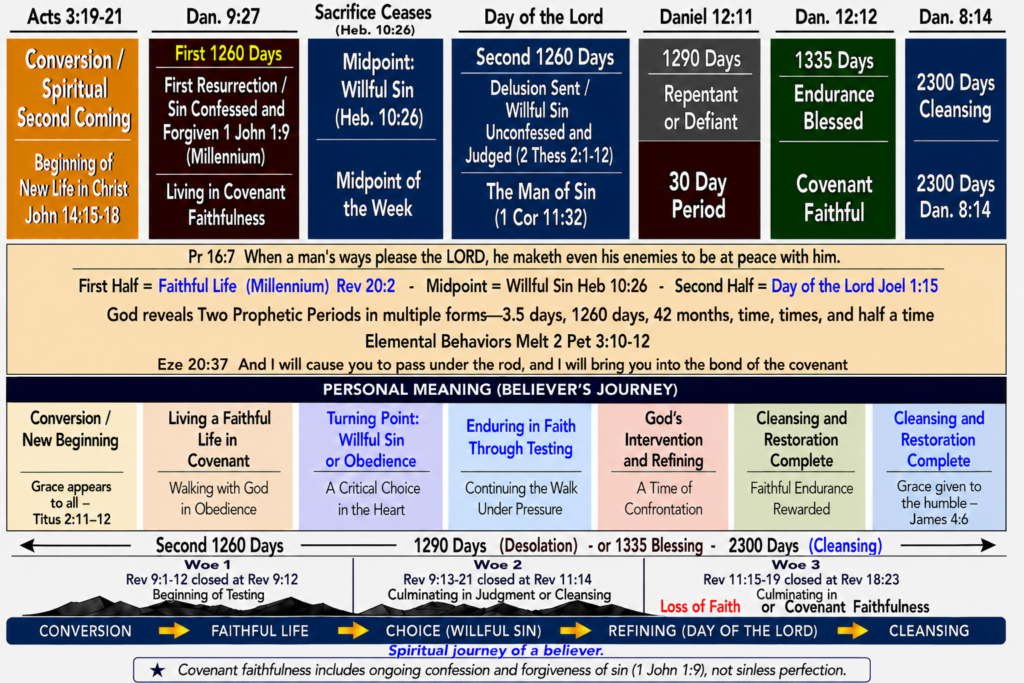
Timeline of the Woe‑Pattern and Daniel’s symbolic stages of deception, testing, and restoration.
Woe 1 — Torment of willful sin
The believer enters the fire of discipline (Matt 25:41; Heb 10:26).
Misrepresented Christianity becomes public proclamation.
Woe 2 — Spiritual death possible
During the second correction stage—Woe 2—spiritual death through the loss of faith becomes possible (Rev 9:15), and knowing that Peter would enter this stage, Jesus prayed that he would overcome it in Luke 22:32.
Woe 3 — The loss of faith
Woe 3 is the point where the delusion reaches maturity, the voice of faith ceases, and the believer enters irreversible hardness.
These woes are not random punishments. They are God’s structured correction in response to the martyrs’ cry.
The numerical markers in Daniel (1290, 1335, 2300) are labels for stages of deception, not literal durations.
The Hebrew forms of 1290, 1335, and 2300 show that Daniel uses different grammatical constructions for each number, signaling symbolic stages rather than literal durations.
The Hebrew grammar of Daniel’s numbers shows they function as symbolic stage‑markers, not literal durations. Daniel 12:11 expresses 1290 with a compressed number‑phrase (אֶלֶף וּתְשַׁע מֵאוֹת), the kind of construction Hebrew uses for labels, not calendar counts. Daniel 12:12 expresses 1335 through a full asher‑clause (אַשְׁרֵי… אֶלֶף שְׁלֹשׁ מֵאוֹת וְחֲמִשָּׁה), marking a condition of blessedness, not a measured time span. Daniel 8:14 expresses 2300 with the prophetic “evening–morning” formula (עֶרֶב־בֹּקֶר אַלְפַּיִם וּשְׁלֹשׁ מֵאוֹת), an idiom signaling a symbolic movement within the vision, not a literal 2300‑day period. Because Daniel uses three different grammatical constructions for the three numbers, the text itself signals three distinct stages of deception and restoration, perfectly matching the woe‑pattern rather than a single linear timeline.
- 1290 — hardened decision; delusion publicly professed
- 1290–2300 — the difficult window where repentance becomes possible again once God breaks the delusion
- 1335 — blessedness of restored obedience
6. Armageddon: Divine Correction, Not Believer‑Against‑Believer Combat
Armageddon is not a battle between Christians. It is a divine act of separation, revelation, and correction.
God:
- brings the obedient and deluded together
- reveals the delusion through proximity
- removes the destructive implements from the disobedient
- restores the peace of His land
This matches the swords‑to‑plowshares transformation (Isa 2:4; Mic 4:3):
- Swords = the harmful ways a deceived believer weaponizes spiritual things — false teaching, corrupt ideas, and misused Scripture — to reinforce delusion.
- Plowshares = peaceful, obedient Christian behavior — the tools God gives for planting, nurturing, and growing genuine spiritual life.
God burns the weapons of wickedness (Ezek 39:10 and 2 Thess 2:8) and restores covenant fruitfulness.
7. Gog–Magog: The Personal Day of the Lord
Jesus personalizes the Day of the Lord for each believer.
Gog = the Devil and his angels
Magog = believers under that influence
God brings the disobedient into the sphere of the obedient (Ezek 38:4 Rev 20:9).
The hostility belongs to the demonic spirits influencing the believer misrepresenting Christianity, not the obedient Christian.
This confrontation:
- sharpens the faithful
- reforms the fallen
- reveals hidden compromise
- restores covenant order
This is Armageddon and Gog–Magog applied to daily life — iron sharpening iron (Prov 27:17).
Jesus intensifies this personalization of the Day of the Lord by showing in Matthew 24:28 that judgment is drawn to the individual whose behavior has decayed, just as vultures gather to a single carcass. In Revelation’s woe‑pattern, this means the believer whose misrepresentation of Christ has matured into corruption and willful sin becomes the one identified for covenant exposure (Deut 28:15)—the person whose inner condition summons the covenant fire (Matt 25:41) that reveals, confronts, and restores, and from which release only comes when the last “penny” of correction has been satisfied (Matt 5:26), that is, when the believer becomes aware of and confesses the sin, and re‑enters the cleansing process of 1 John 1:9 just as Job did when he finally acknowledged his hidden pride in Job 42:6. The believer then exits the second half of Daniel’s 70th week—the corrective period of the Day of the Lord—and re‑enters the first half, the millennial condition of Revelation 20 in which Satan is bound and obedience is restored, fulfilling the promise that when a person’s ways please the Lord, even their enemies are made to be at peace with them (Prov 16:7).
This same corrective pattern appears again in Revelation 20:9.
8. The Fire That Corrects (Revelation 20:9)
Revelation 20:9 and John 2:17 use the same Greek verb kataphagein, meaning “to consume” or “to devour.”
In John 2:17, the word describes Jesus being “consumed” by zeal — a purifying passion, not destruction.
Because Revelation 20:9 uses the same verb, the fire that “devours” can be understood the same way: a consuming that corrects rather than annihilates.
Thus the fire in Revelation 20:9:
- purifies the captive Israelites
- reveals God to the watching nations
- restores covenant order
It is corrective, not destructive.
9. The Restoration Pattern
The unified pattern is:
- Hidden sin
- Delusion
- Correction
- Confession
- Restoration
This is the Day of the Lord as personal correction (1 Cor 11:32).
10. The Final Resolution: Revelation 19:2
Revelation 19:2 declares the fulfillment of the martyrs’ cry:
- the destroyers of the land are corrected
- the corruption is removed
- the faithful are vindicated
The covenant land is restored.
11. The Day of the Lord and the Martyrs’ Cry
The Day of the Lord is the correction period that unfolds in the second half of Daniel’s 70th week.
It is the same pattern Jesus described in Matthew 24, where willful sin stands in the holy place and God begins correcting His covenant people.
In Revelation, this is how God deals with Babylon — the backslidden believers whose misrepresentation of Christ “sheds the blood” of the obedient saints by corrupting their witness.
The believers who “lost their lives” in order to find them (Matt 10:39) are the martyrs of Revelation 6:10.
Their question — “How long?” — “Until when” is a plea for covenant correction.
God answers through the Day of the Lord. He hides His face (Eze 39:23), and this withdrawal allows delusion to take hold (2 Thess 2:11). As the delusion settles, the believer’s hidden wickedness becomes visible to them (Job 42:6; 2 Thess 2:12).
This exposure leads to confession and forgiveness (1 John 1:9), and cleansing follows—God corrects their corruption (Eze 39:3), purifies His land, and vindicates His faithful servants.
The burying of the bones (Eze 39:12–16) pictures this cleansing work: God, through His servants, removes the underlying supports of the sin and wickedness that caused the backsliding.
12. Conclusion
Revelation, Daniel, Isaiah, Ezekiel, and Jesus’ teaching in Matthew 24–25 all describe one unified covenant pattern:
- The obedient are the land.
- The deluded destroy the land.
- The martyrs cry out for correction.
- God reveals corruption through the woe‑pattern.
- Armageddon disarms the disobedient.
- Gog–Magog restores the fallen.
- Revelation 19:2 announces the final vindication.
All of these passages describe the same process: Christ revealing Himself by correcting His people
This is not geopolitical prophecy; it is God’s covenant lawsuit—the exposure of misrepresented Christianity and the restoration of His faithful people. It is the revelation of Jesus Christ Himself, the unveiling of Christ in you, the hope of glory.