
🕒 20 min read · 📝 3814 words
⭐ Summary
Revelation is not a timeline of disasters.
It is a picture of how Jesus lovingly disciplines His people.
The Seals show the tools He uses, the Trumpets warn us when we drift, and the Bowls reveal what happens when correction is resisted.
All three describe the same process: God exposing sin, calling for repentance, and restoring those who respond to Him.
In Revelation, “Babylon” represents a covenant community that has fallen into delusion (2 thess 2:11) — those who claim to belong to God yet refuse His truth.
Jesus describes a condition in Revelation 2:9 and 3:9 as those “who say they are Jews and are not,” meaning people who profess covenant identity but do not walk in covenant faithfulness.
Revelation portrays Babylon as a corrupted spiritual system that misleads God’s people, sheds innocent blood (Revelation 16:6), and deceives the nations through its sorceries (Revelation 18:23).
Because of this, God disciplines Babylon—not to destroy, but to expose, judge, and remove the delusion that has taken root among those who claim His name while resisting His truth.
The Seals, Trumpets, and Bowls reveal this discipline as Christ confronts false profession, restores the faithful, and vindicates the cry of the saints.
Revelation uses repeated marker phrases to show that its judgment scenes are connected and describe the same covenant discipline.
The book never uses the exact phrase “the Day of the Lord,” but it repeatedly employs equivalent markers: “the Lord’s Day” (Revelation 1:10), “the great day of His wrath” (Revelation 6:17), “the hour of His judgment” (Revelation 14:7), and “the great day of God Almighty” (Revelation 16:14).
These phrases appear at major structural transitions, signaling that the Seals, Trumpets, and Bowls belong to one unified Day‑of‑the‑Lord discipline directed toward a deluded covenant community.
The Seals, Trumpets, and Bowls do not describe three different judgments.
They are three perspectives on the same Day of the Lord — the covenant discipline Christ applies to Babylon, the deluded covenant community, throughout the age.
Each cycle reveals a different perspective on the same event: the Seals show the instruments of judgment, the Trumpets announce the warnings, and the Bowls reveal the completed exposure of what has resisted His correction.
They show the same Day of the Lord from three viewpoints: the Seals reveal God’s work, the Trumpets warn people to repent (Joel 2:1), and the Bowls show the completion of His corrective judgment.
Revelation reinforces this with another recurring marker: “Here is the patience of the saints” (Revelation 13:10; 14:12), which frames the endurance required of the faithful while God disciplines Babylon for false profession.
Together, these markers show that Revelation’s cycles are not separate timelines but overlapping covenant judgments fulfilling 1 Corinthians 11:32—“When we are judged, we are disciplined by the Lord, so that we will not be condemned with the world.”
In Revelation, “Babylon” represents a covenant community that has fallen into deception and false profession.
Jesus uses similar language in Revelation 2:9 and 3:9 when He speaks of those “who say they are Jews and are not, but are a synagogue of Satan.”
This does not refer to an ethnic or earthly group, but to anyone who claims covenant identity while resisting God’s truth.
Babylon embodies this same spiritual condition: a deluded system that calls itself God’s people yet corrupts the earth, sheds innocent blood (Revelation 16:6), deceives the nations (Revelation 18:23), and refuses Christ’s correction.
⭐ 1. Babylon Section —
Babylon represents the covenant community in its most hardened, deluded state — not an external enemy, but God’s own people when they refuse correction.
Revelation uses Babylon to show what happens when covenant identity is claimed outwardly but abandoned inwardly.
This makes Babylon the mature form of the same false profession Jesus confronts in the churches: a community that bears God’s name while resisting His truth.
Because Babylon is the corrupt covenant community, she becomes the corrupter of God’s people—misleading believers, spreading delusion, and causing the very covenant violations for which she is judged.
This corruption is what provokes the martyrs’ cry of “How long?” in Revelation 6:10, and the Seals, Trumpets, and Bowls reveal God’s answer to that plea.
Synagoge of Satan
Revelation never gives a verse that separates Babylon from the “synagogue of Satan.”
There is no passage that says Babylon is not the synagogue of Satan, nor any verse that distinguishes them as different spiritual categories.
Instead, Revelation consistently portrays both as false covenant identities—people who claim to belong to God but oppose Christ and corrupt His people.
The “synagogue of Satan” in Revelation 2:9 and 3:9 describes those “who say they are Jews and are not,” meaning people who claim covenant identity but reject Christ’s truth.
Babylon in Revelation 17–18 represents the fully developed form of this same rebellion: a deluded covenant community that corrupts the earth, deceives the nations (Revelation 18:23), sheds innocent blood (Revelation 16:6; 18:24), and refuses repentance.
Because Revelation never provides any verse separating these two identities, the text supports the conclusion that Babylon is the mature, system‑wide expression of the same false profession Jesus confronts earlier as the “synagogue of Satan.”
Revelation shows God disciplining Babylon to expose false profession, restore the faithful, and vindicate the cry of the saints.
Before we begin, here is a symbol key that will help readers understand the imagery used throughout Revelation.
- Earth = covenant environment
- Green things = believers
- Fruit = people (good or bad)
- Sea = unbelieving realm
- Blood = covenant violation
- Saints’ blood = innocent blood (Shedding innocent blood is the covenant‑triggering offense God avenges, Rev 16:6)
For new readers, it helps to understand that Revelation’s seven Seals, seven Trumpets, and seven Bowls are not separate timelines but the progressive stages of God’s covenant discipline, summarized in 1 Corinthians 11:32: “When we are judged, we are chastened by the Lord, so that we will not be condemned with the world.”
These stages unfold in an incremental pattern—first exposing sin, then warning, then refining.
The shedding of “the blood of saints” (Revelation 16:6) represents the faithful cry of martyrs against fellow believers who have led others astray, causing spiritual harm and the symbolic shedding of innocent blood.
Jesus’ millstone warning in Matthew 18:6 reflects this same covenant reality: those who cause stumbling enter a severe but purposeful refinement, pictured as being cast into the “sea,” the realm of unbelief.
Through this process, some are restored into the 1335 blessing, while others tragically fall away into the 1290 loss of faith and profession of delusion pictured in Dan 12:11, 2 Thess 2:11 and Rev 18:23.
Revelation’s judgments are therefore not random catastrophes but the ordered stages of God’s corrective love toward His covenant people.
⭐ 2. Symbol Key —
“The Symbol Key shows that Revelation’s judgments operate through consistent covenant imagery, allowing readers to see the Seals, Trumpets, and Bowls as spiritual conditions within God’s people rather than physical disasters on the earth.”
These symbols are not arbitrary; they reflect consistent patterns throughout Scripture.
Revelation uses familiar images — earth, sea, trees, stars — to reveal spiritual conditions rather than physical geography.
This allows readers to understand the judgments as covenant realities unfolding within God’s people, not ecological disasters happening to the planet.
It is sobering to realize that what the world often calls “the punishments of Revelation” are actually the stages of God’s discipline toward His own people.
Revelation is the revelation of Jesus Christ—not the destruction of humanity, but the unveiling of how Christ corrects, refines, and restores His covenant people so they will not be condemned with the world (1 Corinthians 11:32).
The Seals, Trumpets, and Bowls show this discipline in an ordered, incremental pattern, revealing Christ’s faithfulness even in judgment.
Introduction: Revelation’s Answer to the Martyrs’ Cry
The trumpet judgments of Revelation are not random ecological disasters. They are part of God’s answer to the cry of the saints in Revelation 6:10:
“How long, O Lord, until You judge and avenge our blood?”
The phrase “How long?” literally means “Until when?” but throughout Scripture it expresses more than a question about time.
It is a cry asking when and how God will act.
Revelation follows this same pattern.
The martyrs ask for justice, and God answers through the seals, trumpets, and bowls.
These judgments reveal God’s covenant process of exposing corruption, correcting His people, and ultimately restoring those who respond to Him.
⭐ PART 1 — The Contradictions Created by the Sequential Model
Many readers struggle with Revelation because the traditional sequential model creates contradictions the text itself refuses to support.
For example, the 5th Seal shows the saints still being persecuted and crying out for vindication, yet the 3rd Bowl declares that persecution has already been completed and avenged.
Seal 6, Trumpet 7, and Bowl 7 all describe the same cosmic judgment scene, yet the sequential model forces them into different points on a timeline.
Babylon sheds the blood of saints in Revelation 16:6, but the synagogue of Satan opposes the faithful in Revelation 2:9 and 3:9—two identities the text never separates, though the sequential model treats them as unrelated.
The Day of the Lord appears at several important points in Revelation, yet the linear approach often treats these repeated descriptions as separate events instead of recognizing that Revelation shows the same covenant judgment from different perspectives.
These contradictions arise not from the text, but from the assumption that Revelation unfolds chronologically, one event after another.
⭐ PART 2 — How this Model Resolves Every Contradiction
These tensions disappear when Revelation is understood as overlapping, repetitive cycles rather than a single forward‑moving timeline.
The Seals, Trumpets, and Bowls are not sequential stages but simultaneous covenant tools Christ applies as needed throughout the age to discipline and correct His people.
The seals reveal ongoing conditions under Christ’s authority, the trumpets reveal ongoing warnings and partial judgments, and the bowls reveal the final exposure of what has resisted His correction.
Seal 6 is not only the Day of the Lord but the continual work of separation and judgment described in 1 Corinthians 11:32, becoming final only for those who abandon their faith, Rev 18:23.
This repetitive model allows all cycles to describe the same covenant reality from different perspectived, resolving the contradictions created by the sequential approach and revealing Revelation as a unified portrayal of Christ’s ongoing discipline, exposure, and restoration of His people.
The seals, trumpets, and bowls are not three unrelated timelines.
They are three literary layers describing the same divine discipline:
The Seals, Trumpets, and Bowls are not sequential stages but overlapping cycles.
Each cycle describes the same covenant age from a different angle.
The seals reveal the ongoing conditions Christ governs throughout the age, the trumpets reveal ongoing warnings and partial judgments, and the bowls reveal the final exposure of what has resisted His correction.
These cycles operate simultaneously, not consecutively.
The seals are not events Jesus triggers one after another; they are tools He uses simultaneously throughout the entire covenant age.
- The seals reveal the agents and instruments operating under Christ’s authority.
- The trumpets announce warnings and partial judgments calling God’s covenant people to repentance.
- The bowls reveal God’s corrective judgment and the full exposure of what has resisted His correction.
Revelation’s declaration confirms this purpose:
“He has judged the great prostitute who corrupted the earth and has avenged on her the blood of His servants” (Revelation 19:2).
God’s vengeance is not merely punishment; it is His action to restore holiness and vindicate His servants.
The Trumpets: Directed Winds Under God’s Authority
The trumpet judgments represent directed winds or spirits — divinely summoned forces released under God’s authority to discipline covenant members who have become willfully sinful.
⭐ 3. Trumpets Section —
The trumpets function as covenant alarms.
They do not destroy; they expose.
Each trumpet reveals a different area where corruption has taken root — teaching, leadership, spiritual nourishment, stability, and protection.
These warnings are partial by design, giving space for repentance before discipline intensifies.
This covenant-alarm imagery intentionally echoes the Old Testament Day of the Lord. Although Revelation never says, “the trumpets are the Day of the Lord,” the repeated sounding of trumpets recalls passages such as Joel 2:1, where the trumpet announces God’s imminent intervention among His covenant people. The literary connection makes the Day-of-the-Lord background apparent even when the phrase itself is not used.
These winds are not chaotic.
Revelation 7:1 shows four angels holding back the winds until God’s servants are sealed.
This demonstrates that judgment is controlled, targeted, and released only when God permits.
The seals, trumpets, and bowls operate together:
- The seals describe the instruments of judgment.
- The trumpets warn and shake the covenant community through partial judgments.
- The bowls administer the completed corrective judgment.
Revelation repeatedly states that these forces “were given” authority, showing that nothing operates independently from Christ’s rule.
Even hostile powers serve God’s purpose. Revelation 17:15–17 explains that God directs the hearts of kings who oppose Him so that His purpose is accomplished.
This is not partnership with evil; it is sovereign use of hostile forces for correction.
The Birds of Revelation 19:17–18 and the Consumption of Flesh
The Birds of Revelation 19:17–18 and the Consumption of Flesh
The imagery of consumption must be understood symbolically.
In Scripture, eating does not always represent receiving nourishment; the object being consumed determines the meaning.
Here, the flesh being consumed represents the removal of human rebellion, pride, and corrupted authority.
This is similar to Fire consuming something.
Revelation 19:17–18 describes an angel inviting the birds of the air to gather for “the great supper of God” and to eat the flesh of kings, captains, mighty men, horses, and riders.
This imagery does not describe random destruction.
It follows the Old Testament pattern found in Ezekiel 39:17–20, where birds are summoned to consume the defeated forces of Gog after God’s judgment.
Ezekiel 39 provides the Old Testament foundation for this imagery.
After God defeats Gog, He describes the fallen armies as a “great sacrifice” and summons the birds to consume their flesh (Ezekiel 39:17–20).
This symbolic feast portrays God’s judgment on rebellion and the cleansing of the land from all that defiles it.
Revelation 19 employs the same imagery to depict Christ’s judgment on those among His people who harden themselves against His reign.
Yet this pattern of cleansing ultimately finds its deepest fulfillment in the cross, where Jesus becomes the true sacrifice and bears sin in His own body (1 Peter 2:24).
What Ezekiel portrays through the destruction of God’s enemies, Christ accomplishes at the cross with respect to sin itself: sin is judged, corruption is removed, and God’s people are cleansed and restored through His blood (1 John 1:7).
The Greek word translated “eat” is ἐσθίω (esthiō), meaning “to eat” or “consume.”
While eating often represents nourishment and participation in Scripture (such as eating the Word of God or partaking of Christ), the meaning depends upon the context.
In Revelation 19, the birds consuming flesh represents the complete exposure and removal of what is opposed to God.
The flesh being consumed symbolizes human strength, pride, rebellion, and corrupted authority.
Throughout Scripture, “flesh” frequently represents human existence operating apart from God:
- Human strength instead of dependence upon God (Isaiah 31:3).
- The works of the flesh opposed to the Spirit (Galatians 5:19–21).
- Human pride and self-rule resisting God’s authority.
The birds represent judgment forces summoned by God.
Scripture repeatedly shows that hostile spiritual powers may be permitted to serve God’s sovereign purpose of exposing and correcting rebellion (Job 1–2; 1 Kings 22:19–23; Luke 22:31; 1 Corinthians 5:5).
Therefore, the image communicates not nourishment but judgment.
What is fleshly and rebellious is brought into the open and consumed under God’s authority.
This contrasts with the marriage supper of the Lamb (Revelation 19:9).
Those united with Christ receive life through Him, while those who remain united to the flesh experience the removal of everything that resists God’s kingdom.
The imagery reveals the same covenant pattern seen throughout Revelation:
God exposes.
God judges.
God removes corruption.
God restores those who respond to Him.
God Judges His Own People to Restore Them
Throughout Scripture, God’s warnings are directed first toward those in covenant with Him.
Paul explains:
“When we are judged, we are disciplined by the Lord, so that we will not be condemned with the world” (1 Corinthians 11:32).
Revelation follows this pattern:
- The faithful are protected.
- The disobedient are warned.
- Those who remain hardened experience full covenant discipline.
The purpose is restoration, not destruction.
This fulfills Ezekiel 20:37:
“I will cause you to pass under the rod, and I will bring you into the bond of the covenant.”
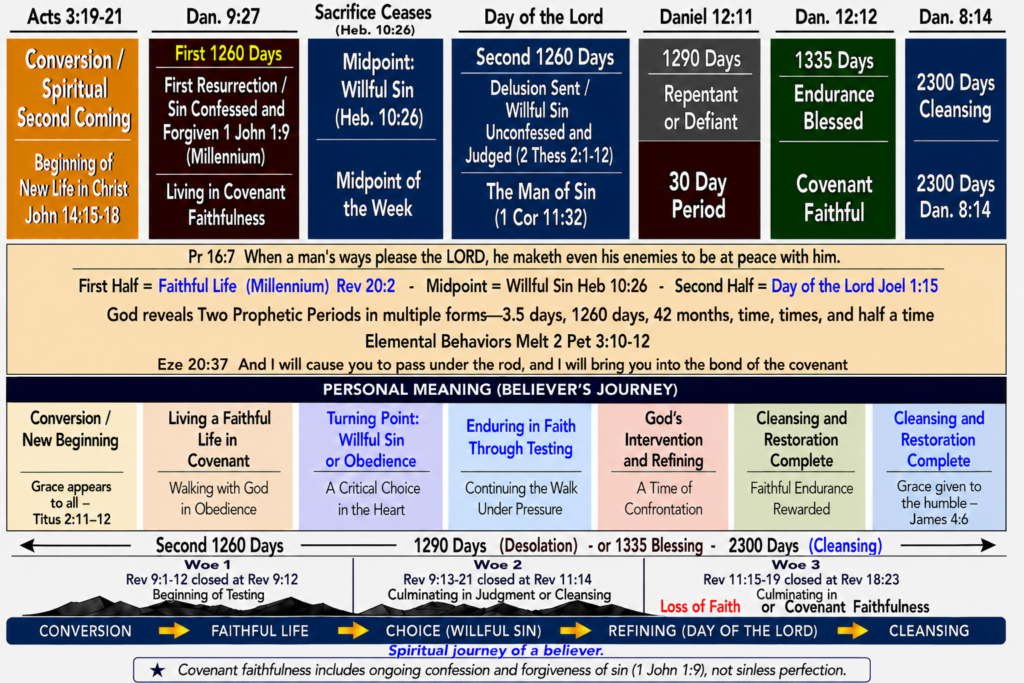
To help visualize this covenant process, the chart below shows how the trumpet judgments correspond to the believer’s spiritual journey—from conversion, to testing, to refining, and finally to cleansing and restoration.
The Trumpets Use Symbolic Language
Jesus taught that spiritual truths are often revealed through symbolic imagery (Matthew 13:11–12). Revelation follows the same pattern.
The trumpet images represent spiritual realities:
Trumpet 1 — Trees and Grass (Revelation 8:7)
- Trees represent established believers and mature growth.
- Grass represents new or vulnerable believers.
The judgment affects both, but new growth suffers especially during covenant testing. The greatest accountability falls upon those entrusted with teaching and feeding God’s people.
Trumpet 2 — Sea and Ships (Revelation 8:8–9)
- Sea represents nations and worldly instability.
- Ships represent covenant representatives navigating among the nations.
The judgment on ships represents discipline upon believers or ministries that become compromised by worldly influence.
Jesus walking on the sea (Matthew 14:25; John 6:19) reveals the opposite picture:
- The sea represents the instability of the world.
- Christ walking upon it represents victory over worldly influence.
- Peter walking upon it represents believers overcoming when focused on Christ.
- Sinking represents covenant failure.
Trumpet 3 — Rivers and Springs (Revelation 8:10–11)
Water often represents teaching and spiritual nourishment.
The rivers and springs becoming bitter represent corruption entering the source of spiritual instruction.
- Rivers = teaching streams.
- Springs = doctrinal sources.
- Wormwood = bitterness and deception.
Trumpet 4 — Sun, Moon, and Stars (Revelation 8:12)
Throughout Scripture, celestial imagery often represents authority and leadership.
- Sun = primary spiritual authority.
- Moon = reflected authority.
- Stars = teachers and leaders.
The partial darkening represents a loss of spiritual understanding and guidance, consistent with God allowing delusion where truth is rejected (2 Thessalonians 2:11).
Trumpets 5–6: Stronger Discipline
The later trumpets describe hostile spiritual forces being released as instruments of discipline, consistent with:
- Job 1–2
- 1 Kings 22
- Luke 22:31
- Revelation 9
God does not cooperate with evil, but He can use hostile powers within His sovereign purpose.
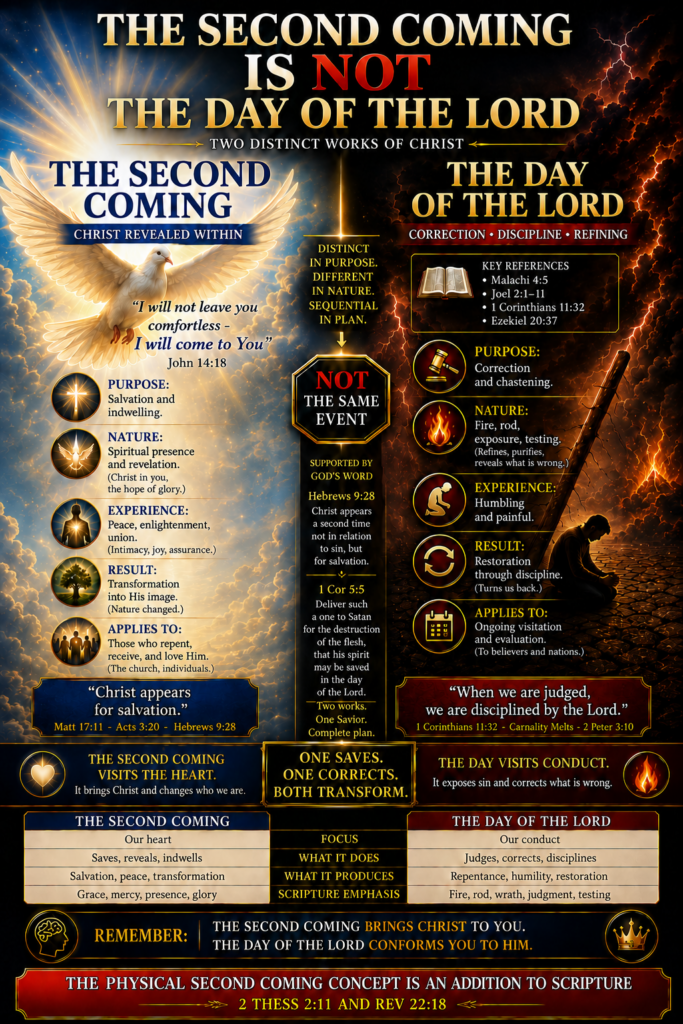
Throughout Scripture, the Day of the Lord refers to God’s decisive intervention to expose and judge hardened rebellion within His covenant people.
Joel announces it as a day when destruction comes from the Almighty to confront what has resisted Him (Joel 1:15).
Paul explains that this same pattern continues in the New Covenant, where the unrepentant may be “delivered to Satan for the destruction of the flesh, so that the spirit may be saved” (1 Corinthians 5:5).
Before this day arrives, a falling away and the revealing of the man of sin must occur—signs of covenant rebellion reaching its peak (2 Thessalonians 2:3).
Scripture consistently describes the Day of the Lord as coming “like a thief in the night” (1 Thessalonians 5:2; 2 Peter 3:10), meaning it arrives suddenly, unexpectedly, and with unavoidable exposure.
Importantly, the Day of the Lord is not the Second Coming itself; Peter teaches that Christ is sent from heaven only after the repentance from unbelief and then the times of refreshing and the restoration of all things begins (Acts 3:20–21). Scripture warns us not to add to what God has revealed (Revelation 22:18), so the Second Coming must be understood according to this biblical sequence.
The Day of the Lord is the climax of God’s covenant discipline, when He confronts willful sin, removes corruption, and restores those who respond to Him.
This background prepares us to understand why Revelation describes the Day of the Lord as a sudden release of judgment.
⭐ 4. Day of the Lord Section —
The Day of the Lord is not a single future catastrophe but God’s decisive intervention whenever covenant rebellion reaches a breaking point.
Scripture shows this pattern repeatedly: exposure, shaking, separation, and restoration.
Revelation places this day within the believer’s spiritual journey, revealing how God confronts hardened sin to bring His people back into the bond of the covenant.
The Day of the Lord and the Sudden Release of Judgment
The Day of the Lord comes “as a thief” — suddenly and unexpectedly.
This corresponds with the sudden release of the trumpet winds.
These judgments are not merely physical events; they represent spiritual intervention where God exposes and corrects what has resisted Him.
Seal 6 does not represent only the final Day of the Lord. It represents God’s ongoing judgment — His continual work of separating, exposing, and correcting His covenant people (1 Corinthians 11:32).
This separation becomes final only for those who reject faith, Revelation 18:23. Thus Seal 6 is both present throughout the age and climactic at its end.
Earth, Winds, and Covenant Reality
In Revelation, “earth” is not merely the physical planet. It symbolizes the fallen covenant condition where disobedient members are exposed.
The faithful remain spiritually aligned with heaven, while those shaken by the winds fall into the realm where judgment operates.
These covenant realities do not remain theoretical.
They unfold within our daily lives, often revealed through rising irritations, stubborn attitudes, resentments, or even hateful behaviors.
Such patterns are not random; they are signs that the winds of discipline are exposing what resists God so that we may be brought into the bond of the covenant.
Recognizing these signs is essential, because they remind us that God is sovereign over the process and actively refining His people.
The aim of His work is always righteousness, peace, and joy in the Holy Spirit — the present experience of right standing with God.
Whenever these qualities diminish, it signals that this covenant discipline is unfolding in real time, inviting us to return, yield, and be restored.
The symbols reveal:
- Trees = people.
- Grass = new believers.
- Sea = nations.
- Ships = covenant representatives.
- Rivers = doctrine.
- Sun, moon, stars = spiritual authority.
- Winds = directed spiritual forces.
Taken together, these symbols reveal how God works within His covenant people—shaking what is unstable, exposing what is resistant, and strengthening what is rooted in Him—so that His refining purpose can be completed in every believer.
Conclusion
The trumpet judgments reveal God’s precise covenant work.
The same winds that bring discipline also bring correction, refinement, and restoration.
God’s judgments are never random.
They are directed, purposeful, and personal.
He searches every heart (Jeremiah 17:10), weighs every spirit (Proverbs 16:2), disciplines His people (1 Corinthians 11:32), exposes deception (2 Thessalonians 2:11), restores the repentant (1 John 1:9), and strengthens those who overcome the world (1 John 5:4–5).
The trumpet judgments reveal that God can govern the entire covenant community while simultaneously working within each individual believer.
Every believer is known.
Every believer is examined.
Every believer is invited to overcome.