🕒 8 min read · 📝 1513 words
The page presents a unified biblical pattern showing how feast imagery, sacrificial language, and devouring symbolism are used throughout Scripture to describe God’s covenantal judgment on His own backslidden people, illustrating the Armageddon purification event.
1. Blessing Feast vs. Judgment Feasts
Psalm 23:5 — The Only Blessing Feast
God prepares a table for His obedient people in the presence of enemies: Christians are being taught to deny ungodliness as unbelievers watch.
Judgment Feasts
Revelation 19 and Ezekiel 39 describe feasts prepared for God’s enemies — His own willfully sinful people who have fallen under demonic influence.
Birds and beasts symbolize hostile spiritual powers that influence wickedness in God’s people and are eventually rendered idle through the Armageddon crisis.
These two feast categories establish the covenant pattern Scripture uses to reveal how God deals with obedience and rebellion.
These two feast categories symbolically correspond to the two halves of Daniel’s 70th week: the first half marked by obedience and the continual sacrifice (The millennium), and the second half marked by willful sin, the cessation of confession, and the Day‑of‑the‑Lord judgment feast.
2. The Day of the Lord as Internal Covenant Judgment
When God hides His face (Ezek 39:23–24), clarity collapses and the believer experiences only the pressure of wickedness.
This pressure is the “demonic feast” — the exposure of rebellion that forces a choice:
Confession (1 John 1:9) → cleansing, bone‑burying, restoration, Spirit outpouring.
Abandonment (Rev 18:23) → collapse of faith and spiritual darkness.
This mechanism matches 2 Thessalonians 2:11: God sends a working of delusion by withdrawing His clarity (hiding His face/presence) and permitting the thief to generate the tuphōsis‑smoke. The delusion is God‑sent in authority, but third‑party in operation.
Once this delusion begins, Scripture consistently describes its effects using sacrificial and feast imagery.
3. Prophetic Feast Imagery Across Scripture
Multiple passages use sacrificial or feast language to portray covenant judgment:
Isaiah 34:6 — “sacrifice in Bozrah”
Jeremiah 46:10 — sword devours, drunk with blood
Zephaniah 1:7–8 — God prepares a sacrifice
Ezekiel 21:10–11 — sword prepared for slaughter
Hosea 9:4 — sacrifices become mourning
Isaiah 30:27–33 — Topheth prepared as a burning site
All depict the same pattern:
The devourers are rendered idle.
This prophetic pattern becomes even clearer when viewed across the entire biblical narrative.
4. The Judgment Pattern
Across all prophetic texts:
Those who devoured others are rendered idle.
Those who oppressed others are overturned.
Those who shed blood (backslidden believers) become the feast of blood (become the demonic target and are cleansed).
Those who consumed nations become the consumed.
This is the covenant justice pattern seen in Revelation 16:6, Revelation 19, Ezekiel 39, Zephaniah 1, Isaiah 34, Jeremiah 46, and Jesus’ own warnings.
This same pattern reaches its fullest expression in the event Scripture calls Armageddon.
5. Armageddon Explained
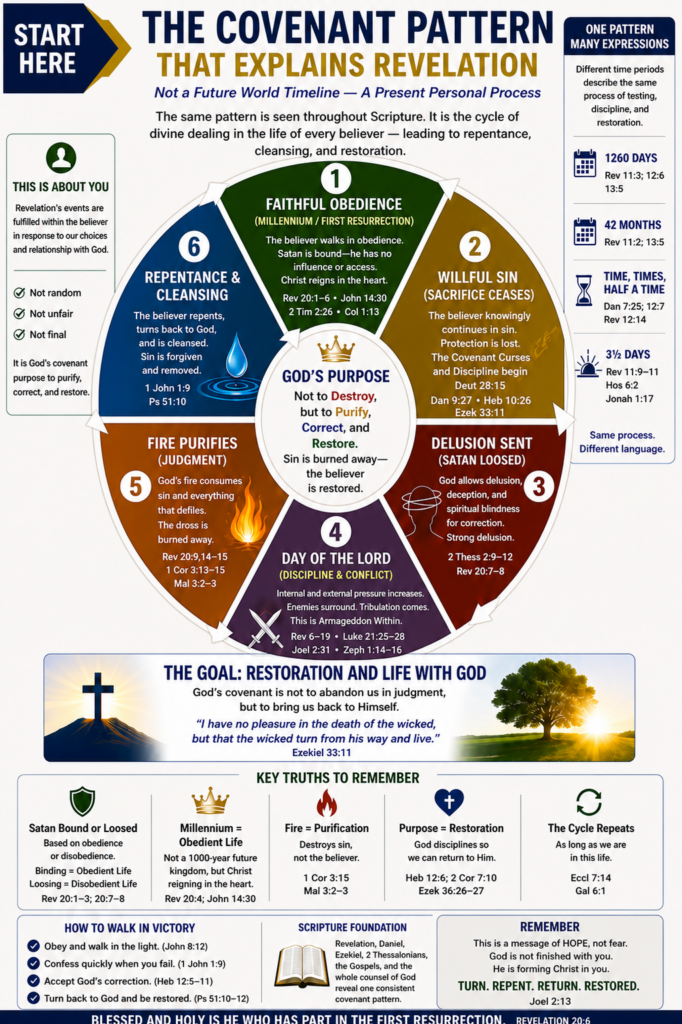
Armageddon is not geopolitical — it is internal covenant confrontation.
Armageddon is the moment when willfully sinful believers surround obedient believers. It is not geopolitical; it is God exposing rebellion inside His own covenant people by allowing the backslidden to surround the faithful. This confrontation is the pattern Scripture repeats from Genesis to Revelation.
In Ezekiel 38:8 and 39:2, the word translated “against” is the Hebrew preposition עַל (ʿal), which does not inherently mean hostility. It simply means movement “upon,” “toward,” or “into proximity.” The hostility in these passages is not in the obedient believers or the backslidden believers, but in the demonic powers influencing the backslidden. God brings His deceived people toward His faithful people to expose rebellion and purify them. The confrontation is spiritually hostile, not humanly hostile.
Jesus instructs His faithful followers to step away from those who choose willful sin for their own protection. Yet God later brings some of these wayward believers back into the lives of the faithful so they can be confronted, guided, and restored. Separation protects the obedient; reconnection purifies the disobedient. This covenant pattern appears throughout Scripture.
The Pattern
God gathers His backslidden people (Magog) to surround His obedient people (mountains of Israel).
God knocks the carnal weapons out of their hands (Ezek 39:3) — rebellion, pride, accusation, self‑will.
Their sinful nature is consumed — the devourers become ineffective.
Bone‑burying symbolizes the removal of willful sin.
God no longer hides His face/presence and instead pours out His Spirit (Ezek 39:29).
Restoration follows purification, not destruction.
Armageddon is the corporate replay of the pattern Jesus fulfilled personally at the cross.
This corporate purification mirrors the sacrificial system itself, which was always a prophetic shadow.
6. Sacrificial System as Prophetic Shadow
Isaiah 34:6 shows that the OT sacrificial system was never about animals — it was a prophetic preview of how God would purify His people at the end of the age.
Lambs, goats, rams = God’s covenant people in rebellion
Fat, kidneys, blood = corruption, excess, and cleansing
Sacrifice = the destruction of the sinful nature.
Sacrifice = the destruction of the sinful nature. This is why Paul commands believers to present their bodies as living sacrifices (Rom 12:1).
Jesus embodies the entire system in His own body, fulfilling the pattern personally; Armageddon fulfills it in His followers.
Paul’s command to “present your bodies as a living sacrifice” (Rom 12:1) is the New Covenant expression of the Bozrah/Bashan pattern. The body is where the fall resides, where rebellion is exposed, and where God performs His purifying work. Jesus fulfilled this pattern physically; Armageddon fulfills it in us as we put sin to death in the flesh.
Two prophetic locations highlight this pattern with striking clarity.
7. Bozrah and Bashan — Prophetic Twins
Bozrah (Isaiah 34) = corrupt sheepfold
Bashan (Psalm 22) = proud, devouring bulls
Both symbolize God’s covenant people in rebellion, the same group confronted in Ezekiel 38–39 and Revelation 19–20.
Jesus personally faced Bashan at the cross and corporately fulfilled Bozrah as the sacrifice.
Jeremiah 46 shows the pattern using Whore‑and‑Beast imagery.
Bozrah in Isaiah 34 and Bashan in Psalm 22 are prophetic twins. Both symbolize God’s covenant people in rebellion. Bozrah is the corrupt sheepfold where God has a sacrifice; Bashan is the proud, devouring bulls who surrounded Jesus at the cross. These two images describe the same spiritual reality: the backslidden, hostile portion of Israel that God confronts at Armageddon. Jesus personally faced Bashan at the cross and corporately fulfilled Bozrah as the sacrifice. Ezekiel 38–39 and Revelation 19–20 replay this pattern on a national scale, where God knocks the carnal weapons out of His backslidden people’s hands, reverses their devouring behavior, and purifies them through the Armageddon process.
Jesus experienced Bozrah and Bashan physically because He entered our world in a real human body and absorbed the external hostility of rebellious Israel. He faced the bulls of Bashan outside Himself because He had no inner rebellion. We experience Bozrah and Bashan spiritually because the same hostility He faced externally now appears inside us as pride, self‑will, and inner rebellion. Jesus took the physical Armageddon so that our Armageddon would be spiritual—an inner confrontation where God purifies the rebellious “Israel” within us. His physical suffering becomes the pattern for our spiritual transformation.
Final Paragraph (ready to paste)
This repeated Bozrah‑and‑Bashan pattern is the key believers must look for whenever they read Scripture. From Genesis to Revelation, God retells the same story through different symbols, nations, feasts, sacrifices, and prophetic images: He reveals how He deals with unbelief in His own people. Though the imagery changes across history, the underlying pattern never does. Those who seek Him will always see the same covenant storyline—God exposing rebellion, confronting it, purifying His people, and restoring them by His Spirit.
8. Jeremiah 46:10 — Old Testament Whore-on-the-Beast
Jeremiah 46:10 mirrors Revelation 17–19:
Devouring sword = Beast
Drunk with blood = Whore
Sacrifice in the north = Bozrah pattern
Day of vengeance = Armageddon
Demonic Devourers losing their influence = Gog/Magog pattern
Jeremiah shows God’s backslidden people becoming His adversaries, devouring the righteous, and being judged through the same feast imagery.
This brings us back to the core mechanism: the demonic feast.
9. The Demonic Feast
The “feast” is spiritual pressure, not literal consumption.
When God hides His face:
clarity collapses
wickedness becomes loud
rebellion is exposed
demonic pressure increases
This pressure makes the sinful nature apparent per Job 42:5-6, forcing repentance or abandonment.
It is the prelude to cleansing.
Final Summary Statement
Scripture uses feast and sacrificial imagery to portray God’s covenantal judgment on His backslidden people.
When God hides His face, clarity collapses, and the believer experiences the “demonic feast,” the exposure of rebellion.
This pressure forces a choice: confession leading to cleansing, or abandonment leading to darkness.
Armageddon is the definition of this pattern — God gathers the backslidden, knocks the weapons out of their hands, consumes their sinful nature, buries the remnants of rebellion, and restores them by His Spirit.
The devourers become ineffective, fulfilling the prophetic situation seen in Isaiah 34, Zephaniah 1, Ezekiel 39, Jeremiah 46, and Revelation 16–20.
In this way the Day of the Lord is said to come as a thief.
2 Pe 3:10 But the day of the Lord will come as a thief in the night; in which the heavens shall pass away with a great noise, and the elements shall melt with fervent heat, the earth also and the works that are therein shall be burned up.