🕒 26 min read · 📝 5159 words
This study explores the possibility that the six seals reveal the spiritual progression of a covenant people rather than merely a sequence of world events. The seals trace a journey from faithfulness, through testing and compromise, to God’s intervention, cleansing, and final separation.
Babylon does not appear suddenly in the narrative. It develops from compromise. What begins as a departure from covenant faithfulness matures into deception, and deception ultimately becomes the strong delusion described in 2 Thessalonians 2:11-12. This deluded, willfully sinful state then precedes the Judgment called the Day of the Lord.
Theological chain –
- Faithfulness
- Conflict
- Choice of yoke Rev 6:5
- Willful Sin and persistence Heb 10:26
- Strong delusion 2 Thess 2:11
- Failure to confess 1 Jn 1:9 Spiritual fornication (Babylon)
- Nations drink her wine; faithful witness is suppressed
- Covenant judgment: Exposure to discipline Martyrs cry “How long? 1 Cor 11:32
- Woe process Sixth-seal intervention
- Babylon judged: Loss of Faith or Cleansing Rev 18:23
That chain ties together:
- Daniel 9:27
- Hebrews 10:26
- 1 John 1:9
- 2 Thessalonians 2:11-12
- 1 Corinthians 11:32
- Revelation 6
- Revelation 18:23
In Daniel 9:27, the sacrifice ceases, just as mentioned in Hebrews 10:26.
This is the appearance of willful sin in the Believer’s life.
Willful sin results in God’s judgment – designed to bring about repentance 1 Cor 11:32.
If a believer persists in willful sin, he is sent into delusion so he believes a lie (2 Thess 2:11) and no longer recognizes the truth. This relates to Job believing he was righteous in his own eyes, as stated in Job 32:1.
They stop acknowledging their actions as sinful, and according to 1 John 1:9, they are not forgiven but instead judged as stated in 1 Corinthians 11:32.
In Rev 6:10, the Faithful witnesses are seen crying out, and the answer to their cry appears in Rev 18:20 and 19:2.
Babylon is not merely guilty of her own sins. She bears responsibility for the bloodshed connected to her influence Rev 18:24.
The same principle appears in Jesus’ indictment of Jerusalem
“That upon you may come all the righteous blood shed upon the earth…” (Matthew 23:35)
“O Jerusalem, Jerusalem, thou that killest the prophets…” (Matthew 23:37)
Babylon makes the nations drink the wine of her fornication (Rev. 17:2; 18:3), leading them into spiritual adultery and rebellion against God.
Because her corrupting influence seduces the world away from covenant faithfulness, she is subsequently found “drunken with the blood of the saints” (Rev. 17:6), and God declares that “in her was found the blood of prophets, and of saints” (Rev. 18:24).
Thus Babylon’s harlotry is a spiritual corruption that results in the suppression and figurative shedding of the life and witness of God’s faithful servants.
This is the question, along with its answer, as addressed in Revelation.
They cry out against those who shed their blood in Rev 17:2. The nations are drunk with wine (of Babylon’s harlotry), and in 17:6 she is drunk with the blood of the saints.
The imagery suggests that the Blood symbolizes the spiritual corruption represented by Babylon.
The concern of the martyrs (those believers who lost their lives for Christ, Jn 12:25) is not merely personal vindication.
They seek God’s response to the covenant unfaithfulness that has overtaken Babylon and damaged the testimony of the faithful.
God’s response suggests that some of them will choose to be living martyrs as they were, but will be saved through fire per the woe structure in Rev 6:10-11.
The earthquake of the sixth seal is the beginning of God’s answer to the witnesses’ cry. “The Day of the Lord” is the judgment meant to correct the backsliding believers Joel 1:15.
The kingdom attributes of Joy and gladness are cut off from the believer Joel 1:16 during this time.
The Six Seals as a Covenant Journey
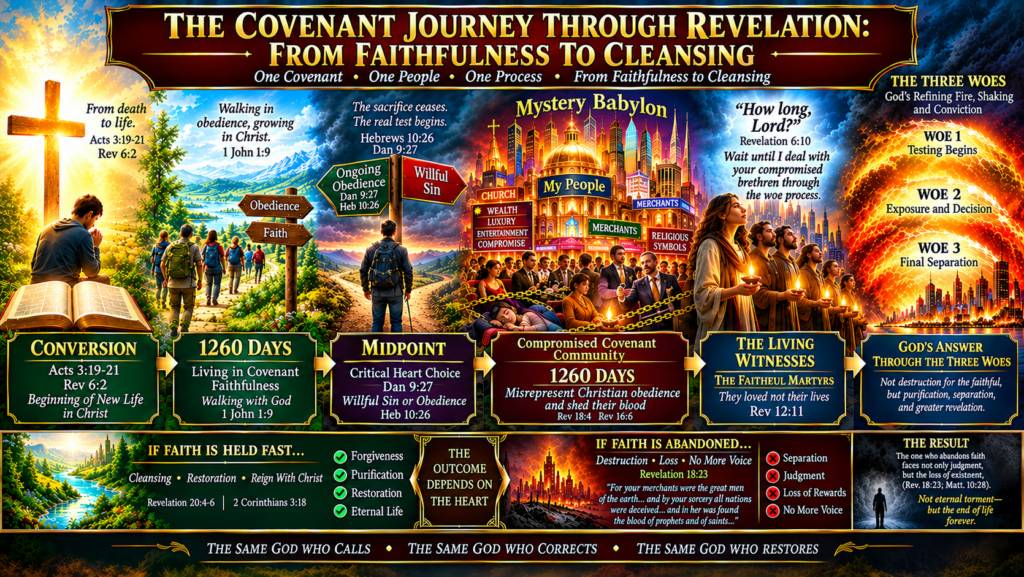
The Covenant Journey Through Revelation: From Faithfulness to Cleansing
This is the confirmation of the covenant mentioned in Daniel 9:27.
During Daniel’s 70th week, Jesus confirms the covenant with His people.
The question becomes: when willful sin is entered into, at which of the seals is the believer given over to delusion and willful sin?
This depends on the chosen guidance, symbolized by the rider of the Horse in seal three, as the yoke is selected.
The concept of a yoke (Strong’s #2218) is the literal translation of the word translated as “a pair of balances”.
When God sees continuing willful sin among His people, He responds by sending delusion and judgment per Heb 10:26 and 2 Thess 2.
Refer to a sword that will pierce Mary’s heart as well Luke 2:35, meaning we are all disciplined per the animal sacrifices in the Old Covenant Isaiah 34:6.
Which leads into the question: we will not all sleep (backslide), but we will all be changed 1 Cor 15.
The change is corruption being replaced by incorruption. Some believers embrace this cleansing willingly, while others must be disciplined as they undergo it.
The seals symbolize a believer’s covenant journey, beginning with faithfulness, moving through temptation (Matt 4:3), and leading to the decision of which spiritual guidance, represented by the horse’s rider, they follow; afterward, God intervenes to separate and purify His covenant people.
He separated the sheep and goats from among His flock Ez 34:12-17 and Matt 25:32-33. This is the separation of the living martyrs and those who misrepresented their devoted lives.
The horse-and-rider imagery provides an important key to this progression.
The horse represents the believer, while the rider represents the spiritual governance or guidance under which the believer is proceeding.
The changing horses and riders therefore portray changing covenant conditions within the person.
The Six Seals as a Covenant Journey
- Seal 1 — Faithfulness: The covenant journey begins with overcoming faith and faithful living.
- Seal 2 — Fire-like Red rider: Peace is spiritually removed, and temptation is entered into: Matt 6:13.
- Seal 3 — The Yoke of servitude: The Lord gives the disobedient believers over to measured harm.
- Seal 4 — Matt 25:41: Willful covenant violation is disciplined.
- Seal 5 — The Faithful Witnesses Cry Out: The faithful witnesses ask, “How long (How will you deal with our covenant-violating brethren), O Lord?”
- Seal 6 — God Intervenes: Day of the Lord: The stars fall, heaven is rolled up as in Isaiah 34:4, the shaking of the covenant order begins, and God responds to their question by illustrating the Woe process.
The fifth seal asks the question. The sixth seal shows God’s answer to their unfaithful representation of Christianity.
Seal One — The White Horse: Faithfulness
Revelation 6:1–2
The first seal introduces the covenant journey with a white horse. White is associated throughout Scripture with purity, righteousness, victory, and overcoming.
The horse represents the believer, while the rider represents the spiritual governance or guidance of Jesus under which the believer proceeds.
The progression begins with a faithful response to God’s covenant.
The rider goes forth conquering and to conquer, portraying the overcoming character of faithful covenant living.
Conversion → Obedience → Faithful Living
Seal Two — The Red Horse: Conflict
Revelation 6:3–4
The second seal takes peace away from the earth.
In the world or earth, there are three forces—lust of the flesh, lust of the eyes, and the pride of life—that influence believers’ behavior.
However, at the second seal the believer is guided by earthly behavior.
They are not yet deceived, and they can confess and be forgiven, as this does not yet appear to be willful sin, as stated in 1 John 1:9.
Within this covenant pattern, the believer’s faithful walk encounters opposition, pressure, and conflict. Faith is not merely professed; it is tested, James 1:3.
This conflict suggests that faith is being eroded and peace is being compromised Proverbs 16:7.
Faithfulness → Conflict → Testing Begins
Seal Three — The Black Horse: The Yoke and the Choice
Revelation 6:5–6
The third seal introduces the black horse and the balances. The Greek word zygos can refer to balances or a yoke.
This provides an important covenant image because a yoke speaks of authority, submission, service, and governance.
The question is therefore not simply what is being measured, but under whose governance the believer will continue.
Jesus speaks of taking His yoke upon us in Matthew 11:29–30. The third seal presents the covenant choice: Whose yoke will the believer carry?
- Christ’s yoke: Faithfulness, endurance, and continued submission to God.
- Another yoke: Compromise, deception, and a different form of spiritual governance.
The third seal is therefore a turning point. The issue of governance becomes exposed, and the believer’s response becomes decisive. This is the confrontation and testing of faith.
Faithfulness → Conflict → Choice of Yoke
The second and third seals depict believers who, though imperfect and struggling, still remain aware of covenant provisions such as confession and forgiveness 1 Jn 1:9. The fourth seal marks the transition to willful persistence, where spiritual delusion (2 Thess 2:11) obscures the need for repentance, allowing covenant judgment to proceed.
The Transition from Choice to Delusion
The second and third seals depict believers who remain accountable to covenant provisions such as confession, repentance, and forgiveness. Though struggling and imperfect, they still recognize sin as sin and may turn back to God through confession (1 John 1:9). This still falls within the first 3.5 days of Daniel’s 70th week and before the midpoint – the sacrifice ceasing and the second 3.5 days.
The third seal presents the decisive question of governance by the rider of the horse. The issue is not merely behavior but whose yoke the believer will carry (Matt. 11:29-30). As long as sin is confessed and forsaken, covenant restoration remains available.
The fourth seal signifies a shift. The rider, known as Death, is followed by Hell. Scripture shows a pattern: willful sin leads to judgment, and Jesus hands the sinner over to Hell, as seen in Matthew 25:41. This suggests that in seal 4, willfulness is identified and dealt with when the rider becomes Hell. It reflects not just ordinary mistakes, but the state that arises when covenant breaches become deliberate and ongoing.
Hebrews 10:26 describes this progression:
“For if we sin wilfully after that we have received the knowledge of the truth, there remaineth no more sacrifice for sins.”
The issue is not an isolated act of sin but the rejection of the covenant provision itself. The sacrifice remains effective for the repentant believer, but the one who knowingly persists in sin no longer seeks the remedy God has provided.
Jesus describes a similar judicial principle in Matthew 25:41:
“Depart from me, ye cursed, into everlasting fire, prepared for the devil and his angels.”
Within this covenant pattern, the believer who rejects God’s governance experiences the consequences of the alternative governance chosen. The person comes under adversarial influence and discipline rather than enjoying the protection associated with covenant fellowship.
Second Thessalonians 2:10-12 describes the next stage:
“Because they received not the love of the truth … God shall send them strong delusion, that they should believe a lie.”
The delusion is judicial. It does not create the rebellion but exposes and confirms the direction already chosen. The believer who refuses truth becomes unable to accurately evaluate his own condition.
At this stage the lie is not necessarily open denial of God. The greater danger is self-deception. Sin is no longer recognized as requiring confession and repentance. What God calls sin comes to be viewed as acceptable, necessary, justified, or no longer relevant.
The deluded person has effectively enthroned himself in the place of God. Rather than submitting to God’s definition of righteousness and sin, he assumes the authority to determine those things for himself. What God calls sin he now calls acceptable. In this sense, he sits in God’s place as judge, making his own rules and following his own governance. The issue is not merely deception but usurpation of divine authority.
The deluded person has not literally become God. Rather, he has assumed for himself the authority to define good and evil, righteousness and sin. Having rejected God’s judgment concerning his conduct, he places his own judgment upon the throne.
The progression therefore becomes:
- Faithfulness.
- Conflict and temptation.
- Choice of governance and yoke.
- Willful persistence in sin.
- Strong delusion.
- Failure to recognize the need for confession.
- Covenant judgment revealing the hidden condition.
The fourth seal therefore represents more than punishment. It reveals the point at which continuing willfulness results in spiritual blindness, allowing the judgment described in 1 Corinthians 11:32 to proceed: This is God concealing His face /presence from the believer so the sin becomes pronounced and recognizable to the person Eze 39:24-29.
“When we are judged, we are chastened of the Lord, that we should not be condemned with the world.”
Judgment reveals the condition. Discipline seeks correction. Repentance remains the path to restoration.
One manifestation of the delusion is that the believer no longer recognizes his conduct as requiring confession and repentance.
Babylon: The Mature Form of Covenant Compromise
Babylon does not appear suddenly at the end of the covenant journey. Rather, she represents the mature and fully developed form of the compromise that began when men departed from covenant faithfulness. What begins as a choice between obedience and self-rule eventually grows into a system of spiritual harlotry that opposes the purposes of God and corrupts the nations.
The progression seen throughout the seals reveals how covenant unfaithfulness develops. The rider of the white horse presents the call to faithfulness and covenant victory. As that faithfulness is rejected, conflict, division, and competing loyalties emerge. Men place themselves under false measures, false values, and ultimately false authority. The result is spiritual death, not merely through outward judgment, but through the gradual hardening of the heart against the truth.
This process reaches its mature expression in Babylon. John describes her as the great harlot:
“With whom the kings of the earth have committed fornication, and the inhabitants of the earth have been made drunk with the wine of her fornication.” (Rev. 17:2)
Her fornication is spiritual in nature. She seduces rulers and nations away from covenant fidelity, causing them to embrace values, loyalties, and worship contrary to God. What began as compromise ultimately becomes collective rebellion.
The consequences of this corruption extend beyond personal apostasy. Babylon’s influence suppresses and opposes those who remain faithful to God. Thus John sees:
“The woman drunken with the blood of the saints, and with the blood of the martyrs of Jesus.” (Rev. 17:6)
The symbolism is striking. The nations are drunk with her wine, and Babylon herself is drunk with the blood of the saints.
The deception becomes so entrenched that what began as a distortion of Christianity is eventually accepted as Christianity itself.
Through continued compromise and deception, the distorted image of Christianity becomes normalized until many regard the counterfeit as the genuine faith.
This explains the cry heard under the fifth seal:
“How long, O Lord, holy and true, dost thou not judge and avenge our blood?” (Rev. 6:10)
The martyrs are not merely seeking personal vindication. They call for God to expose and judge the system that has corrupted the earth and opposed His faithful witnesses. Their cry remains unanswered only temporarily.
The answer begins to arrive as the covenant journey advances toward the sixth seal. The heavens are shaken, earthly powers are exposed, and those who trusted in the structures of men suddenly recognize that divine judgment has come. What the martyrs requested under the fifth seal begins to unfold in the events that follow.
The connection becomes explicit in the judgment of Babylon:
“And in her was found the blood of prophets, and of saints, and of all that were slain upon the earth.” (Rev. 18:24)
Babylon therefore stands as the culminating image of covenant compromise. She is the fully matured expression of spiritual adultery, a system that seduces the nations, opposes the truth, and bears responsibility for the suffering of God’s faithful servants.
The fifth seal reveals the victims of her corruption, while the later judgments reveal God’s answer to their cry.
In this way, Babylon is not separate from the covenant journey illustrated by the seals, but its final and most complete manifestation before divine intervention and restoration.
Seal Four — The Pale Horse:
Revelation 6:7–8
The fourth seal introduces the pale horse. Its rider is called Death, and Hell follows with him. Within this interpretive framework, this does not yet represent the final death or abandonment of faith.
That later condition is revealed more clearly in Revelation 18:23.
The fourth seal represents the trying of faith under covenant judgment. The willful covenant violation that was confronted in the preceding choice now becomes manifest in the believer’s condition. Judgment reveals what has been taking place within.
This distinction is important. Ordinary sin does not automatically equal abandonment of faith. Scripture provides a means of confession, repentance, correction, and restoration. The fourth seal portrays the serious consequence of refusing that covenant response.
Compromise → Deception → Faith Is Tried → Hidden Condition Exposed
Hell as a Condition of Adversarial Governance
Within this covenant interpretation, Hell is not being used as a synonym for irreversible finality. The imagery can instead portray a condition in which the person is delivered into the presence and governance of the adversary and his angels.
Matthew 25:41 describes the everlasting fire as having been prepared for the devil and his angels. The Devil remains the adversary; he is not God’s partner in salvation. Rather, God can permit an adversarial power to function within His judicial discipline without making that power good or righteous.
This agrees with the principle expressed in 1 Corinthians 11:32: when God’s people are judged, they are chastened by the Lord so that they should not be condemned with the world.
In this sense, judgment reveals rather than creates the condition. The person experiences the consequences of the governance that has been chosen, and the hidden condition can become apparent to the person himself.
The Hiding of God’s Face
The Scriptures also connect judgment with God hiding His face. This provides another way of understanding the fourth seal. When God’s protective presence is concealed, the person’s condition is no longer concealed by that protection.
The pattern can be seen in Job, where affliction brings Job’s recognition and understanding of His self-righteousness. Ezekiel 39:23–24 likewise connects Israel’s judgment with God’s hiding His face because of transgression. Yet Ezekiel 39:29 later declares that God will no longer hide His face and will pour out His Spirit.
The sequence therefore contains both judgment and the possibility of restoration: exposure of the condition, recognition of the condition, and the possibility of returning to God.
The Prison and the Possibility of Deliverance
Jesus gives another covenant image in Matthew 5:25–26. The sequence is adversary → judge → officer → prison, followed by confinement until the required condition is satisfied.
Within this framework, the prison represents judicial confinement rather than automatically meaning irreversible finality. The discipline exposes the seriousness of the person’s condition and creates an opportunity for repentance.
This is why the fourth seal should be described as the trying of faith. The person has entered a severe judicial condition, but the covenant process has not yet necessarily reached its final confirmation.
Judgment reveals the condition. Discipline provides the opportunity for correction. Repentance opens the way to deliverance.
Strong Delusion and Judgment
Second Thessalonians 2:10–12 describes people who refuse to receive the love of the truth. God sends a strong delusion, and the passage then speaks of judgment concerning those who believed the lie rather than the truth.
This should be understood as judicial exposure to wickedness rather than as God becoming the author of evil. The delusion allows the chosen condition to become manifest. The judgment reveals what the person has embraced.
The language of this passage belongs to the field of judgment and judicial decision. Therefore, the passage should not automatically be turned into a doctrine of irreversible damnation at this stage of the covenant pattern.
The Death of Faith Comes Later
The distinction between the fourth seal and the later condition described in Revelation 18:23 is essential. The fourth seal portrays faith being tried and the hidden condition being exposed. It does not require that faith has already been abandoned.
Revelation 18:23 describes a later and more hardened condition in which the voice of the bridegroom and bride is no longer heard in Babylon. Within this covenant pattern, that loss of hearing represents the abandonment of covenant faith rather than merely the testing of faith.
The progression is therefore:
- Third Seal: The choice of spiritual governance is exposed.
- Fourth Seal: Faith is tried, and the hidden condition becomes manifest.
- Judicial confinement: The consequences of the chosen condition are experienced.
- Repentance: The possibility of deliverance remains.
- Revelation 18:23: A later hardened condition reveals the abandonment of covenant faith.
Seal Five — The Faithful Witnesses Cry Out
Revelation 6:9–11
“How long, O Lord?”
The fifth seal introduces the faithful witnesses who cry out to God. Their question is not merely a request for information. It expresses the tension created by the continuing presence of covenant corruption and the apparent delay of judgment.
The faithful witnesses have seen the condition of their backslidden brethren, yet the process has not reached its appointed conclusion. Their cry therefore points forward to God’s intervention.
The fifth seal asks the question.
Seal Six — God Intervenes
Revelation 6:12–17
The sixth seal begins the answer to the question raised by the faithful witnesses. The earthquake and cosmic shaking portray divine intervention in the established covenant order.
The imagery is not limited to physical geography. Throughout Scripture, shaking can describe the removal or exposure of an established order. What has appeared stable is shaken so that its true condition can be revealed.
The sixth seal begins God’s answer.
The Shaking of the Covenant Order
The earthquake imagery appears again at important points in Revelation. Revelation 8:5 connects the shaking with the altar, fire, thunder, voices, and earthquake. Revelation 11:19 presents the shaking in connection with the temple and the ark. Revelation 16:18 presents a great earthquake in connection with the collapse of Babylon.
These passages can therefore be viewed as different perspectives on the same covenant pattern of divine intervention. The imagery separates the events for definition without requiring that each appearance establish a separate chronological event.
From the earth, the established order is shaken. From the altar, judgment is activated. From the temple, the covenant reality is revealed. In the final imagery, Babylon’s established condition collapses.
The Three Woes and the Work of Exposure
The relationship between the seals and the three woes continues the same covenant pattern. The fifth seal raises the question, the sixth seal begins the shaking, and the woes develop the testing, exposure, and separation that follow.
- The fifth seal: The faithful witnesses cry, “How long?”
- The sixth seal: God begins to shake the established covenant order.
- Woe One: The testing intensifies.
- Woe Two: The hidden condition is exposed and the response becomes evident.
- Woe Three: The process reaches separation and loss of faith.
The purpose of the imagery is therefore not simply destruction. It reveals what has been hidden and brings the covenant condition into the open.
Babylon and the Call to Come Out
Revelation 18:4
“Come out of her, my people.”
This command is significant because God’s people are still addressed as being within Babylon. The call to come out therefore presents another covenant choice: return to covenant faithfulness or remain within the hardened system.
The third seal introduced the question of whose yoke would govern the believer. The fourth seal tried that faith under judgment. The later judgment exposes the result of that response.
Babylon therefore represents more than an external city in this interpretive framework. It portrays a hardened covenant condition in which the original relationship with God has been compromised.
One Covenant Pattern with Many Symbols
The six seals can be understood as one covenant pattern expressed through different symbols. The imagery moves from faithful governance, through conflict and choice, into the trying of faith, exposure, witness, intervention, and finally separation and loss of faith.
The seals therefore do not have to be read as six unrelated disasters occurring one after another in world history. They can be read as successive stages in the revelation of a believer’s covenant condition. Daniel’s 70th week of confirmation.
The horse represents the believer. The rider represents spiritual governance. The changing conditions of the horse and rider reveal the changing covenant condition of the person.
The Covenant Progression
- Faithfulness
- Conflict
- Choice of Yoke
- Faith Is Tried
- Hidden Condition Exposed
- Faithful Witnesses Cry Out
- God Intervenes
- Testing and Separation
- Cleansing or loss of faith
- The 7th seal is loss of faith Rev 18:23
The governing principle throughout this process is simple: judgment reveals the condition; discipline provides an opportunity for correction; repentance opens the way to deliverance; and confirmation establishes the resulting covenant condition.
This provides a unified way to read the seals, the trumpets, the bowls, Babylon, and the Day of the Lord. The symbols differ, but the covenant pattern remains consistent: what is hidden is exposed, the response is revealed, and the resulting condition is confirmed.
The Necessity of Covenant Disclosure
Before examining the Day of the Lord itself, it is necessary to understand why such a day is required. Scripture presents the possibility that individuals and even entire religious systems may sincerely believe themselves to possess a covenant identity that God does not recognize.
The Day of the Lord therefore functions as more than judgment; it is a divine disclosure that exposes false claims and establishes God’s assessment as the final reality.
Revelation 2:9 and 3:9 may be viewed through the principle expressed in John 7:17: “If any man will do his will, he shall know of the doctrine.”
If spiritual knowledge comes through obedience, then persistent disobedience can result in persistent misunderstanding.
In such a condition, people may sincerely hold a covenant identity that God does not recognize, not because the truth was unavailable, but because the pathway to understanding, namely obedience to revealed truth, was neglected.
As disobedience continues, error becomes tradition, tradition becomes doctrine, and doctrine becomes identity, until individuals confidently say they are what they are not.
Thus Christ’s declaration that they “say they are Jews, and are not” is not merely a correction of terminology but an exposure of a deeper condition in which self-perception has become separated from God’s assessment.
Smyrna and Philadelphia recognized and resisted the leaven of false covenant identity, whereas the remaining churches reveal its progressive development from diminished love to complete self-deception, culminating in the Laodicean condition that anticipates Babylon’s boast, “I sit a queen,” and Paul’s strong delusion of 2 Thessalonians 2:11.
Thus Christ’s declaration that they “say they are Jews, and are not” is not merely a correction of terminology but an exposure of a deeper condition in which self-perception has become separated from God’s assessment.
Smyrna and Philadelphia recognized and resisted the leaven of false covenant identity, whereas the remaining churches reveal its progressive development from diminished love to complete self-deception. Ephesus abandons its first love, Pergamum tolerates compromise, Thyatira permits corruption, Sardis has a reputation for life but is dead, and Laodicea can no longer recognize its true spiritual condition.
What was initially recognized as falsehood in others ultimately becomes internalized, culminating in the Laodicean condition that anticipates Babylon’s boast, “I sit a queen,” and Paul’s strong delusion of 2 Thessalonians 2:11.
Scripture also provides a remedy for this condition in 1 Corinthians 5:5: the offender is delivered to Satan “for the destruction of the flesh, that the spirit may be saved in the day of the Lord Jesus.” I feel that this is Scripture’s most concise definition of what happens during the judgment period called the Day of the Lord.
The judgment called the Day of the Lord or the 3 woe process is the remedy.
Here the adversarial realm functions as a divinely appointed corrective environment in which false confidence, fleshly identity, and misplaced covenant assumptions are brought to ruin so that truth may emerge.
In this sense, the Day of the Lord is revealed not merely as a day of wrath but as a day of divine disclosure, when all false claims are exposed, and all things are brought into conformity with God’s judgment.
This accords with Joel’s declaration that “the day of the LORD is at hand” and with the woe sequences of Revelation, where progressive judgments uncover hidden realities and compel acknowledgment of God’s verdict.
The promise of Revelation 3:9 then becomes the culmination of this process, as those who once held a mistaken identity are brought “to know” the truth that Christ reveals, demonstrating that true covenant understanding, genuine faith, and authentic covenant identity are the result of God’s corrective work operating through obedience, judgment, and revelation.
Armageddon represents the final overthrow of misplaced covenant assumptions.
Those who stand opposed to God’s people do so under a false understanding of reality, just as those in Revelation 2:9 and 3:9 claim an identity that Christ does not recognize.
When divine intervention occurs, the true victory is not military conquest but the unveiling of God’s judgment.
The adversarial mind is brought to an end, false identities collapse, and truth alone remains standing. This corruptible must put on incorruption, 1 Cor 15:53-54.
In this sense, Armageddon is the ultimate fulfillment of the Day of the Lord, wherein all things are exposed and brought into conformity with God’s assessment.
The covenant journey revealed through the six seals therefore culminates not in destruction for its own sake, but in the confirmation of truth, the vindication of God’s people, and the final overthrow of every false claim to covenant identity.
The cry of the martyrs beneath the fifth seal is ultimately a cry for the correction of a Christian world in which God’s assessment and man’s assessment have become separated.
Their plea, “How long, O Lord?” is answered not merely by judgment, but through the progressive disclosure of truth revealed in the woe sequence.
As the Day of the Lord unfolds, hidden realities are exposed, false identities are challenged, and misplaced covenant assumptions are brought to ruin so that truth may emerge.
The central conflict of Revelation is therefore not between nations, armies, or earthly powers, but between authentic covenant identity and counterfeit covenant identity; between those whom God recognizes as His own and those who merely claim such standing.
The promise of Revelation 3:9 stands as the resolution to this conflict, for Christ declares that those who once opposed His people shall come “to know” the reality they formerly denied.
Thus the battle culminates not in the triumph of force, but in the triumph of divine revelation.
Those who retain faith through the corrective process are brought into conformity with God’s judgment and are confirmed in authentic covenant identity, while every false claim collapses before the truth.
In this sense, the covenant journey revealed through the six seals reaches its consummation when God’s verdict alone remains standing, and those whom He acknowledges are revealed as the true Jews, the true Christians, and the true people of God.
Thus, the covenant journey revealed through the six seals reaches its consummation when God’s verdict alone remains standing, and those whom He acknowledges are revealed as His true and faithful people.