
🕒 7 min read · 📝 1321 words
Revelation shows the redeemed walking through a spiritual process in which Christ acts upon them, and they respond to Him.
- The Lamb reveals — exposing what is hidden within the believer.
- The Lamb corrects — bringing conviction, discipline, and the opportunity for repentance.
- The Lamb transforms — shaping the believer into His image.
- The believer responds — through prayer, obedience, resistance, or willful sin, revealing the heart’s response to the Lamb’s work.
Revelation’s judgments are inward spiritual movements.
Believers are the ones being examined, corrected, and shaped into Christ’s image through the symbolism of Revelation.
- Through prayer, obedience, and faithfulness, they resist darkness;
- Through willful disobedience, they yield ground and allow their spiritual enemies greater influence.
This reflects the biblical pattern of binding and loosing (Matt 16:19).
Revelation 20 illustrates this: Satan is bound initially, and then released to deceive when the believer willfully sins.
This is similar to 2 Thessalonians 2:11, where God sends a delusion to a believer who falls back and rejects the truth Isaiah 28:13.
These passages reveal the heart’s condition.
⭐ Core Thesis
Revelation portrays the redeemed walking through Christ’s refining judgment and discipline.
The book’s ultimate aim is:
The revelation of Jesus Christ within His people — “Christ in you, the hope of glory” (Col 1:27).
⭐ The Knowledge of God
The knowledge of God is not merely information—it is the unveiling of God’s covenant pattern within the believer. Scripture reveals this pattern again and again, through different symbols, visions, and prophetic images. Though each biblical writer used unique language, they all described the same spiritual reality as they were carried by the Spirit and sought the Divine.
At the heart of this knowledge is the recognition that God works in consistent stages as He forms Christ within His people. This pattern appears in Daniel’s prophetic time periods, in Revelation’s visions, in Jesus’ teachings, and throughout the writings of the apostles and prophets.
The Divine Pattern of the Knowledge of God:
- Exposure — God reveals what is hidden. “The Lamb reveals—exposing what is hidden sin within the believer.”
- Correction — God warns, convicts, and disciplines. “The Lamb corrects—bringing conviction, discipline, and the opportunity for repentance.”
- Purification — God refines through judgment. “Believers undergo the cleansing those judgments bring as they are poured out.”
- Victory — Christ conquers inner rebellion. “Christ conquers inner rebellion; the believer’s will aligns with the Lamb’s character.”
- Indwelling Glory — Christ is fully revealed within the redeemed. “The revelation of Jesus Christ within His people—Christ in you, the hope of glory.”
This is the knowledge of God: seeing His covenant actions, His refining work, and His transforming grace operating consistently across Scripture and within the believer’s life.
Daniel shows the timeline of this transformation. Revelation shows the imagery of this transformation. The prophets show the warnings and calls to return. The apostles show the inner work of Christ forming His image in His people.
All of them tell the same story— the story of Christ revealed in the redeemed.
“Both describe the same spiritual journey: conversion, faithfulness, willful sin, refining, cleansing, restoration.”
This is the knowledge of God: the recognition of His pattern, His process, and His presence— the unveiling of Christ within the believer.
⭐ 1. The Seals — Revelation’s Judgment tools (Rev 6–8:1)
- The redeemed are shaped by the tools Jesus employs as He opens the seals.
⭐ 2. The Trumpets — Warning (Rev 8–11)
- Believers, if unrepentant, will experience the trials those warnings announce.
⭐ 3. The Bowls — Purification Through Judgment (Rev 15–16)
- Believers undergo the cleansing those judgments bring as they are poured out Rev 16:2.
⭐ 4. The Judgment Conflict
Triumph Through Obedience (Rev 17–19)
- The redeemed join Christ in righteous warfare; they battle powers and principalities.
- Believers are in the battle, but the battle is the Lord’s (1 Cor 11:32).
- They confess sin (1 John 1:9) and ask for grace to deny ungodliness (Titus 2:11–12).
- He confirms the covenant Dan 9:27 and circumcises the Believer’s Heart per Deut 30:6.
- Their faith is challenged and confirmed during the struggle against evil, as reflected in Matthew 11:12 and Acts 14:22.
- Mt 11:12 And from the days of John the Baptist until now the kingdom of heaven suffereth violence, and the violent take it by force.
- All we need is to keep the faith, and God’s grace will guide us to where He wants us to be—the image of Christ, as in 2 Tim 4:7.
- 2Ti 4:7 I have fought a good fight, I have finished my course, I have kept the faith:
- Christ conquers inner rebellion; the believer’s will aligns with the Lamb’s character.
⭐ 5. The New Creation
Christ Fully Revealed Within (Rev 21–22)
- The redeemed rule with Christ—overcome and sit with Him on His throne.
- They are fully sanctified—no longer under judgment.
⭐ Believer’s Journey
- Exposure — The seals reveal the spiritual tools that will play a role in addressing and disciplining sin (Rev. 6–8).
- Correction — The trumpets warn of the approaching judgment (Rev 8–11).
- Purification — The bowls pour out that judgment (Rev 15–16).
- Victory — Christ conquers inner rebellion (Rev 17–19).
- Indwelling Glory — Christ fully revealed in His people (Rev 21–22).
- The outcomes are overcoming (Day 1335) or hardening (Day 1290) and loss of faith per Rev 18: 23.
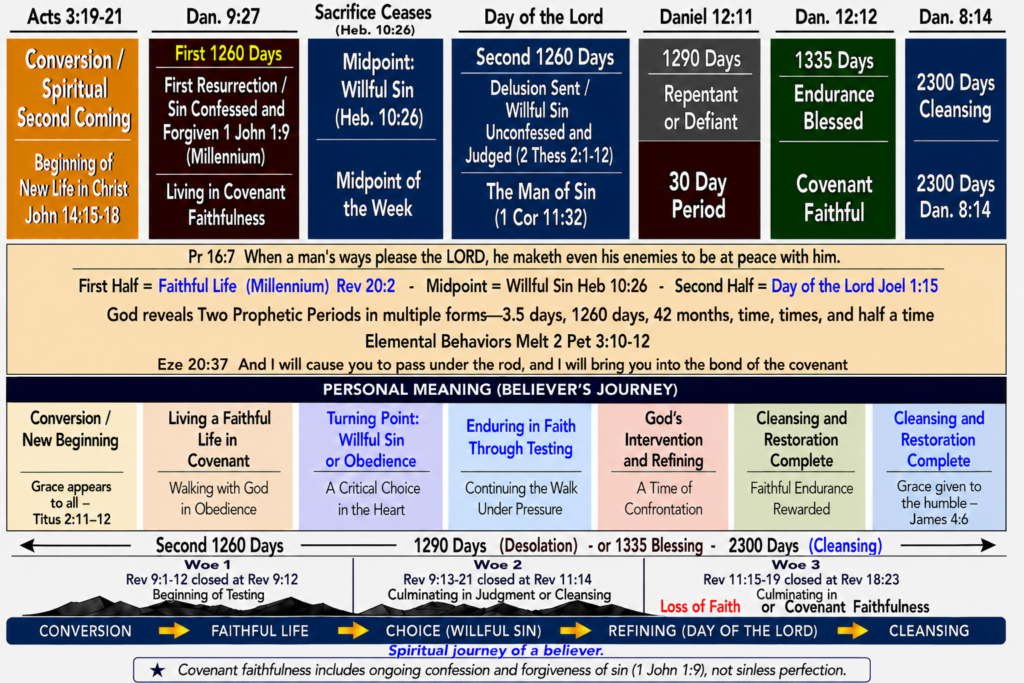
Revelation Can Be Read as the Believer’s Journey
- Daniel’s 70th week (Daniel 9:27) = timeline of transformation or covenant confirmation.
- Revelation = imagery of transformation
Both end in the same place:
1Pe 1:9 Receiving the end of your faith, even the salvation of your souls.
Christ fully formed in the believer.
Daniel uses symbolic time periods (1260, 1290, 1335, 2300). Revelation uses symbolic visions (seals, trumpets, bowls, New Jerusalem).
Both describe the same spiritual Journey:
- conversion
- faithfulness
- willful sin
- refining
- cleansing
- restoration
⭐ Martyrs Represent the Believer’s Inner Life
- Martyrs represent believers who have “died to sin” — those who lay down their old life and live in the new life Christ gives (Romans 6:4, Rev 20:4). Their witness comes from surrender, not physical death, showing what it means to follow Christ with a heart that is yielded and faithful.
- Bride: sanctified community
Kings represent the believer’s inner rulership — the thoughts, desires, and motivations that sit on the “throne” of the heart.
These inner rulers can submit to Christ, or they can become tangled in sin, pride, fear, or spiritual deception.
Revelation often leaves its kings unnamed because the focus is not on earthly political leaders, but on the spiritual powers and influences that shape a person’s inner life.
This follows the same pattern seen in Ezekiel, where corrupted kings and leaders symbolize the pride, rebellion, and idolatry operating inside God’s people.
This connection between Ezekiel and Revelation reinforces the thesis that Revelation’s characters represent the believer’s inner life.
Together they show the redeemed walking through Christ’s work in every stage of transformation.
- Choose this day who you will serve. Joshua 24:15; Deuteronomy 28
- You obey → God reveals more truth.
- You fall → God disciplines.
- You endure → God refines.
- You overcome → Christ is revealed in you.
Revelation is telling that story.
⭐ The Revelation of Jesus Christ Is Ultimately the Revelation in a Believer
The end result is the pattern — the revelation of Jesus Christ, and the end is Christ in you, the hope of glory.
Revelation is about Christ returning to the world, Acts 1:6.
Ac 1:6 ¶ When they therefore were come together, they asked of him, saying, Lord, wilt thou at this time restore again the kingdom to Israel?
It’s about Christ returning within the believer and restoring His image—the image lost in the Garden of Eden—which represents the Second Coming described in Acts 3:20.
Ac 3:20 And he shall send Jesus Christ, which before was preached unto you:
Daniel shows the timeline. Revelation shows the process.
⭐ Final Summary Statement
Revelation’s judgments are the believer’s inner journey retold in symbolic form.
The end/Goal of the book is the end/Goal of the process:
The revelation of Jesus Christ within the redeemed — Christ in you, the hope of glory.