
🕒 7 min read · 📝 1281 words
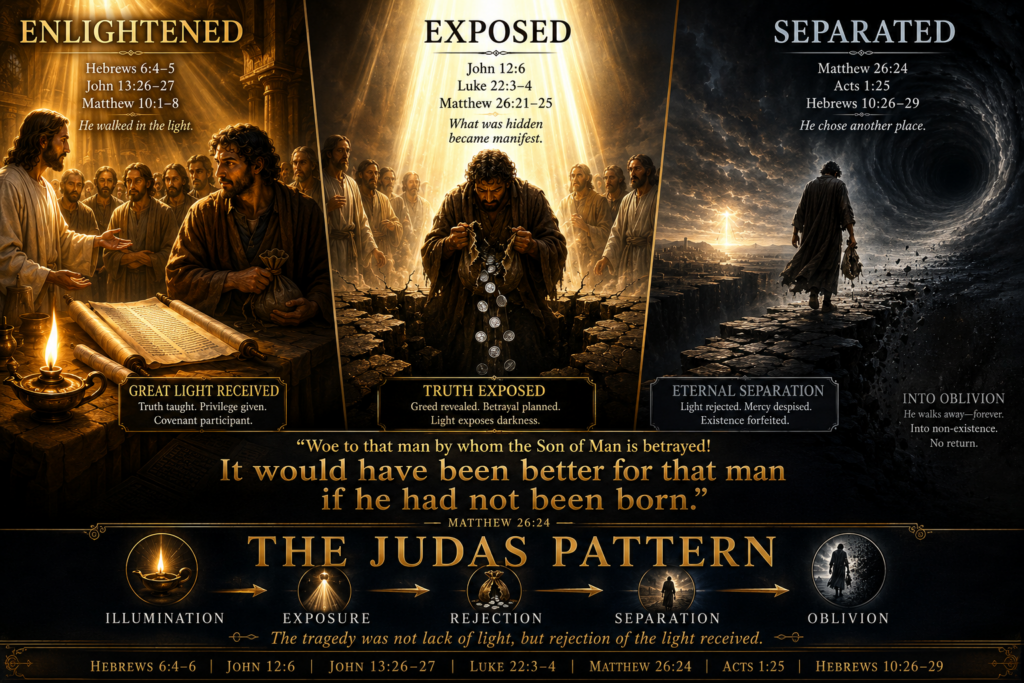
“Jesus’ words about Judas make sense only when understood spiritually: entering the life He gives and then turning away from it is a greater loss than never entering that life at all.”
Matthew 26:24 “The Son of Man goes as it is written about Him, but woe to that man who betrays the Son of Man. It would have been good for that man if he had not been born.”
Once we understand that Jesus was speaking about spiritual birth, His meaning becomes clear.
Judas entered the life Jesus gave, received real spiritual light, and then turned away from it.
Losing that life is a greater tragedy than never entering it at all.
This is the force of Jesus’ statement. He is evaluating two possible paths:
- entering spiritual life and later abandoning it
- never entering spiritual life in the first place
The first path carries a far greater loss.
If Jesus were speaking about physical birth, His words would not make sense.
Physical life is a gift.
Even an unbelieving life contains goodness, relationships, joy, and the grace God gives to all people.
Non‑existence has no consciousness, no suffering, and no awareness.
Living an unbelieving life is still better than never having been born.
Only the loss of the life of Christ — betrayal — is worse than never having lived at all.
Even unbelievers experience meaningful lives filled with relationships, joy, and the goodness God gives to all people — their lives simply do not continue into eternity.
Never having been born would not be better than living an unbelieving life.
But receiving the life Jesus gives and then turning away from it is a greater loss than never entering that life at all, Rev 18:23.
Jesus’ statement only becomes coherent when applied to spiritual birth.
Judas received the life of Christ and then rejected it, and that loss is the only condition Jesus describes as worse than never having lived — because Christ in you, the hope of glory, once received and then abandoned, is the greatest loss a soul can experience.
Introduction
Jesus’ statement about Judas — “It would have been better for that man if he had not been born” — is one of the most sobering lines in Scripture.
But it is also one of the most misunderstood.
Many assume Jesus is speaking about Judas’s physical birth, but this cannot be the case.
Physical life, even for an unbeliever, is always treated in Scripture as a gift filled with joy, relationships, meaning, and the goodness God gives to all people.
Jesus’ words only make sense when understood in terms of Judas’s spiritual birth and life, not his physical existence.
Judas once received real spiritual light. He entered the same spiritual life the other disciples shared. He walked with Jesus, believed His words, and participated in the work of the kingdom.
His tragedy is not that he lived a human life, but that he received spiritual life and later abandoned it.
1. The Believer’s Struggle Is Better Than the Unbeliever’s Peace
A person who receives spiritual life enters a process of cleansing and transformation.
This process can be difficult, but it is meaningful and purposeful.
It shapes the soul, increases capacity for God, and leads toward glory.
This is the grace of God teaching believers to deny ungodliness, Titus 2:11-12.
An unbelieving life may feel peaceful, but it lacks transformation.
This does not mean unbelief is truly peaceful — Scripture shows that unbelief carries an inner hostility toward God (Gen 3:15), a reality explored more fully in my pages on Gog, Magog, and the inner battle of Armageddon.
Why Unbelief Is Never Truly Peaceful
Unbelief is never peaceful. Scripture teaches that the Day of the LORD is always near upon the unbeliever (Obad 1:15), and they continually reap what they have sown under the influence of hostile spirits.
That same hostility surrounds God’s people and becomes the pressure through which the Day of the LORD reaches them as well — but for believers the judgment is tempered by Christ, applied not for destruction but for covenant confirmation (Dan 9:27) and correction (1 Cor 11:32).
Revelation 20:9 portrays this dual reality: the unbelieving world “surrounds” the saints, and in that moment both groups reap what they have sown — unbelievers in untempered judgment, believers in Christ‑governed discipline — while some unbelievers are simultaneously exposed to the gospel.
This is why the apparent quietness of unbelief is deceptive.
It produces nothing that lasts.
The struggle of spiritual life is always better than the quietness of unbelief, because the struggle is temporary and the life is eternal.
2. Judas entered the life Christ gives and then abandoned it, and that abandonment is what makes his final state so severe.
Judas received spiritual life. He walked in the light, shared in Jesus’ ministry, and tasted the reality of the age to come.
He began the cleansing process, but he turned away from it.
He abandoned the life he had received.
This makes his case unique. He experienced the beginning of spiritual transformation, but did not continue in it.
His final condition is worse than if he had never entered spiritual life at all.
This is the point Jesus is making.
3. Why Jesus’ Words Cannot Refer to Judas’s Physical Birth
Jesus was not speaking about Judas’s physical existence.
Human life, even without faith, is still a gift.
It includes relationships, joy, and the goodness God gives to all people.
A person who never receives spiritual life loses nothing eternal. The natural man cannot understand that the concepts of Eternal life in Christ are real. Their life ends as it began, in non-existence.
Judas’s situation is different.
He received spiritual life and then turned away from it.
This loss is far more serious than anything related to physical birth.
Jesus’ statement only makes sense when applied to Judas’s spiritual life, not his physical one.
4. The Only Birth Whose Loss Can Explain Jesus’ Words
The only “birth” whose loss could make Jesus’ statement true is spiritual birth.
Judas believed, was enlightened, tasted the Spirit, and entered the life of Christ.
Losing that life is more tragic than never having received it.
This matches the pattern found in passages like Hebrews 6 and 2 Peter 2, where the loss of spiritual life is described as a condition worse than the beginning.
Jesus’ words fit this pattern exactly.
5. The Logic in One Clear Line
It is better to receive spiritual life and struggle through the transformation, and into the Image of Christ (learning to deny Ungodliness, Titus 2:11-12) than to live peacefully without this confirmation process (Dan 9:27) and dwell in unbelief.
Daniel 9:27 in the following linked page explains the Believer’s covenant confirmation per Ezekiel 20:37.
Ezekiel 20:37 KJV — And I will cause you to pass under the rod, and I will bring you into the bond of the covenant:
Conclusion –
Jesus’ words about Judas make sense only when understood spiritually.
Physical life is a gift.
Ordinary unbelief is not worse than non-existence.
But receiving spiritual life and then abandoning it is a tragedy greater than never having received faith.
Judas’s story is not about the value of physical birth.
It is about the seriousness of spiritual birth.
Jesus’ statement shows that Judas truly received spiritual life and later turned away from it.
The loss of that life — not physical existence — is the only condition Scripture describes as worse than never having lived.