🕒 9 min read · 📝 1719 words
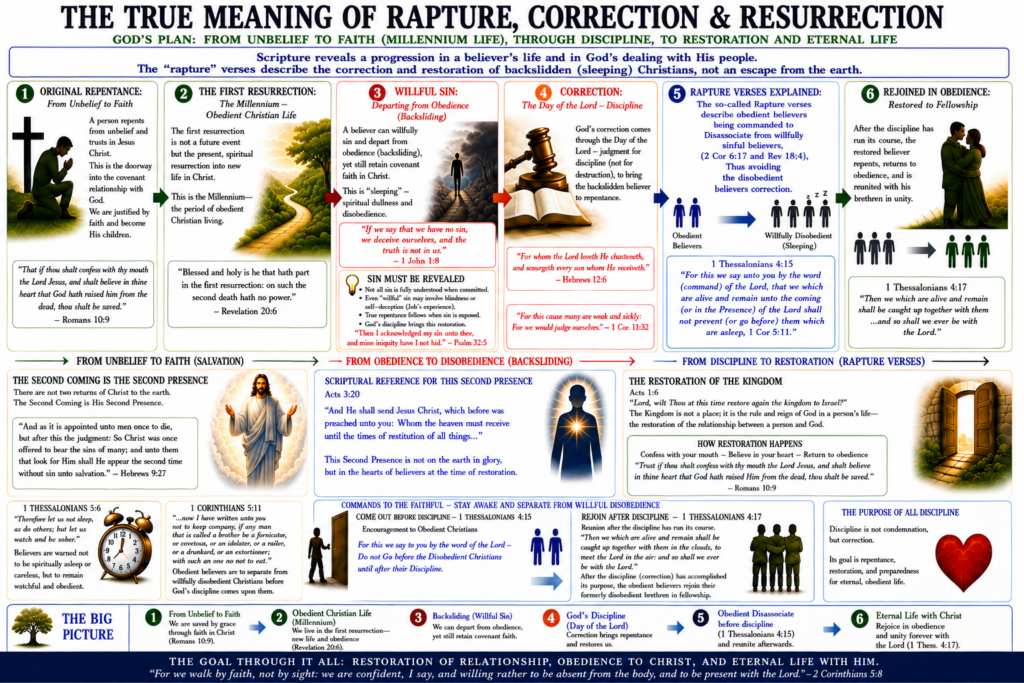
Daniel 9:27 depicts a symbolic week of covenant confirmation that takes place throughout the life of every believer.
Jesus summed up our covenant with God by teaching us to love God and love our neighbor, as recorded in Matthew 22:36-40.
Ezekiel 20:37 says that God will cause us to pass under the Rod and bring us into the bond of the covenant.
These two verses explain what is happening during Daniel’s 70th week.
The first 1,260 days of Daniel’s 70th week represent a season of covenantal obedience (when we sin we recognize and confess it, 1Jn 1:9) — the same symbolic period Revelation depicts as the Millennium.
The turning point comes when “the sacrifice ceases”: the believer stops confessing sin, enters willful disobedience, and no longer recognizes that particular sin as being sinful.
In willful sin, the believer is outside the bond of covenant obedience, and only God’s judgment can bring them back.
This is seen in 2 Thess 2:8, where the wickedness in the Man of sin is brought to an end by the presence of the Lord.
The Man is cleansed of the wickedness.
When a believer enters willful sin, they step out of the obedience‑blessing structure of Deuteronomy 28 and into the discipline‑curse structure of the covenant until God restores them.
Hebrews 10:26 makes it clear that if someone deliberately chooses to sin, there’s no sacrifice left for them—only the expectation of judgment.
They then begin the corrective process God has designed to bring them back into the covenant.
This process of judgment teaches a person to deny ungodliness (Titus 2:11-12) and brings them back into the bond of the covenant.
2Th 2:12 (ASV) that they all might be judged who believed not the truth, but had pleasure in unrighteousness.
It begins with God sending delusion to the Man of sin, as 2 Thess 2:11-12 says.
This is God’s response to the willfulness and the believer’s sinful persistence.
It marks the beginning of the Day of the Lord in a person’s life.
In this state, the individual believer stops recognizing and confessing a particular sin (1 Jn 1:9) as being sinful; the sin has then become willful Heb 10:26.
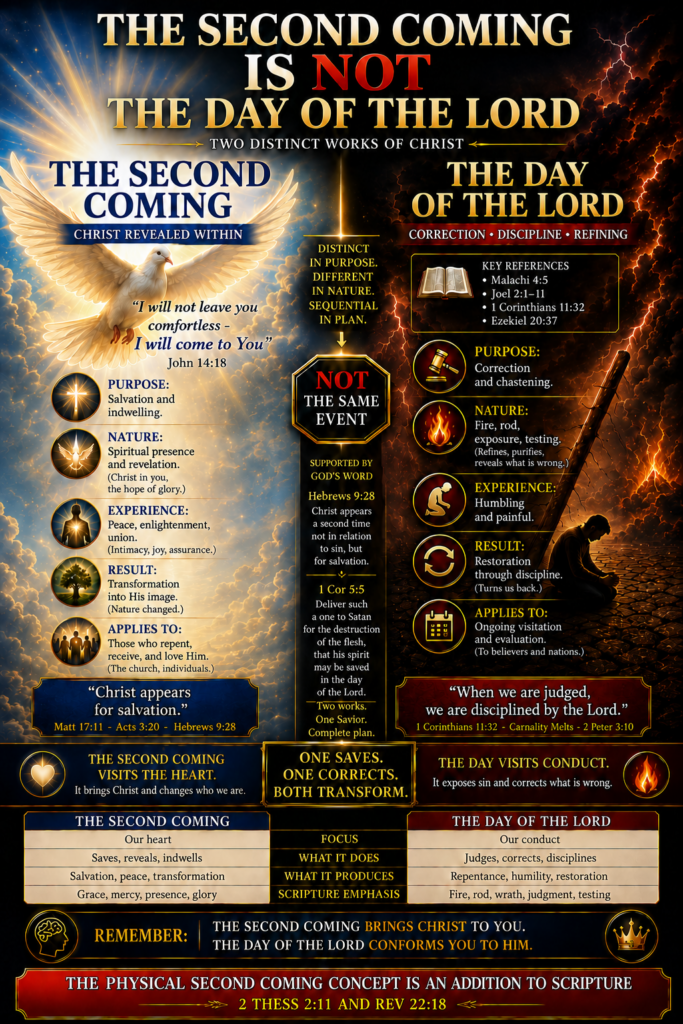
God’s judgment, meant for cleansing, comes after such willful sin, as noted in 1 Corinthians 11:32 and 2 Peter 3:10.
In 2 Peter 3:10, the elemental/carnal things in the person’s life melt during the judgment called the Day of the Lord.
Paul summarized the Day of the Lord this way – 1Co 5:5 To deliver such an one unto Satan for the destruction of the flesh, that the spirit may be saved in the day of the Lord Jesus.
This Judgment/Day of the Lord constitutes the second half of Daniel’s 70th week.
The first half of Daniel’s 70th week represents covenant obedience—the “millennium” season of faithfulness.
Hebrews 10:26 marks the midpoint, where willful sin causes the sacrifice to cease.
The second half of the week corresponds to the Day of the Lord, the season of divine discipline described in Joel 1:15.
This brings judgment intended for correction (1 Cor 11:32), and God brings the person back into the bond of the covenant.
It is important to remember that this page illustrates how God teaches His people to deny ungodliness (Titus 2:11–12).
Every believer is already experiencing these covenant dynamics in daily life, as God continually works to draw His people further into His kingdom. Bringing them into the bond of the covenant.
He surrounds them with unbelievers, with opposing influences, and with the spiritual forces that motivate those around them — all as the circumstances require — to expose, correct, refine, and mature His own people.
Pr 16:7 ¶ When a man’s ways please the LORD, he maketh even his enemies to be at peace with him.
(KJV)
The images on this page begin at that midpoint after the first 1260 days have elapsed and the person becomes willfully sinful; this is when the sacrifice ceases — that is, when the continual confession/sacrifice of 1 John 1:9 stops and willful sin takes hold.

Infographic of the second half of Daniel’s 70th week, illustrating the 1260 days of willful sin and personal blasphemy after the sacrifice ceases (Heb 10:26), leading into the 1290‑day abomination point where hardening occurs and Jesus’ call to separate becomes applicable. Christians are not told to separate before the 1290‑day proclaimation point; separation is never encouraged during ordinary willful sin, but only after the carnal believer begins publicly professing the distorted, delusional doctrinal position.
As this willful rebellion continues and reaches the 1,290‑day point, Jesus identifies it as the abomination that brings desolation (Matthew 24:15).
From there, the path divides: either desolation results, or the believer reaches the blessing at the 1,335‑day mark. The person then continues toward the 2,300‑day point, where the sanctuary or person is cleansed.
Revelation’s three‑woe pattern illustrates this escalating discipline. In the first woe, God permits affliction but not spiritual death, as seen in Job. In the second woe, the possibility of spiritual death — the loss of faith — emerges. In the third woe, faith is finally extinguished, fulfilling the warning of Revelation 18:23.
The numbers illustrated below from Daniel began as pictographic images that expressed concepts. Over time, the pictographs evolved into letters, and only later were numerical values assigned to those letters. Thus, the numbers in Daniel reflect concept‑letters that eventually received numeric values.
This model does not suggest that Daniel consciously drew or encoded ancient pictographs.
Rather, it recognizes that the Hebrew number‑words Daniel used were built from letters whose conceptual meanings originated in pictographic forms.
When Daniel employed symbolic number‑words such as 1290, 1335, and 2300, the concepts from which the numbers originated symbolized movements towards an end result.
The pictographs presented on this page reflect the concepts embedded in the language Daniel used.
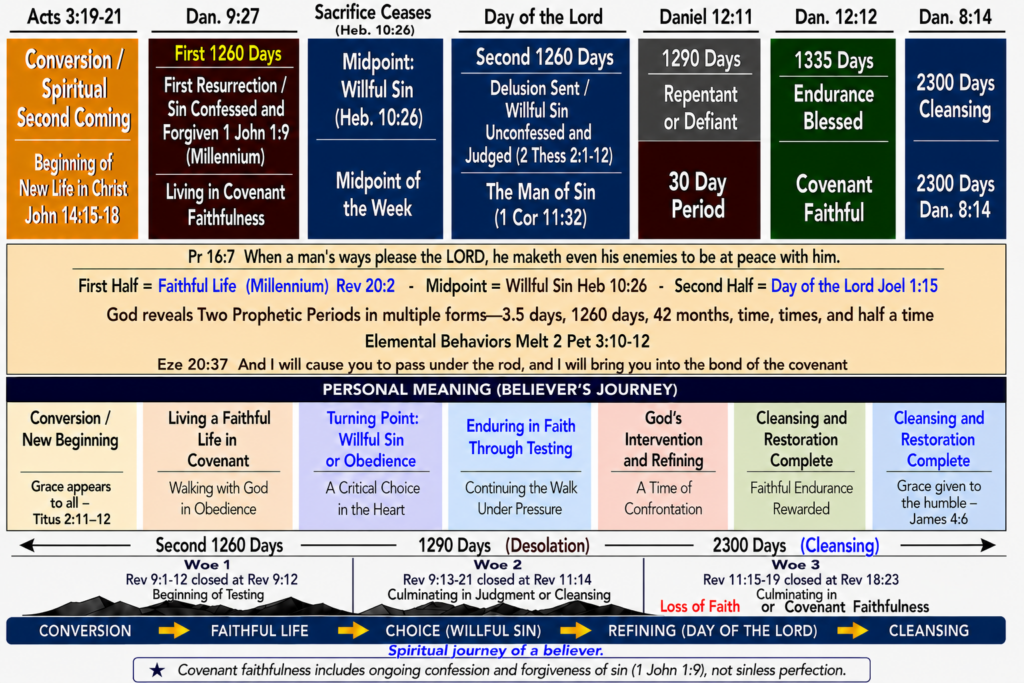
The original conceptual meanings of the Hebrew number‑letters — first expressed through ancient pictographs — are reflected in the illustrations below.
They clarify the purposes of God expressed by the numbers through pictographic images.
Daniel wrote in square Hebrew script, but the number‑words he used still carried the ancient pictographic meanings from which the Hebrew letters originally developed. These images are conceptual aids.
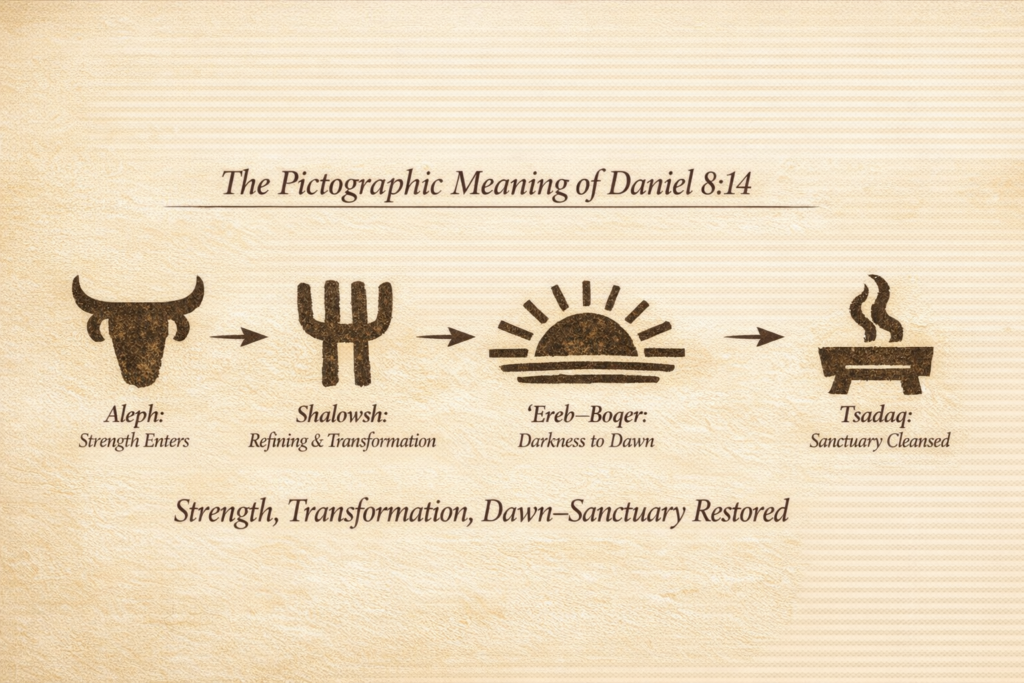
Daniel 8:14 (KJV) Unto two thousand and three hundred days; then shall the sanctuary be cleansed.
Both of these illustrations symbolize the time after the sacrifice ceases and God enters to refine and cleanse.
Dan 12:11-12, illustrated below, expands upon this flow a little more.
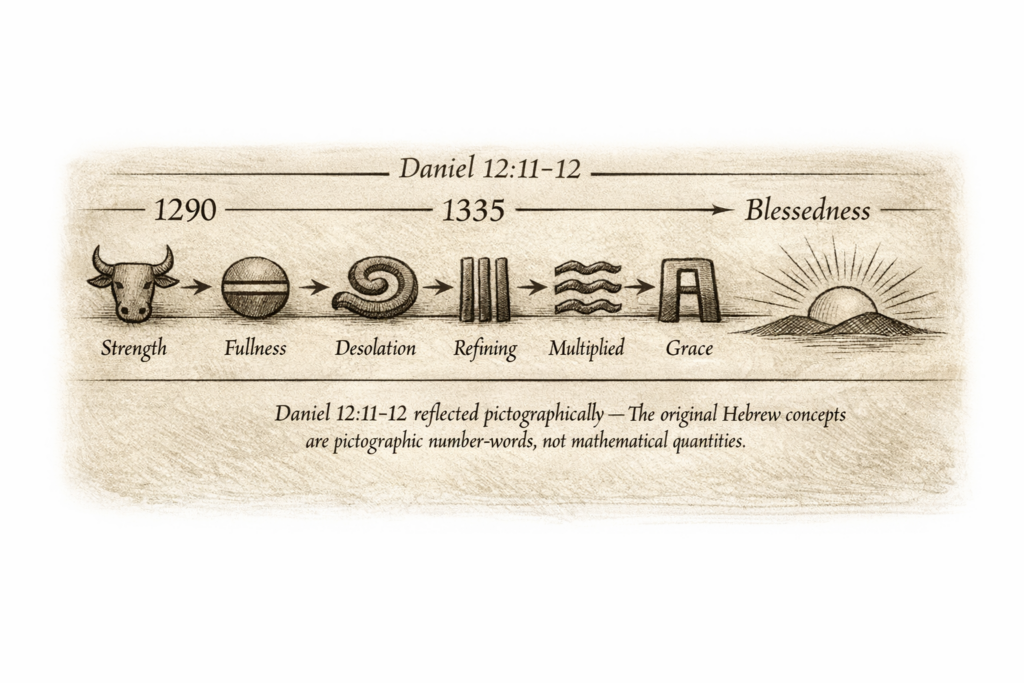
Daniel 12:11 (KJV) From the time that the daily sacrifice shall be taken away, and the abomination that maketh desolate set up, there shall be a thousand two hundred and ninety days.
Daniel 12:12 (KJV) Blessed is he that waiteth, and cometh to the thousand three hundred and five and thirty days.
Both arcs start at the midpoint of Daniel’s 70th week, marking the beginning of the period the Bible refers to as “The Day of the Lord.”
The Day of the Lord is a period of discipline after willfully sinful behavior, and God’s strength enters to deal with and remove it from the believer’s life, per 1 Cor 11:32.
This means that the two illustrations starting with Aleph (God’s strength) represent the Day of the Lord cleansing the sinful man from wicked behavior.
Just as a quick aside – Matthew 24 and 1 Thess 4 also pertain to the Day of the Lord.
Both Jesus and Paul suggest that obedient Christians should separate themselves from disobedient Christians when the disobedience reaches the 1290-day point, or what Jesus refers to as the abomination which brings desolation, Matt 24:15 and Daniel 9:27.
Da 9:27 And he shall confirm the covenant with many for one week: and in the midst of the week he shall cause the sacrifice and the oblation to cease (Heb 10:26), and for the overspreading of abominations he shall make it desolate, even until the consummation (until the willful sin is consumed), and that determined shall be poured upon the desolate (believer).
This is seen in Matt 24, where obedient Christians are told to flee to the mountains, and in 1 Thess 4:15.
In 1 Thess 4:15, obedient Christians are told not to “go before” willfully sinful (sleeping) brethren until they are revived by the Lord in 1 Thess 4:17. The sleepers/dead in Christ rise in 16 and then are reunited with the obedient believers in 4:17.
1Th 4:15 (BBE) For this we say to you by the word of the Lord, that we who are still living at the coming of the Lord, will not “go before” those who are sleeping.
This small addition to the page will be a departure from traditional understanding, but is none the less true.
Paul also comments on this in 1 Cor 5:11.
1Co 5:11 But now I have written unto you not to keep company, if any man that is called a brother be a fornicator, or covetous, or an idolater, or a railer, or a drunkard, or an extortioner; with such an one no not to eat.
This clearly shows the depth of delusion within the body of Christ as Jesus works to rouse them from their slumber.