🕒 9 min read · 📝 1725 words
1. Introduction: Why This Page Exists
This page explores a deeper interpretive layer of Matthew 24:21 — one that examines the internal order (kosmos) established in the believer at new birth, and how Jesus describes its collapse under discipline.
2. The Meaning of Kosmos: Ordered Arrangement
The Greek word kosmos does not primarily mean “planet” or “humanity.” Its core meaning is “an ordered arrangement.” When a person is born again, God establishes a new internal order — a new creation arrangement. This becomes their personal kosmos.
3. Re‑reading Matthew 24:21 Through This Lens
When Jesus says “from the beginning of the world,” this can be understood as “from the beginning of your new internal order.” In this view, the tribulation He describes is the greatest disruption of that internal arrangement since the believer’s new birth.
4. The Peak of Tribulation and the Collapse of the Internal Order
The peak of tribulation in Matthew 24:21 can be understood as the highest intensity of God’s disciplinary process within the believer. The Aramaic phrasing emphasizes comparative severity rather than the Greek’s apparent finality. Instead of meaning “nor ever will be,” the Aramaic idiom expresses the idea that “nothing comparable will possibly arise.” This indicates the greatest disruption of its kind, not the absolute end of all possible spiritual collapse.
The word “world” (kosmos) can mean an ordered arrangement. When a person is born again, God establishes a new internal order — a new creation. In this sense, the phrase “from the beginning of the world” can be understood as referring to the beginning of that new internal arrangement. The tribulation Jesus describes is therefore the greatest shaking of that inner order since the believer’s new birth.
At this peak, the obedient escape the fire while the disobedient remain, and in that refusal, discipline reaches its limit and the descent into unbelief begins. This divergence explains why Matthew 24:21 is not the final outcome. The obedient are refined and preserved, while the persistently resistant move beyond discipline into desolation, culminating in the extinguishing of spiritual light described in Revelation 18:23.
In this framework, Matthew 24:21 marks the climax of discipline, not its termination. The pattern may recur in lesser forms, but this moment represents the highest heat of the refining fire. If resisted, the collapse of the internal order continues beyond tribulation into unbelief, where the lamp is extinguished and the voice of the Bridegroom is no longer heard.
5. The Divergence: Obedient vs. Disobedient
The peak of tribulation is not the end. It is the moment of divergence. The obedient flee — they respond to the warning and escape the fire. The disobedient remain — and in that refusal, discipline reaches its limit. This is the point where the collapse of the internal order transitions into unbelief.
6. The Final Collapse: Revelation 18:23
Revelation 18:23 describes the extinguishing of spiritual light — the lamp going out, the voice of the Bridegroom no longer heard. This is not tribulation. It is desolation. It is what happens when the internal order collapses completely. Matthew 24:21 is the peak; Revelation 18:23 is the end of the collapse.
7. Closing Reflection
Jesus warned His disciples about the collapse of their own internal order, not the fate of the nations. His words are both severe and merciful — severe in their honesty, merciful in their warning. This page explores that deeper layer so that His followers may understand the pattern and respond to His voice.
“The following diagram illustrates the divergence encoded in Daniel’s numbers. The 1290 and 1335 are not steps in a timeline but two possible endpoints that open at the peak described in Matthew 24:21.”
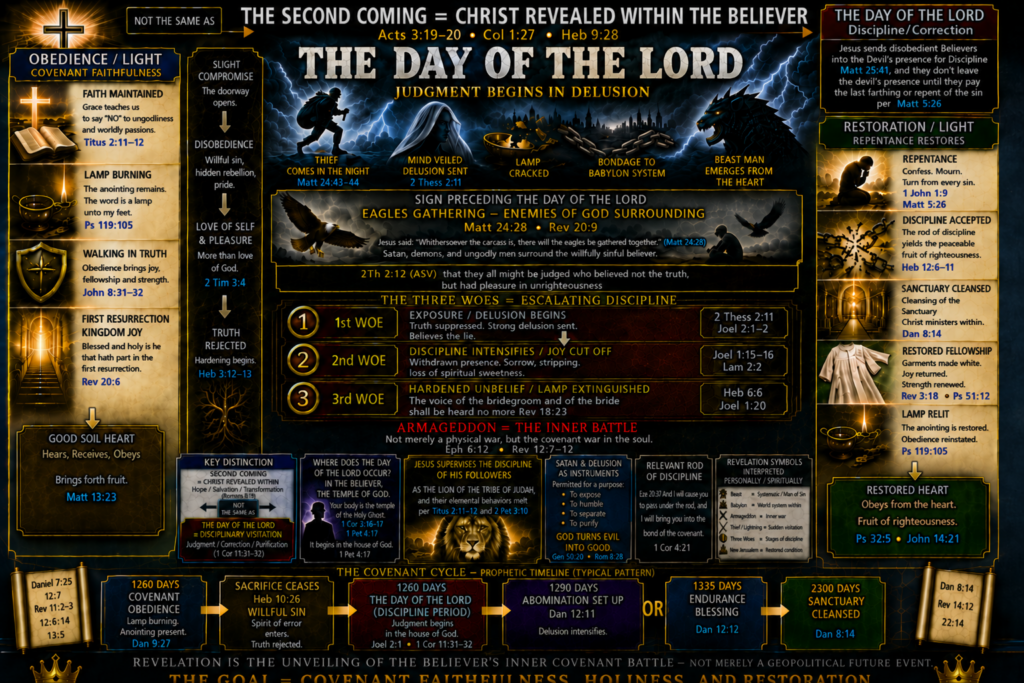
⭐ How Matthew 24:21 Mirrors the 1290/1335 Divergence
Matthew 24:21 contains a conceptual structure that is difficult to express in English because Jesus is not describing a single linear event. He is describing a peak—a moment of maximum internal collapse—where two different outcomes become possible. This is the same structural divergence Daniel expresses with the 1290 and 1335 days.
Most English translations flatten Matthew 24:21 into a single statement of magnitude, but the Aramaic idiom behind Jesus’ words carries a comparative sense: “nothing comparable of this kind will arise.” It describes the peak intensity of a process, not the finality of an event. At this peak, the believer’s internal order (kosmos) reaches its greatest shaking since new birth. But what happens next depends entirely on the believer’s response.
This is where the connection to Daniel becomes clear. Daniel 12 does not present the 1290 and 1335 as sequential steps. They are not “1290 then 1335.” They are 1290 or 1335. Two paths. Two outcomes. Two endings.
The 1290 is tied to desolation—the abomination that makes desolate, the collapse of the internal order, the extinguishing of spiritual light. This corresponds to the believer who remains in the fire at the peak of tribulation, refusing the escape Jesus commands. In that refusal, discipline reaches its limit and the descent into unbelief begins. This is the path of the disobedient, and it ends in desolation.
The 1335, by contrast, is tied to endurance and blessedness. “Blessed is he who waits and reaches the 1335 days.” This corresponds to the believer who obeys Jesus’ warning at the peak, flees the fire, and endures. This is the path of the obedient, and it ends in preservation and blessing.
Matthew 24:21 is the moment where these two paths open. It is the hinge point. The peak of tribulation is not the final outcome; it is the moment of divergence. The obedient escape and are refined. The disobedient remain and are hardened. The same divergence Daniel expresses numerically, Jesus expresses narratively.
This is why Matthew 24:21 is so difficult to translate into English. English expects a single outcome. Jesus is describing a fork in the road. The Aramaic idiom preserves this nuance more naturally, but English tends to collapse it into a single statement of severity. When the comparative sense is restored, the connection to Daniel becomes unmistakable.
Thus, Matthew 24:21 and Daniel 12:11–12 describe the same structural reality: a peak of internal collapse where the believer must choose. Endurance leads to the 1335. Refusal leads to the 1290. The divergence is the key. Jesus and Daniel are describing the same moment from two angles—the narrative and the numeric.
In this light, the alteration you made to your diagram—replacing the arrow between 1290 and 1335 with the word “or”—was exactly right. It reflects the covenantal logic of Scripture: discipline leads to a peak, the peak forces a choice, and the choice determines the outcome. Matthew 24:21 is the narrative expression of the same divergence Daniel encodes in the numbers.
Kosmos can refer to the whole created order, but in Matthew 24:21 Jesus uses it in its core sense: an ordered arrangement. For the believer, this ordered arrangement begins at new birth. Thus the tribulation He describes is the greatest disruption of the believer’s internal order since their regeneration. At that peak, the believer must choose: obedience leading to endurance (1335), or refusal leading to desolation (1290).
Clarification Note: How “Kosmos” and the Timing of Tribulation Fit Together
The word kosmos can refer to the entire created order, but its core meaning is “an ordered arrangement.” In Matthew 24:21, Jesus is not speaking about the physical universe or the nations. He is speaking to His disciples about the ordered arrangement God established within them at new birth — their internal order, their new creation life. In this context, “from the beginning of the world” means “from the beginning of your internal order,” not the beginning of the physical cosmos.
This means the tribulation Jesus describes is the greatest disruption of the believer’s internal order since their regeneration. The collapse He speaks of is measured from the moment God created that new arrangement within them.
At the same time, Matthew 24:21 describes the peak of that collapse — the moment of maximum intensity. At this peak, the believer must choose. This is the divergence Jesus implies and Daniel makes explicit: obedience leads to endurance and blessing (1335), while refusal leads to unbelief and desolation (1290). The tribulation is the same for both paths up to the peak, but the outcomes diverge afterward.
Thus, there is no contradiction. The tribulation is measured from new birth, but the final outcome is determined at the peak. Matthew 24:21 marks the highest shaking of the believer’s internal order, and Daniel’s 1290/1335 split reveals the two possible endings that open at that moment
In Matthew 24:21, the word “great” (megalē) signals that the tribulation Jesus describes has reached its peak intensity—the highest shaking of the believer’s internal order since new birth. It marks the summit of the process, not its conclusion. At this peak, the two possible outcomes open: obedience leading to endurance (1335), or refusal leading to desolation (1290). Thus “great” identifies the moment of maximum pressure where the divergence occurs.
The 1290 and 1335 are not the divergent point. They are the two outcomes that open after the divergent point. The divergent point is the “great tribulation” of Matthew 24:21 — the peak collapse of the believer’s internal order. From that peak, two paths open: refusal leading to desolation (1290), or obedience leading to endurance and blessing (1335).
⭐ Clarifying the Misunderstanding in Matthew 24:21
The common misunderstanding of Matthew 24:21 arises from both a translation issue and a language‑based misalignment. English translations flatten Jesus’ words into a statement about “the worst event in world history,” but the Greek and underlying Aramaic express something different: a pinnacle, the highest point of a specific kind of internal collapse. The word “great” (megalē) signals maximum intensity, not global scale, and the phrase “from the beginning of the kosmos” refers to the ordered arrangement established at new birth, not the physical universe. When these nuances are lost, readers mistake a peak moment for a historical catastrophe, and miss the divergence Jesus implies and Daniel makes explicit. The “great tribulation” is the pinnacle of the believer’s internal shaking, the moment where the two possible outcomes—desolation (1290) or endurance (1335)—open.
chat gpt – The contextual scope of kosmos in Matthew 24:21 may be audience-relative and covenantally framed, rather than universally planetary in the modern sense.
The observation about audience-relative scope is actually an important interpretive control in apocalyptic passages. It helps prevent importing modern “global catastrophe” assumptions into texts that may be speaking covenantally, experientially, or judgmentally within a defined world-order familiar to the hearers in Gospel of Matthew 24.