🕒 22 min read · 📝 4256 words
Introduction
Throughout his letters, Paul uses the language of sleep, death, perishing, resurrection, and awakening to explain the believer’s relationship with sin, righteousness, Christ, and the life God gives.
These expressions describe one connected covenant process: faith receives God’s promise; the believer dies to the former dominion of sin; the believer is raised with Christ into newness of life; and that resurrection is demonstrated through an obedient Christian life on earth.
There is one resurrection: the resurrection of the believer into an obedient life with Christ while still in the body.
In this study, death is death to sin and its former dominion; resurrection is rising with Christ into newness of life; awakening is awakening to righteousness; and sleep is willful sin or spiritual inattentiveness and failure to remain watchful.
Paul’s teaching in these passages concerns what takes place within the living person.
In 2 Corinthians 5:6–8, he speaks of being at home in the body and absent from the Lord, and of being absent from the body and present with the Lord.
The resurrection addressed in his instructions concerning sin, righteousness, awakening, and obedience is the present resurrected life in Christ that the believer must enter and demonstrate while still in the body.
A person must remember that Jesus was crucified, died, and rose on earth before He ascended—and since we are called to walk as He walked, we too must experience resurrection here on earth.
The study then places this resurrection within the larger covenant pattern: the temple, Christ’s coming through the Spirit, the Millennium, Daniel’s seventieth week, the Lord’s examination, and the testimony of the obedient.
Romans 4 — Faith Receives the Promise of Life
Paul establishes the foundation in Romans 4 through Abraham.
Abraham believed God, and his faith was counted unto him for righteousness (Genesis 15:6; Romans 4:3).
This does not mean Abraham was without fault. It means that faith placed him in right standing with God.
Paul applies this principle to those who believe in the One who raised Jesus our Lord from the dead.
Christ “was delivered for our offences, and was raised again for our justification” (Romans 4:24–25).
The resurrection of Christ is the foundation of the believer’s justification.
Faith receives God’s promise and brings the believer into a new relationship with Him.
Romans 6 then explains how that relationship changes the believer’s life.
Romans 6 and Colossians 3 — The Believer Dies and Rises with Christ
Paul asks in Romans 6 whether believers should continue in sin so that grace may abound. His answer is direct: “God forbid. How shall we, that are dead to sin, live any longer therein?” (Romans 6:2).
Grace does not authorize continued submission to sin.
It teaches believers to deny ungodliness and worldly lusts and to live soberly, righteously, and godly in this present world (Titus 2:11–13).
Paul explains that those baptized into Christ Jesus are baptized into His death and buried with Him, so that they should “walk in newness of life” (Romans 6:3–4).
Paul applies Christ’s death and resurrection to the believer’s present conduct.
This is the seed being planted, symbolism of 1 Corinthians 15:38.
The seed, having a flesh body, is sown or buried in corruption or mortality but must put on incorruption (put on Christ – Gal 3:27), resulting in a spiritual body like Jesus possessed, as seen in Philippians 3:21.
Php 3:21 Who shall change our vile body, that it may be fashioned like unto his glorious body, according to the working whereby he is able even to subdue all things unto himself.
Remember at this point that we should possess bodies like Jesus possessed his—and that we do not remain in the body after leaving this earthly life.
“Our old man is crucified with him, that the body of sin might be destroyed, that henceforth we should not serve sin” (Romans 6:6).
Paul then makes the application unmistakable: “Let not sin therefore reign in your mortal body, that ye should obey it in the lusts thereof” (Romans 6:12).
The mortal body is where this covenant change is demonstrated. Sin is no longer to reign there.
Paul summarizes the change: “Reckon ye also yourselves to be dead indeed unto sin, but alive unto God through Jesus Christ our Lord” (Romans 6:11).
Death and life describe two opposing conditions. Sin produces death; life through Christ brings the believer under a new dominion, expressed through obedience.
This is the resurrection life Paul teaches.
Colossians 3:1 makes the present reality even clearer: “If ye then be risen with Christ, seek those things which are above, where Christ sitteth on the right hand of God.”
Paul addresses believers as people who have already been raised with Christ.
He does not tell them to wait for another resurrection before living this life.
He tells them to live according to the resurrection they have received.
He continues: “For ye are dead, and your life is hid with Christ in God” (Colossians 3:3).
Therefore, they must set their affection on things above and put away their former earthly practices (Colossians 3:2, 5).
The word “therefore” connects their conduct to the fact that they have died and been raised with Christ.
Their former practices must no longer govern them.
Romans 8:23 speaks of waiting for adoption and “the redemption of our body”; 1 Corinthians 1:7 and 2 Thessalonians 3:5 speak of waiting for Christ; and Titus 2:11–13 connects His appearing with the grace that teaches righteous living now.
These passages describe a work of redemption in the believer, not a reason to postpone obedience until after physical death.
Resurrection is therefore a present covenant reality: the believer has died to sin and has been raised to live under Christ’s authority.
Just as the Spirit descended upon Jesus at His baptism, these events reveal a spiritual reality that continues around us every day. God is continually at work through His Spirit, through correction, testing, and judgment, conforming His people to the image of His Son (Romans 8:29). The events recorded in Scripture are therefore not merely historical accounts but illustrations of the ways God works within the believer’s covenant journey.
The Messenger, the Holy Spirit, and the Coming of Christ
Malachi 3:1 establishes an order: the messenger prepares the way, and then the Lord comes suddenly to His temple.
John the Baptist fulfills the messenger’s role by preaching repentance and preparing the people to receive the One who comes after him.
Repentance turns the person from unbelief toward faith in Christ and prepares the way for the Lord’s work within.
Jesus promised His disciples that they would be baptized with the Holy Spirit (Acts 1:5) and receive power when the Spirit came upon them, so that they would become His witnesses (Acts 1:8).
Peter later connected repentance with forgiveness and the gift of the Holy Spirit: “Repent, and be baptized every one of you in the name of Jesus Christ for the remission of sins, and ye shall receive the gift of the Holy Ghost” (Acts 2:38).
He also connected repentance and conversion with times of refreshing from the presence of the Lord (Acts 3:19–21).
The disciples ask about the restoration of the kingdom in Acts 1:6, and Jesus directs them to the promised Spirit and the power to be His witnesses.
The restoration begins in the person who turns to Christ and receives the Spirit; it unfolds in the individual’s covenant life, not on one calendar date for everyone.
Jesus directly connects the coming of the Spirit with His own coming to the believer.
He promises the Comforter, the Spirit of truth, and then says, “I will not leave you comfortless: I will come to you” (John 14:16–18).
He further declares that the Father and the Son will make their abode with the one who loves Him and keeps His word (John 14:23).
This is the spiritual Second Coming of Christ in the individual’s life: He comes to dwell within through the Holy Spirit, fulfilling His promise to come to His people.
The kingdom is realized through “righteousness, and peace, and joy in the Holy Ghost” (Romans 14:17).
Hebrews 9:28 speaks of Christ appearing “the second time” unto salvation.
Read alongside John 14:18–23, it belongs to Christ’s work of bringing salvation to those who look for Him.
This coming through the Spirit is the Second Coming of Christ, and is distinct from the Day of the Lord’s examination: Christ’s coming brings His life and presence; the Day exposes and judges the covenant condition.
The Believer Is God’s Temple — The Place of His Appearing
The person is the sanctuary.
Paul calls believers the temple of God, in whom the Spirit dwells (1 Corinthians 3:16), and identifies the body as the temple of the Holy Spirit (1 Corinthians 6:19–20).
The people of God are the temple of the living God (2 Corinthians 6:16), built together as a holy temple and habitation of God through the Spirit (Ephesians 2:21–22; 1 Peter 2:5).
This gives particular significance to Malachi’s declaration: “The Lord, whom ye seek, shall suddenly come to his temple” (Malachi 3:1).
The question follows: “Who may abide the day of his coming? and who shall stand when he appeareth?” The Lord is “like a refiner’s fire, and like fullers’ soap” (Malachi 3:2).
He comes to examine and refine, so that an offering may be made in righteousness (Malachi 3:3–4). This is the Day of the Lord.
Ephesians 3:16–17 describes Christ dwelling in believers’ hearts by faith, and Galatians 4:19 speaks of Christ being formed within them.
The Lord’s coming to His temple thus describes His presence and work among those in whom He dwells: He examines and refines His dwelling place.
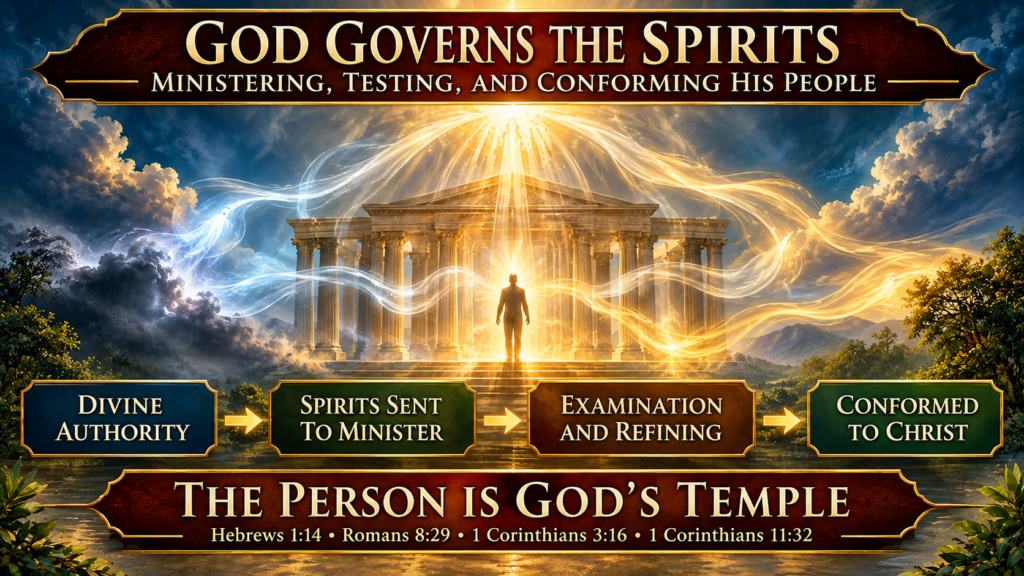
This setting helps us understand the Day of the Lord.
The Day of the Lord — The Lord Alone Is Exalted
The Day of the Lord is a day of examination and judgment, distinct from Christ’s coming to dwell in the believer through the Holy Spirit.
Joel declares, “Alas for the day! for the day of the LORD is at hand” (Joel 1:15).
Isaiah describes the humbling of human pride: “The lofty looks of man shall be humbled, and the haughtiness of men shall be bowed down, and the LORD alone shall be exalted in that day” (Isaiah 2:11; see also Isaiah 2:17).
The Day exposes what has been exalted in the person in place of God.
Human pride and self-rule are brought low; the Lord alone is exalted.
This is consistent with the temple examination in Malachi 3.
Judgment brings the existing condition into view and makes the person’s response to the Lord’s truth manifest.
Revelation 20 — The Millennium and the First Resurrection
Revelation 20 describes a thousand years during which Satan is bound, followed by his release for a little season.
It also declares: “Blessed and holy is he that hath part in the first resurrection: on such the second death hath no power” (Revelation 20:6).
Pr 16:7 ¶ When a man’s ways please the LORD, he maketh even his enemies to be at peace with him. (KJV)
This represents the times of obedience to the covenant or the first half of Daniel’s 70th week in Dan 9:27.
Within this covenant pattern, the Millennium describes the obedient Christian life in the body.
It is the life of the believer who has been raised with Christ and lives under His authority.
The first resurrection represents participation in that obedient life.
It is the same resurrection Paul identifies in Romans 6 and Colossians 3:1.
The thousand years represent the fullness of this covenant condition, not a separate physical resurrection after death.
Satan is bound, and the believer lives under Christ’s reign rather than sin’s former dominion.
Revelation 20:7 then says that when the thousand years are expired, Satan will be released.
In this interpretation, the end ( the Greek concept of telos) of the Millennium marks the completion of the obedient condition and the entrance of willful sin.
The believer turns from faithful obedience and becomes exposed again to deception and opposition Matt 25:41.
This corresponds to the midpoint of Daniel’s seventieth week, when the sacrifice ceases Heb 10:26.
Daniel’s Seventieth Week — The Covenant Midpoint and Temple Examination
Daniel 9:27 describes a covenant week divided into two halves.
Within this framework, the seventieth week describes the believer’s covenant journey.
Its first half corresponds to the Millennium: the obedient Christian life in the body, under Christ’s authority.
Its midpoint corresponds to the end of that obedient condition.
Daniel describes the sacrifice and oblation ceasing.
Hebrews 10:26 explains the spiritual significance: “For if we sin wilfully after that we have received the knowledge of the truth, there remaineth no more sacrifice for sins but the expectation of judgment v27.”
The cessation of sacrifice describes the abandonment of the faithful response of acknowledging/confessing sin and seeking forgiveness 1 John 1:9.
The believer has received the knowledge of truth but turns to willful sin.
This contrasts with 1 John 1:9, which describes the faithful confession through which God forgives and cleanses from unrighteousness.
The issue is not that the believer must claim never to have sinned.
It is whether the believer continues to acknowledge sin and seek cleansing, or instead rejects the truth and persists in willful disobedience.
The second half of Daniel’s 70th week describes examination and discipline.
Second Thessalonians 2:10–12 says that those who refuse the love of the truth and take pleasure in unrighteousness are given over to strong delusion.
This judgment exposes the condition of those who have refused the truth. It is when God hides His face so that the person can see their sinfulness clearly Ezekiel 39:24-29.
First Corinthians 11:31–32 explains that the Lord’s judgment chastens His people so that they should not be condemned with the world.
Hebrews 12:5–11 likewise describes the Lord’s discipline as producing the peaceable fruit of righteousness.
The second half is thus the Day of the Lord’s examination of the compromised covenant condition.
Revelation’s Three Woes — The Examination Unfolds
Revelation announces three woes (Revelation 8:13; 9:12; 11:14). They belong to the unfolding examination that follows the covenant midpoint.
They are not simply three unrelated disasters; they portray the Lord’s escalating dealings with the compromised condition and the response to that correction.
The seals, trumpets, and bowls distinguish aspects of one covenant process, not three unrelated chronological histories: the seals reveal the instruments and conditions of testing, the trumpets sound warnings, and the bowls disclose the consequences of resisted correction.
Similar to Job’s experience, which exposed His previous condition of pride – Job 32:1, as seen in Job 41:34.
The testimony of the faithful remains essential.
In Revelation 6:9–11, the witnesses cry, “How long?”
Their testimony is not forgotten but answered by God through the illustration of the woe process.
Revelation 18:20–24 brings the judgment of Babylon into view and connects it with the blood of the witnesses and the servants of God.
Revelation 18:23 shows that the believer can cease to be a believer.
Re 18:23 And the light of a candle shall shine no more at all in thee; and the voice of the bridegroom and of the bride shall be heard no more at all in thee: for thy merchants were the great men of the earth; for by thy sorceries were all nations deceived.
The examination exposes the contrast between faithful witness and the covenant community that has resisted the truth.
Armageddon and the Gog and Magog Pattern — The Testimony of the Obedient
Armageddon belongs to this same covenant process.
Revelation 16:13–16 describes the gathering of the kings (Believers should be Kings and Priests Rev 1:5-6, 5:9-10 and 20:6) of the earth to the place called Armageddon.
The pattern is illuminated by Ezekiel 38–39 and appears again in Revelation 20:7–10 in the account of Gog and Magog.
These passages describe a covenant confrontation, not a geopolitical contest between modern nations.
In Ezekiel, God puts hooks into Gog’s/Magog’s jaws and brings them forth (Ezekiel 38:4).
The adversarial movement remains under divine authority.
In this covenant pattern, God brings the exiled and wayward to the mountains of Israel and the obedient community (Ezekiel 39:4), where His holiness and authority are made manifest.
He brings Gog against His land so that He may be sanctified and His holy name made known (Ezekiel 38:16; 39:7).
The obedient believers’ testimony plays a role in their redemption.
Jesus says, “And it shall turn to you for a testimony” (Luke 21:13), and Isaiah declares, “When thy judgments are in the earth, the inhabitants of the world will learn righteousness” (Isaiah 26:9).
Their faithful conduct demonstrates the life the wayward have abandoned and confronts them with the truth.
Ezekiel 20:37 likewise describes God bringing His people under the rod and into the bond of the covenant.
Paul comments on this process in 1 Cor 4:21.
The purpose is to expose the condition and make His truth known.
Revelation 20 places Gog and Magog after the Millennium and Satan’s release; Revelation 16 describes the gathering at Armageddon.
These are distinct narrated settings, but express the same covenant pattern: opposition is brought before God’s people, the obedient stand as witnesses, and the Lord’s holiness is revealed.
1 Corinthians 15 — Awake to Righteousness and Sin Not
Paul’s illustration of the Gospel message in 1 Corinthians 15 establishes the foundation of the believer’s life.
If Christ has not been raised, preaching and faith are vain, and believers remain in their sins.
Christ’s resurrection is essential to the believer’s deliverance from sin and entrance into new life.
Paul then gives a direct command: “Awake to righteousness, and sin not; for some have not the knowledge of God: I speak this to your shame” (1 Corinthians 15:34).
This is the practical expression of the resurrection life.
The believer must awaken to righteousness and cease from sin.
Romans 6 describes being dead to sin and alive to God; Colossians 3 describes being raised with Christ and putting away earthly practices; 1 Corinthians 15 commands the believer to awaken to righteousness.
Paul’s contrast between the natural and spiritual body (1 Corinthians 15:42–49), read within this covenant application, describes life governed by the Spirit rather than the former condition governed by sin.
He declares that death is swallowed up in victory (1 Corinthians 15:54–55) and concludes by calling believers to steadfastness and abundant work in the Lord (1 Corinthians 15:58).
Resurrection hope is inseparable from this faithful life.
1 Thessalonians 4–5 — Sleep, Watchfulness, and the Children of Light
In 1 Thessalonians 4:13, Paul speaks of those who are asleep and comforts believers who might otherwise sorrow as those without hope.
His language of sleep belongs with his repeated contrast between spiritual inactivity (willful sin) and the watchfulness expected of those who belong to Christ.
In verse 16, the Lord descends from heaven with a shout, the voice of the archangel, and the trump of God.
Within this covenant interpretation, the Lord’s descent and the gathering of His people correspond to the Armageddon pattern and the confrontation with Gog described in Revelation 20:9.
The prophetic picture in Ezekiel 39 adds an important detail: God strikes the bow from Gog’s hand and causes his arrows to fall (Ezekiel 39:3), and Gog’s forces fall upon the mountains of Israel (Ezekiel 39:4).
I will make you enemies acknowledge that I have loved you Rev 3:9.
Re 3:9 Behold, I will make them of the synagogue of Satan, which say they are Jews, and are not, but do lie; behold, I will make them to come and worship before thy feet, and to know that I have loved thee.
Ezekiel further describes God sending fire upon Magog and among those dwelling carelessly in the isles (Ezekiel 39:6).
The scattered peoples (scattered because of sin) , represented by the distant isles, are brought under God’s judgment and disarmed in the confrontation with His obedient people.
This confrontation also gives meaning to Jesus’ words in Luke 21:13: “And it shall turn to you for a testimony.”
The opposition becomes the setting in which the faithful bear witness.
Those brought against the obedient encounter the testimony of those who remain faithful to God.
Their testimony exposes the difference between obedience and willful sin, while God Himself brings the opposition under His authority.
The gathering of the Lord’s people and the testimony they bear belong to this same covenant pattern.
Paul tells believers to comfort one another with these words (1 Thessalonians 4:18).
He then continues by explaining that the day of the Lord comes as a thief in the night (illustrating that the events of 1 Thess 4:13-5:6 occur during the Day of the Lord or judgment per Joel 1:15), while those who belong to the light are to remain awake and watchful (1 Thessalonians 5:1–8). The elemental things in the believer’s life melt on the Day 2 Peter 3:10-12.
Physical Death and the One Resurrection
Paul’s instructions to die to sin, be raised with Christ, and awaken to righteousness address the living person: sin must no longer reign in the mortal body (Romans 6); earthly practices must be put away (Colossians 3); and believers must awaken to righteousness (1 Corinthians 15:34).
In 2 Corinthians 5:6–8, Paul distinguishes being at home in the body from being absent from the body and present with the Lord.
The death and resurrection he describes is the believer’s present transformation into Christ-likeness.
There is one resurrection in the covenant sense developed throughout this study: the obedient Christian life on earth, in which the believer dies to sin and lives with Christ.
The believer is not waiting for physical death in order to begin the resurrection Paul commands.
The resurrection life must be entered and demonstrated now, while the person remains in the body.
The One Resurrection — The Complete Covenant Pattern
The passages considered here describe one connected covenant journey:
- Romans 4: Faith receives God’s promise and brings the believer into right standing with Him.
- Romans 6: The believer dies to sin and rises with Christ, walking in newness of life.
- Colossians 3:1–5: Resurrection is a present daily reality (1 Cor 15:31); the believer seeks the things above and puts away former earthly practices.
- The messenger and the Spirit: Repentance prepares the way; Christ comes to the believer through the Holy Spirit and establishes His dwelling. This is the Second Coming Heb 9:28 and Acts 3:19-21.
- The temple: The believer is God’s sanctuary, and the Lord’s coming brings its condition into view for examination and refinement.
- Revelation 20: The Millennium describes the obedient Christian life, and the first resurrection is participation in that life.
- The telos of the Millennium: Willful sin enters as the obedient condition reaches its appointed end.
- Daniel 9:27: The cessation of sacrifice marks the covenant midpoint and the transition into the examination that follows.
- The Day of the Lord and the three woes: The Lord exposes the compromised condition and brings the response to His correction into view. This is the Day of the Lord Joel 1:15.
- Armageddon and Gog and Magog: The wayward are brought into the presence of the obedient, whose testimony confronts them with the truth.
- Awakening: The believer is called to remain awake to righteousness and to continue in faithful obedience.
Conclusion — Raised with Christ, Examined in the Temple, and Awake to Righteousness
Paul’s teaching about sleep, death, perishing, awakening, and resurrection centers on Jesus Christ and the life God gives through Him.
Faith receives the promise.
The believer dies to the former dominion of sin and is raised with Christ into newness of life.
This resurrection is not postponed until after physical death; it is the obedient Christian life on earth.
The believer is God’s temple.
Christ dwells within the Believer through the Holy Spirit, and the Lord examines and refines His dwelling place.
Revelation’s Millennium describes faithful life under Christ’s authority; this is the goal of the age Matt 24:3 and 1 Peter 1:9.
The forsaking of covenant obedience is its telos/end or Goal corresponding to Daniel’s covenant midpoint, when willful sin enters, and the sacrifice ceases.
The Day of the Lord’s examination follows through the woes and the confrontations represented by Armageddon and Gog and Magog.
The testimony of the obedient reveals the life to which the wayward are called.
Judgment brings the existing condition into view and makes the response to God’s truth necessary.
To be raised with Christ is to live under His authority.
To be dead to sin is to refuse sin’s former domination.
This is the same as being dead to the Law; i.e., not having broken the law of God, a believer is dead to the penalities of the law of God, which He assigns to disobedience.
They are not under the law’s authority because they are not obeying sin, but they are under God’s grace, which has taught the believer to deny ungodliness.
Ro 6:14 For sin shall not have dominion over you: for ye are not under the law, but under grace.
To awaken to righteousness is to conduct one’s life according to the life received through faith.
The call is therefore not to wait for resurrection after physical death, but to remain in the resurrection life of Christ now:
The believer is transformed from mortal to immortal as they cast their eyes or sustain their gaze at Christ 1 Cor 15:52.
1Co 15:52 In a moment, in the twinkling of an eye, at the last trump: for the trumpet shall sound, and the dead shall be raised incorruptible, and we shall be changed.
“Therefore, my beloved brethren, be ye stedfast, unmoveable, always abounding in the work of the Lord, forasmuch as ye know that your labour is not in vain in the Lord” (1 Corinthians 15:58).
Scripture References
Genesis 15:6; Ezekiel 20:37; Ezekiel 38–39; Daniel 9:27; Joel 1:15; Isaiah 2:11, 17; Malachi 3:1–4; Matthew 5:25–26; John 14:16–23; Acts 1:5–8; Acts 2:38; Acts 3:19–21; Luke 21:13; Romans 4:17–25; Romans 6:1–23; Romans 8:23; Romans 14:17; 1 Corinthians 1:7; 1 Corinthians 3:16–17; 1 Corinthians 6:19–20; 1 Corinthians 11:31–32; 1 Corinthians 15:12–58; 2 Corinthians 5:6–8; 2 Corinthians 6:16; Galatians 4:19; Ephesians 2:21–22; Ephesians 3:16–17; Colossians 3:1–5; 1 Thessalonians 4:13–18; 1 Thessalonians 5:1–11; 2 Thessalonians 2:10–12; 2 Thessalonians 3:5; Titus 2:11–13; Hebrews 9:28; Hebrews 10:26; Hebrews 12:5–11; 1 John 1:9; 1 Peter 2:5; Revelation 6:9–11; Revelation 8:13; Revelation 9:12; Revelation 11:14; Revelation 16:13–16; Revelation 18:20–24; Revelation 20:1–10.