🕒 18 min read · 📝 3431 words
This study explores the possibility that the six seals reveal the spiritual progression of a covenant people rather than merely a sequence of world events. The seals trace a journey from faithfulness, through testing and compromise, to God’s intervention, cleansing, and final separation.
The Pattern of the Six Seals
- Seal 1 – Faithfulness
- Seal 2 – Conflict
- Seal 3 – The Yoke and the Choice
- Seal 4 – Compromise and Death
- Seal 5 – The Witnesses Cry Out
- Seal 6 – God Intervenes
The fifth seal asks the question. The sixth seal begins God’s answer.
Seal One: The White Horse
(Revelation 6:1-2)
The journey begins with covenant faithfulness.
Throughout Revelation, white is associated with purity, victory, righteousness, and overcoming. The white horse can therefore be understood as the beginning of a faithful covenant walk.
- Conversion
- ↓
- Obedience
- ↓
- Faithful Living
The believer begins life in Christ and walks in covenant faithfulness.
Seal Two: The Red Horse
(Revelation 6:3-4)
Peace is removed.
As faithfulness develops, conflict follows. The believer encounters opposition, pressure, and struggle.
- Faithfulness
- ↓
- Conflict
- ↓
- Testing Begins
The covenant life is no longer comfortable. The faithful walk is now challenged.
Seal Three: The Black Horse
(Revelation 6:5-6)
Traditionally, the object carried by the rider has been understood as a pair of scales. In this study, however, the imagery will be viewed through the lens of a yoke, emphasizing covenant submission, service, authority, and bondage.
Throughout Scripture, a yoke represents authority, service, submission, and bondage.
At this stage a new question emerges:
Whose yoke will the believer carry?
- Faithfulness
- ↓
- A New Yoke Appears
- ↓
- A Choice Must Be Made
The believer stands at a crossroads.
- Christ’s Yoke
- or
- Another Yoke
- Obedience
- or
- Willful Sin
This corresponds to the critical heart choice where covenant faithfulness begins to be tested. The direction chosen here determines what follows.
The choice made here determines everything that follows.
- Christ’s Yoke
- ↓
- Faithfulness Continues
- ↓
- Endurance
- or
- Another Yoke
- ↓
- Compromise
- ↓
- Deception
- ↓
- Spiritual Death
If Christ’s yoke is embraced, covenant faithfulness continues.
If another yoke is embraced, compromise begins to grow. What initially appears to be a small departure gradually develops into deception, spiritual decline, and ultimately the death represented by the pale horse.
Viewed this way, the black horse is not the judgment itself, but the turning point that leads either toward continued faithfulness or toward Babylon.
The pale horse is therefore the natural outcome of abandoning the yoke of Christ and submitting to another master.
Seal Four: The Pale Horse
(Revelation 6:7-8)
The pale horse brings death.
This stage represents the consequences of compromise. What began as faithfulness now deteriorates through disobedience and spiritual decline.
- Compromise
- ↓
- Deception
- ↓
- Spiritual Death
The appearance of religion may remain, but life is fading.
This is the environment in which Babylon develops.
Babylon does not appear suddenly in the narrative. It develops as the outcome of compromise. What begins as a departure from covenant faithfulness matures into deception, and deception ultimately becomes the strong delusion described in 2 Thessalonians 2:11-12. In Daniel 9:27 the sacrifice ceases just as mentioned in Hebrews 10:26.
In this deluded state the believer no longer recognizes sin as sinful and stops confessing it as such, per 1 John 1:9. They are therefore not forgiven but judged per 1 cor 11:32.
The Pale Horse marks this tragic stage of the journey. Death rides, and Hades follows behind. What once appeared to be a small deviation from Christ’s yoke has matured into a condition in which truth is exchanged for falsehood and outward religion replaces genuine obedience. This is the environment from which Babylon emerges and the condition that ultimately requires God’s intervention. The Sixth Seal marks the beginning of the Day of the Lord, and the process of separation has begun. The path that started with compromise now moves toward the judgment described in Matthew 25:41: “Depart from me, ye cursed, into everlasting fire, prepared for the devil and his angels.” The faithful and the unfaithful can no longer remain mixed together. What was hidden is exposed, what was compromised is revealed, and the shaking of God’s covenant order begins.
Seal Five: The Faithful Witnesses
(Revelation 6:9-11)
The horse imagery stops.
Instead, faithful witnesses are seen crying out:
“How long, O Lord?”
These witnesses are those who remained faithful while observing the corruption and compromise around them.
Their concern is not merely personal vindication. They seek God’s response to the covenant unfaithfulness that has overtaken Babylon and damaged the testimony of the faithful.
- Faithful Witnesses
- ↓
- Observe Compromise
- ↓
- Cry Out to God
The fifth seal contains the question.
The progression of the seals suggests that the faithful witnesses are not asking an isolated question.
They have watched the development of compromise, the rise of Babylon, and the loss of covenant faithfulness.
Their cry, “How long, O Lord?” becomes the turning point of the vision.
The sixth seal begins God’s response.
Seal Six: God’s Answer Begins
(Revelation 6:12-17)
The sixth seal introduces a great earthquake and cosmic shaking.
Rather than treating this earthquake as an isolated event, it may be connected to later earthquake passages in Revelation:
- Revelation 8:5
- Revelation 11:19
- Revelation 16:18
All four passages contain the same recurring pattern:
- Voices
- Thunder
- Lightning
- Earthquake
This suggests they may be different perspectives of the same divine intervention.
Throughout Scripture, earthquakes frequently accompany the manifest presence of God. When God descended upon Sinai, the mountain quaked greatly. When God arose to act in judgment or deliverance, the earth trembled before Him. The earthquake therefore represents more than an act of destruction. It is the biblical sign that God has arisen to intervene. If the faithful witnesses ask, “How long, O Lord?” in the fifth seal, then the earthquake of the sixth seal signals that God has entered the scene to answer. The shaking occurs because the presence of God has moved from patient restraint to active intervention.
One Great Shaking
The earthquake of the sixth seal may be the beginning of God’s answer to the witnesses’ cry.
Revelation 6:12
The shaking is viewed from the earth.
- Earthquake
- Sun Darkened
- Moon Altered
- Mountains Shaken
The covenant order is being shaken.
Revelation 8:5
The shaking is viewed from the heavenly altar.
- Witnesses Cry Out
- ↓
- Incense Before God
- ↓
- Fire Cast to Earth
- ↓
- Earthquake
The answer begins where the witnesses had cried out.
Revelation 11:19
The shaking is viewed from heaven’s temple.
- Temple Opened
- ↓
- Ark Revealed
- ↓
- Earthquake
God’s covenant is brought into view.
Revelation 16:18
The shaking is viewed through the collapse of Babylon.
- Great Earthquake
- ↓
- Babylon Falls
- ↓
- The Corrupt System Collapses
The shaking reaches its intended goal.
The Three Woes
The woes unfold God’s answer to the cry of the witnesses.
- Seal Five
- The Question
- ↓
- Seal Six
- The Shaking Begins
- ↓
- Woe One
- Testing
- ↓
- Woe Two
- Exposure and Decision
- ↓
- Woe Three
- Final Separation
The purpose is not merely destruction. The purpose is revelation. What is faithful is exposed. What is false is exposed. The heart is brought into the light.
Babylon
(Revelation 18:4)
God’s call is simple:
“Come out of her, My people.”
The presence of God’s people within Babylon suggests that Babylon contains those who profess faith yet have become entangled in compromise and deception.
The shaking forces a decision.
- Return to Covenant Faithfulness
- or
- Remain in Babylon
The choice first introduced at the black horse now reaches its conclusion.
The Goal: Cleansing
The goal is not destruction but cleansing, restoration, and covenant faithfulness.
- Faithfulness
- ↓
- Conflict
- ↓
- The Yoke and the Choice
- ↓
- Compromise Exposed
- ↓
- The Witnesses Cry Out
- ↓
- God Intervenes
- ↓
- Testing and Separation
- ↓
- Cleansing
The cry of the faithful witnesses is answered not through immediate judgment but through a process of shaking, exposure, refinement, and separation until what is faithful remains.
- Faithfulness
- ↓
- Conflict
- ↓
- Choice of Yoke
- ↓
- Compromise and Death
- ↓
- The Witnesses Cry Out
- ↓
- The Great Shaking Begins
- ↓
- Testing
- ↓
- Exposure
- ↓
- Separation
- ↓
- Cleansing
What begins as a covenant walk eventually reaches a point of decision. The choice of yoke determines whether one remains faithful to Christ or becomes entangled in Babylon. The cry of the faithful witnesses brings forth God’s intervention, and the resulting shaking exposes every heart. The outcome is either covenant restoration or continued participation in Babylon’s downfall.
Key Thought: The fifth seal asks the question. The sixth seal begins the answer. The repeated earthquakes reveal the same divine intervention from different perspectives. The woes unfold that intervention. The fall of Babylon completes it. The goal is a cleansed and faithful covenant people.
The Six Seals as a Covenant Journey
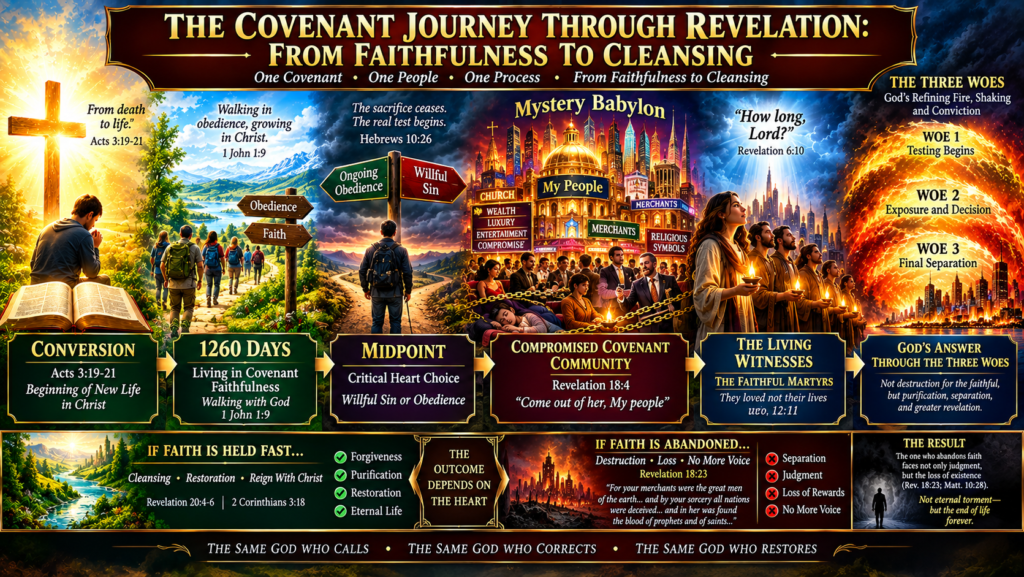
The Covenant Journey Through Revelation: From Faithfulness to Cleansing
This study explores the possibility that the six seals reveal the spiritual progression of a covenant person rather than merely a sequence of world events. The seals portray a covenant journey beginning with faithfulness, moving through conflict and the choice of spiritual governance, and then entering a period in which faith is tested, the hidden condition is exposed, and God intervenes to separate and cleanse His covenant people.
””’insert image”””
The horse-and-rider imagery provides an important key to this progression. The horse represents the believer, while the rider represents the spiritual governance or guidance under which the believer is proceeding. The changing horses and riders therefore portray changing covenant conditions within the person.
The Six Seals as a Covenant Journey
- Seal 1 — Faithfulness: The covenant journey begins with overcoming faith and faithful living.
- Seal 2 — Conflict: Peace is removed, and faithfulness enters a period of opposition and testing.
- Seal 3 — The Yoke and the Choice: The believer is confronted with the question of spiritual governance and whose yoke will be carried.
- Seal 4 — The Trying of Faith: Willful covenant violation becomes manifest, and the hidden condition is exposed under judgment.
- Seal 5 — The Faithful Witnesses Cry Out: The faithful witnesses ask, “How long, O Lord?”
- Seal 6 — God Intervenes: The shaking of the covenant order begins God’s answer.
The fifth seal asks the question. The sixth seal begins God’s answer.
Seal One — The White Horse: Faithfulness
Revelation 6:1–2
The first seal introduces the covenant journey with a white horse. White is associated throughout Scripture with purity, righteousness, victory, and overcoming. The horse represents the believer, while the rider represents the spiritual governance or guidance under which the believer proceeds.
The progression begins with a faithful response to God’s covenant. The rider goes forth conquering and to conquer, portraying the overcoming character of faithful covenant living.
Conversion → Obedience → Faithful Living
Seal Two — The Red Horse: Conflict
Revelation 6:3–4
The second seal removes peace from the earth. Within this covenant pattern, the believer’s faithful walk encounters opposition, pressure, and conflict. Faith is not merely stated; it is tested.
This conflict does not by itself establish that faith has been abandoned. Rather, it introduces the circumstances in which the believer’s response will be revealed.
Faithfulness → Conflict → Testing Begins
Seal Three — The Black Horse: The Yoke and the Choice
Revelation 6:5–6
The third seal introduces the black horse and the balances. The Greek word zygos can refer to balances or a yoke. This provides an important covenant image because a yoke speaks of authority, submission, service, and governance.
The question is therefore not simply what is being measured, but under whose governance the believer will continue.
Jesus speaks of taking His yoke upon us in Matthew 11:29–30. The third seal presents the covenant choice: Whose yoke will the believer carry?
- Christ’s yoke: Faithfulness, endurance, and continued submission to God.
- Another yoke: Compromise, deception, and a different form of spiritual governance.
The third seal is therefore a turning point. The issue of governance becomes exposed and the believer’s response becomes decisive. This is the confrontation and testing of faith.
Faithfulness → Conflict → Choice of Yoke
Seal Four — The Pale Horse: The Trying of Faith
Revelation 6:7–8
The fourth seal introduces the pale horse. Its rider is called Death, and Hell follows with him. Within this interpretive framework, this does not yet represent the final death or abandonment of faith. That later condition is revealed more clearly in Revelation 18:23.
The fourth seal represents the trying of faith under covenant judgment. The willful covenant violation that was confronted in the preceding choice now becomes manifest in the believer’s condition. Judgment reveals what has been taking place within.
This distinction is important. Ordinary sin does not automatically equal abandonment of faith. Scripture provides a means of confession, repentance, correction, and restoration. The fourth seal portrays the serious consequence of refusing that covenant response.
Compromise → Deception → Faith Is Tried → Hidden Condition Exposed
Hell as a Condition of Adversarial Governance
Within this covenant interpretation, Hell is not being used as a synonym for irreversible finality. The imagery can instead portray a condition in which the person is delivered into the presence and governance of the adversary and his angels.
Matthew 25:41 describes the everlasting fire as having been prepared for the devil and his angels. The Devil remains the adversary; he is not God’s partner in salvation. Rather, God can permit an adversarial power to function within His judicial discipline without making that power good or righteous.
This agrees with the principle expressed in 1 Corinthians 11:32: when God’s people are judged, they are chastened by the Lord so that they should not be condemned with the world.
In this sense, judgment reveals rather than creates the condition. The person experiences the consequences of the governance that has been chosen, and the hidden condition can become apparent to the person himself.
The Hiding of God’s Face
The Scriptures also connect judgment with God hiding His face. This provides another way of understanding the fourth seal. When God’s protective presence is concealed, the person’s condition is no longer concealed by that protection.
The pattern can be seen in Job, where affliction brings Job’s recognition and understanding of His self-righteousness. Ezekiel 39:23–24 likewise connects Israel’s judgment with God’s hiding His face because of transgression. Yet Ezekiel 39:29 later declares that God will no longer hide His face and will pour out His Spirit.
The sequence therefore contains both judgment and the possibility of restoration: exposure of the condition, recognition of the condition, and the possibility of returning to God.
The Prison and the Possibility of Deliverance
Jesus gives another covenant image in Matthew 5:25–26. The sequence is adversary → judge → officer → prison, followed by confinement until the required condition is satisfied.
Within this framework, the prison represents judicial confinement rather than automatically meaning irreversible finality. The discipline exposes the seriousness of the person’s condition and creates an opportunity for repentance.
This is why the fourth seal should be described as the trying of faith. The person has entered a severe judicial condition, but the covenant process has not yet necessarily reached its final confirmation.
Judgment reveals the condition. Discipline provides the opportunity for correction. Repentance opens the way to deliverance.
Strong Delusion and Judgment
Second Thessalonians 2:10–12 describes people who refuse to receive the love of the truth. God sends a strong delusion, and the passage then speaks of judgment concerning those who believed the lie rather than the truth.
This should be understood as judicial exposure to wickedness rather than as God becoming the author of evil. The delusion allows the chosen condition to become manifest. The judgment reveals what the person has embraced.
The language of this passage belongs to the field of judgment and judicial decision. Therefore, the passage should not automatically be turned into a doctrine of irreversible damnation at this stage of the covenant pattern.
The Death of Faith Comes Later
The distinction between the fourth seal and the later condition described in Revelation 18:23 is essential. The fourth seal portrays faith being tried and the hidden condition being exposed. It does not require that faith has already been abandoned.
Revelation 18:23 describes a later and more hardened condition in which the voice of the bridegroom and bride is no longer heard in Babylon. Within this covenant pattern, that loss of hearing represents the abandonment of covenant faith rather than merely the testing of faith.
The progression is therefore:
- Third Seal: The choice of spiritual governance is exposed.
- Fourth Seal: Faith is tried and the hidden condition becomes manifest.
- Judicial confinement: The consequences of the chosen condition are experienced.
- Repentance: The possibility of deliverance remains.
- Revelation 18:23: A later hardened condition reveals the abandonment of covenant faith.
Seal Five — The Faithful Witnesses Cry Out
Revelation 6:9–11
“How long, O Lord?”
The fifth seal introduces the faithful witnesses who cry out to God. Their question is not merely a request for information. It expresses the tension created by the continuing presence of covenant corruption and the apparent delay of judgment.
The faithful witnesses have seen the condition of their backslidden brethren, yet the process has not reached its appointed conclusion. Their cry therefore points forward to God’s intervention.
The fifth seal asks the question.
Seal Six — God Intervenes
Revelation 6:12–17
The sixth seal begins the answer to the question raised by the faithful witnesses. The earthquake and cosmic shaking portray divine intervention in the established covenant order.
The imagery is not limited to physical geography. Throughout Scripture, shaking can describe the removal or exposure of an established order. What has appeared stable is shaken so that its true condition can be revealed.
The sixth seal begins God’s answer.
The Shaking of the Covenant Order
The earthquake imagery appears again at important points in Revelation. Revelation 8:5 connects the shaking with the altar, fire, thunder, voices, and earthquake. Revelation 11:19 presents the shaking in connection with the temple and the ark. Revelation 16:18 presents a great earthquake in connection with the collapse of Babylon.
These passages can therefore be viewed as different perspectives on the same covenant pattern of divine intervention. The imagery separates the events for definition without requiring that each appearance establish a separate chronological event.
From the earth, the established order is shaken. From the altar, judgment is activated. From the temple, the covenant reality is revealed. In the final imagery, Babylon’s established condition collapses.
The Three Woes and the Work of Exposure
The relationship between the seals and the three woes continues the same covenant pattern. The fifth seal raises the question, the sixth seal begins the shaking, and the woes develop the testing, exposure, and separation that follow.
- The fifth seal: The faithful witnesses cry, “How long?”
- The sixth seal: God begins to shake the established covenant order.
- Woe One: The testing intensifies.
- Woe Two: The hidden condition is exposed and the response becomes evident.
- Woe Three: The process reaches separation and loss of faith.
The purpose of the imagery is therefore not simply destruction. It reveals what has been hidden and brings the covenant condition into the open.
Babylon and the Call to Come Out
Revelation 18:4
“Come out of her, my people.”
This command is significant because God’s people are still addressed as being within Babylon. The call to come out therefore presents another covenant choice: return to covenant faithfulness or remain within the hardened system.
The third seal introduced the question of whose yoke would govern the believer. The fourth seal tried that faith under judgment. The later judgment exposes the result of that response.
Babylon therefore represents more than an external city in this interpretive framework. It portrays a hardened covenant condition in which the original relationship with God has been compromised.
One Covenant Pattern with Many Symbols
The six seals can be understood as one covenant pattern expressed through different symbols. The imagery moves from faithful governance, through conflict and choice, into the trying of faith, exposure, witness, intervention, and finally separation and loss of faith.
The seals therefore do not have to be read as six unrelated disasters occurring one after another in world history. They can be read as successive stages in the revelation of a believer’s covenant condition. Daniels 70th week of confirmation.
The horse represents the believer. The rider represents spiritual governance. The changing conditions of the horse and rider reveal the changing covenant condition of the person.
The Covenant Progression
- Faithfulness
- Conflict
- Choice of Yoke
- Faith Is Tried
- Hidden Condition Exposed
- Faithful Witnesses Cry Out
- God Intervenes
- Testing and Separation
- Cleansing or loss of faith
The governing principle throughout this process is simple: judgment reveals the condition; discipline provides an opportunity for correction; repentance opens the way to deliverance; and confirmation establishes the resulting covenant condition.
This provides a unified way to read the seals, the trumpets, the bowls, Babylon, and the Day of the Lord. The symbols differ, but the covenant pattern remains consistent: what is hidden is exposed, the response is revealed, and the resulting condition is confirmed.