
🕒 13 min read · 📝 2453 words
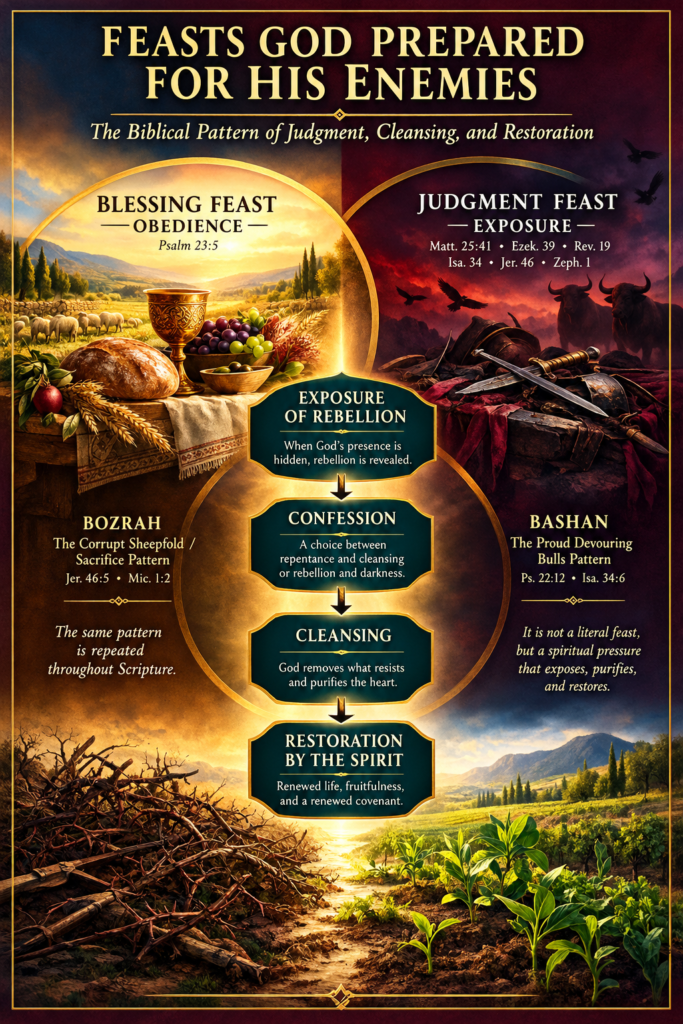
1. Blessing Feast vs. Judgment Feasts
The page presents a unified biblical pattern showing how feast imagery, sacrificial language, and devouring symbolism are used throughout Scripture to describe God’s covenantal judgment on His own backslidden people, illustrating the Armageddon purification event.
Psalm 23:5 — The Only Blessing Feast
God prepares a table for His obedient people in the presence of enemies: This means that Christians are being taught to deny ungodliness as unbelievers watch.
These times of blessing represent the covenant-obedient times in a person’s life Mt 25:34.
Mt 25:34 Then shall the King say unto them on his right hand, Come, ye blessed of my Father, inherit the kingdom prepared for you from the foundation of the world:
Judgment Feasts
These times of judgment are the willfully disobedient times of unconfessed sin in a believer’s lifetime.
Mt 25:41 Then shall he say also unto them on the left hand, Depart from me, ye cursed, into everlasting fire, prepared for the devil and his angels:
Revelation 19 and Ezekiel 39 talk about feasts prepared for God’s disobedient people—His people who have chosen to live in sin, falling under demonic influence and the power of darkness.
Demons (dark impulses) are called to feast on the person as he lets darkness into his life, and God allows him to follow this dark path for a time Matt 25:41.
Birds and beasts symbolize hostile spiritual powers that influence wickedness in God’s people and are eventually rendered idle through the Armageddon crisis.
These two feast categories establish the covenant pattern Scripture uses to reveal how God deals with obedience and rebellion.
These two feast categories also symbolically correspond to the two halves of Daniel’s 70th week: the first half marked by obedience and the continual sacrifice.
Jesus summarizes Daniel’s 70th‑week confirmation (Dan 9:27) through the Sheep‑and‑Goats separation, presenting the same two covenant halves: obedient believers who continue the sacrifice, and backslidden believers who cease it and fall under the demonic feast.
In Scripture, “the sacrifice” refers to the believer’s ongoing confession of sin, and “the sacrifice ceasing” is the Hebrews 10:26 condition where confession stops and willful sin begins.
This first half of Daniel’s 70th week is not a time of sinless perfection.
During this covenantally obedient time, sin is recognized as being sinful and confessed per 1 Jn 1:9.
The second half is marked by willful sin, the cessation of confession, and the Day‑of‑the‑Lord demonic judgment feast.
2. The Day of the Lord as Internal Covenant Judgment
When a believer chooses willful sin, God hides His face/presence (Ezek 39:23–24).
This draws the believer’s attention to the demonic activity (delusion is sent); clarity collapses, and the believer experiences only the pressure of the wickedness.
This pressure is the “demonic feast” — the exposure of rebellion that forces a choice:
Confession (1 John 1:9) → cleansing, bone‑burying, restoration, Spirit outpouring.
Between these two choices lies the three-woe pattern described in Revelation, an escalating process of judgment.
Abandonment (Rev 18:23) → collapse of faith and spiritual darkness.
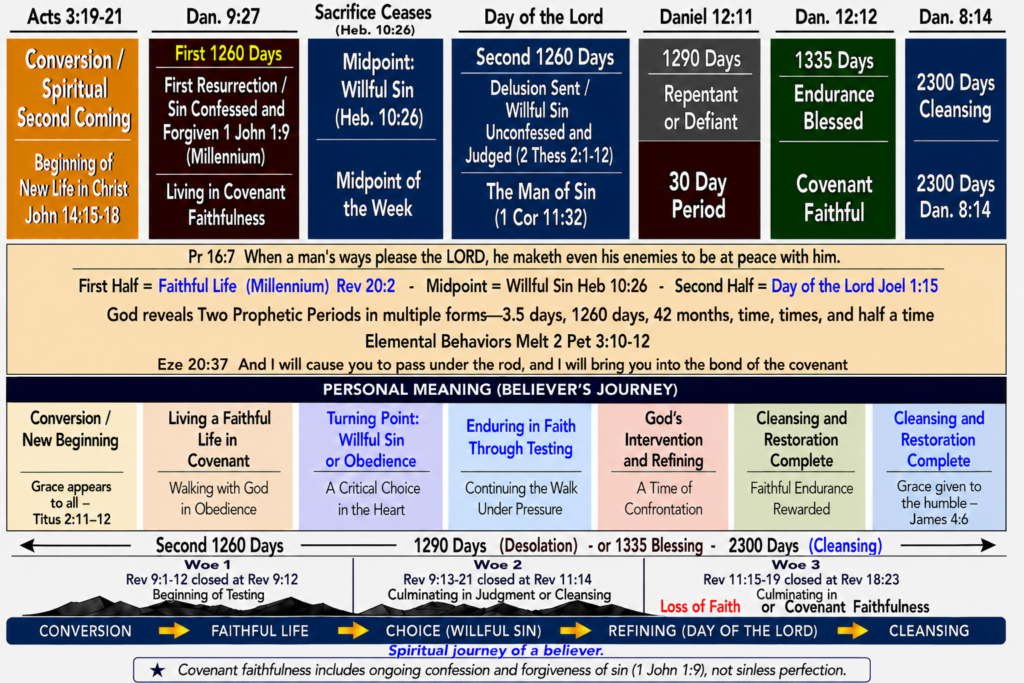
This mechanism matches 2 Thessalonians 2:11: God sends a working of delusion by withdrawing His clarity (hiding His face/presence) and permitting the thief to generate the delusion or Greek “plane” (Strong’s # 4106).
πλάνη means a wandering or drifting into error caused by deception.
In Scripture, planē describes the believer’s movement off the covenant path when clarity is withdrawn and deception fills the gap.
The delusion is God‑sent in authority, but demonic in operation.
God sends the Delusion, but the Day of the Lord comes as a thief, as the devil is allowed to access the believer’s life to influence them towards repentance and purification, as mentioned in 1 Cor 11:32.
1Co 11:32 But when we are judged, we are chastened of the Lord, that we should not be condemned with the world.
Once this delusion begins, Scripture consistently describes its effects using sacrificial and feast imagery.
3. The Demonic Feast
The “feast” is spiritual pressure, not literal consumption.
When God hides His face:
clarity collapses wickedness becomes loud rebellion is exposed demonic pressure increases
This pressure makes the sinful nature apparent per Job 42:5-6, forcing repentance or abandonment.
It is the prelude to cleansing.
4. The Judgment Pattern
Across all prophetic texts:
The demonic spirits who feast in the darkness are rendered idle when the believer asks forgiveness.
God puts a stop to the oppressive actions of demons.
After confession, Jesus begins to cleanse them from ungodly activity.
Those who see obedience as grief‑laden (Hosea 9:4) end up dismissing or undermining the obedient believer’s life, and Scripture describes this spiritual wounding as symbolically “shedding their blood.”
The martyrs in Revelation 6:10 are asking God to act — not asking how He will act.
But their cry naturally raises the question of God’s method, and Revelation later reveals it: the three‑woe cleansing cycle, God’s way of answering their plea for justice.
In effect, God answers them, saying, “This is how I will deal with those who treated obedience as grief‑laden—something sorrowful instead of joyful.”
These are those represented in Hosea 9:4. Their rebellion makes them the target of demonic pressure, but when they confess their sin, that pressure loses its power and becomes inactive in their lives.
A willfully sinful believer who makes an obedient believer’s life of sacrifice seem unnecessary is living in deliberate sin, because he is mocking the very “living sacrifice” God requires of those who choose to die to sin.
The demonic who consumed nations become idle as the believer is taught to deny the ungodliness Titus 2:11-12.
This is the pattern of covenant justice found in Revelation 16:6, Revelation 19, Ezekiel 39, Zephaniah 1, Isaiah 34, Jeremiah 46, and in Jesus’ own warnings.
This same pattern reaches its fullest expression in the event Scripture calls Armageddon.
5. Prophetic Feast Imagery Across Scripture
Multiple passages use sacrificial or feast language to portray covenant judgment:
Isaiah 34:6 — “sacrifice in Bozrah” Jeremiah 46:10 — sword devours, drunk with blood Zephaniah 1:7–8 — God prepares a sacrifice Ezekiel 21:10–11 — sword prepared for slaughter Hosea 9:4 — sinful believers will consider Christianity a chore/mourning Isaiah 30:27–33 — Topheth prepared as a burning site
All depict the same pattern:
The demonic devourers are silenced (Pr 16:7) when believers acknowledge the gravity of their sin, and upon confessing it to the Lord as truly sinful (lifting the delusion), they are forgiven.
Pr 16:7 ¶ When a man’s ways please the LORD, he maketh even his enemies to be at peace with him.
This is the moment they are freed from Hell, as referenced in Matthew 5:26.
Mt 5:26 Verily I say unto thee, Thou shalt by no means come out thence, till thou hast paid the uttermost farthing.
This prophetic pattern becomes even clearer when viewed across the entire biblical narrative.
6. Armageddon Explained (merged intro paragraphs)
Armageddon is not geopolitical — it is internal covenant confrontation. Armageddon is the moment when willfully sinful believers surround obedient believers. It is not geopolitical; it is God exposing rebellion inside His own covenant people by allowing the backslidden to surround the faithful. This confrontation is the pattern Scripture repeats from Genesis to Revelation.
In Ezekiel 38:8 and 39:2, the word translated “against” is the Hebrew preposition עַל (ʿal), which does not inherently mean hostility.
It simply means movement “upon,” “toward,” or “into proximity.”
The hostility in these passages is not in the obedient believers or the backslidden believers, but in the demonic powers influencing the backslidden.
God brings His deceived people toward His faithful people to expose rebellion and purify them.
The confrontation is spiritually hostile, not humanly hostile.
Jesus instructs His faithful followers to step away from those who choose willful sin for their own protection: “come out from among them”.
Yet, God later brings some of these wayward believers back into the lives of the faithful so they can be confronted, guided, and restored.
The initial separation protects the obedient, and God then decides which backslidden believers are again brought into the presence of obedient believers, and their reconnection purifies the disobedient as God sends delusion; sin becomes apparent, and the believer repents.
This covenant pattern appears throughout Scripture.
The Pattern
God gathers His backslidden people (Magog) to surround His obedient people (mountains of Israel).
God knocks the carnal weapons out of their hands (Ezek 39:3) — rebellion, pride, accusation, self‑will.
Their sinful nature is consumed — the devourers become ineffective.
Bone‑burying symbolizes the removal of willful sin in Ezekiel 39. Sins’ structural supports are removed.
God no longer hides His face/presence and instead pours out His Spirit (Ezek 39:29).
Restoration follows purification, not destruction.
Armageddon is the corporate replay of the pattern Jesus fulfilled personally at the cross.
This corporate purification mirrors the sacrificial system itself, which was always a prophetic shadow.
7. Sacrificial System as Prophetic Shadow
Isaiah 34:6 shows that the OT sacrificial system was never about animals — it was a prophetic preview of how God would purify His people at the end of the age.
Isa 34:6 The sword of the LORD is filled with blood, it is made fat with fatness, and with the blood of lambs and goats, with the fat of the kidneys of rams: for the LORD hath a sacrifice in Bozrah, and a great slaughter in the land of Idumea.
Lambs, goats, rams = God’s covenant people in rebellion and willful sin
Fat, kidneys, blood = corruption, excess, and cleansing
Sacrifice = the willfully sinful believers.
Sacrifice = the destruction of the sinful nature. This is why Paul commands believers to present their bodies as living sacrifices (Rom 12:1). Hence also speed the day of the Lord 2 Peter 3:12.
Jesus embodies the entire system in His own body, fulfilling the pattern personally; The Armageddon event symbolizes its fulfillment in a Christian’s life.
Paul’s command to “present your bodies as a living sacrifice” (Rom 12:1) is the New Covenant expression of the Bozrah/Bashan pattern.
Jesus fulfilled this pattern physically; Armageddon fulfills it in us as we put sin to death in the flesh.
Two prophetic locations, Bozrah and Bashan, highlight this pattern with striking clarity.
8. Bozrah and Bashan — Prophetic Twins
Bozrah (Isaiah 34) = corrupt sheepfold (Willfully sinful believers)
Bashan (Psalm 22) = proud, devouring bulls (Demonic)
Both symbolize God’s covenant people in rebellion and the same group confronted in Ezekiel 38–39 and Revelation 19–20.
Jesus personally faced Bashan (The Bulls) at the cross and corporately symbolized (The Sheepfold) Bozrah as the sacrifice.
Bozrah in Isaiah 34 and Bashan in Psalm 22 are prophetic twins.
Both symbolize God’s covenant people in rebellion.
Bozrah is the corrupt sheepfold where God has a sacrifice; Bashan is the proud, devouring bulls who surrounded Jesus at the cross.
These two images describe the same spiritual reality: the backslidden, hostile portion of Israel that God confronts at Armageddon.
Jesus personally faced Bashan Bulls (Demonically controlled people) at the cross and corporately fulfilled Bozrah (The Sheepfold) as the sacrifice.
Ezekiel 38–39 and Revelation 19–20 replay this pattern on a national scale, where God knocks the carnal weapons out of His backslidden people’s hands, reverses their devouring behavior, and purifies them through the Armageddon process.
Jesus experienced Bozrah and Bashan physically because He entered our world in a real human body and absorbed the external hostility of rebellious Israel.
He faced the bulls of Bashan outside Himself because He had no inner rebellion.
We experience Bozrah and Bashan spiritually because the same hostility He faced externally now appears inside us as pride, self‑will, and inner rebellion.
Jesus took the physical Armageddon so that our Armageddon would be spiritual—an inner confrontation where God purifies the rebellious “Israel” within us.
His physical suffering becomes the pattern for our spiritual suffering and resulting transformation.
Final Paragraph
This repeated Bozrah‑and‑Bashan pattern is the key believers must look for whenever they read Scripture.
From Genesis to Revelation, God retells the same story through different symbols, nations, feasts, sacrifices, and prophetic images:
He reveals how He deals with unbelief in His own people.
Though the imagery changes across history, the underlying pattern never does.
Those who seek Him will always see the same covenant storyline—God exposing rebellion, confronting it, purifying His people, and restoring them by His Spirit.
9. Jeremiah 46:10 — Old Testament Whore-on-the-Beast
Jeremiah 46 shows the pattern using Whore‑and‑Beast imagery.
Jeremiah 46:10 mirrors Revelation 17–19:
Devouring sword = Beast Drunk with blood = Whore Sacrifice in the north = Bozrah pattern (Sheepfold)
Sacrifice in the north = Bozrah pattern (Sheepfold) – meaning this judgment feast is where the Demonic are allowed to feast on God’s people, so the believers recognize the demonic within themselves and choose repentance. At the time of recognition and repentance, God strikes the demonic weapons or characteristics from the believer’s life, just as He did when Job repented in Job 42:5 and 6.
Day of vengeance = Armageddon – the day of vengeance for His temple. The temple is God’s obedient people, His dwelling place.
The vengeance is the recompense, or the manner in which He cleanses it, as in Jesus cleansing the temple.
Biblically, “vengeance” and “recompense” both mean God restoring holiness by cleansing corruption — not punishing enemies.
The outer court given to the Gentiles in Revelation 11:2 is the same part of God’s house that Jesus cleanses in the temple (John 2:13-17), symbolizing the outer‑darkness discipline where sinful believers are purified. It’s handed over to the Gentiles for 42 months (Rev 11:2), which matches the three and a half days in the second half of Daniel’s 70th week (Dan 9:27).
Demonic Devourers losing their influence = Gog/Magog pattern
Jeremiah 46 shows God’s backslidden people becoming His adversaries, as in Matt 25:41, the demonic devouring the righteous, and the believer being judged through the same feast imagery.
This brings us back to the core mechanism: the demonic feast.
10. Final Summary Statement
Scripture uses feast and sacrificial imagery to portray God’s covenantal judgment on His backslidden people.
When God hides His face, clarity collapses, and the believer experiences the “demonic feast,” the exposure of rebellion.
This pressure forces a choice: confession leading to cleansing, or abandonment leading to darkness.
Armageddon is the definition of this pattern — God gathers the backslidden, knocks the weapons out of their hands, consumes their sinful nature, buries the remnants of rebellion, and restores them by His Spirit.
The devourers become ineffective, fulfilling the prophetic situation seen in Isaiah 34, Zephaniah 1, Ezekiel 39, Jeremiah 46:1-10, and Revelation 16–20.
In this way the Day of the Lord is said to come as a thief.
2 Pe 3:10 But the day of the Lord will come as a thief in the night; in which the heavens shall pass away with a great noise, and the elements shall melt with fervent heat, the earth also and the works that are therein shall be burned up.