🕒 7 min read · 📝 1315 words
Part I: Foundations of Doctrine
This section establishes the core theological framework centered on a covenant relationship with God. Obedience to the covenant leads to a righteous state (right-standing with God), while sin, if unconfessed, leads to a disobedient state, which triggers divine discipline.
Part II: Covenant, Discipline, and Restoration
This section details how God deals with His people through a recurring cycle of obedience, willful sin, discipline, and restoration. Key concepts include:
The Covenant Cycle: This pattern describes a believer entering a time of covenant confirmation, often referred to as Daniel’s 70th week, Dan 9:27.
Da 9:27: And he shall confirm the covenant with many for one week: and in the midst of the week he shall cause the sacrifice and the oblation to cease (Heb 10:26), and for the overspreading of abominations he shall make it desolate, even until the consummation (2 Thess 2:8) , and that determined shall be poured upon the desolate.
The first half of the week: is marked by covenant obedience, wherein the believer confesses sin, receives forgiveness, and gains right-standing or righteousness.
At the midpoint: the sacrifice stops (Hosea 14:2 and Heb 10:26), and the individual chooses willful sin rather than obedience and confession.
The Second half: brings discipline, leading either to repentance or a loss of faith, Rev 18:23.
God’s Use of Opposition and Discipline: God often uses enemies, conflict, and symbolic spiritual opposition as tools for discipline.
This is seen in the Gog-Magog prophecy: where He sends fire—representing Gog (the Devil and his angels) to judge unbelievers (Magog) and refine misguided believers (“coastlands”), Ezekiel 39:6.
The Day of the Lord: Interpreted as a personal period of judgment and discipline for a willfully sinful believer, not a single apocalyptic event. It is a time of spiritual exposure and correction aimed at restoration.
Delusion: God sends delusion to disobedient believers (Man of sin, 2 Thess 2:11) who reject the truth, serving as an initial form of judgment and a wake-up call intended to bring them to repentance.
The Role of Grace: Grace teaches believers to deny ungodliness and live righteously. This teaching is seen by all (Titus 2:11-12), however it is received by the humble, not the proud, James 4:6.
Part III: Prophetic Doctrine (Daniel & Revelation)
This section connects the doctrinal system with prophetic interpretation, presenting a unified reading of key biblical texts.
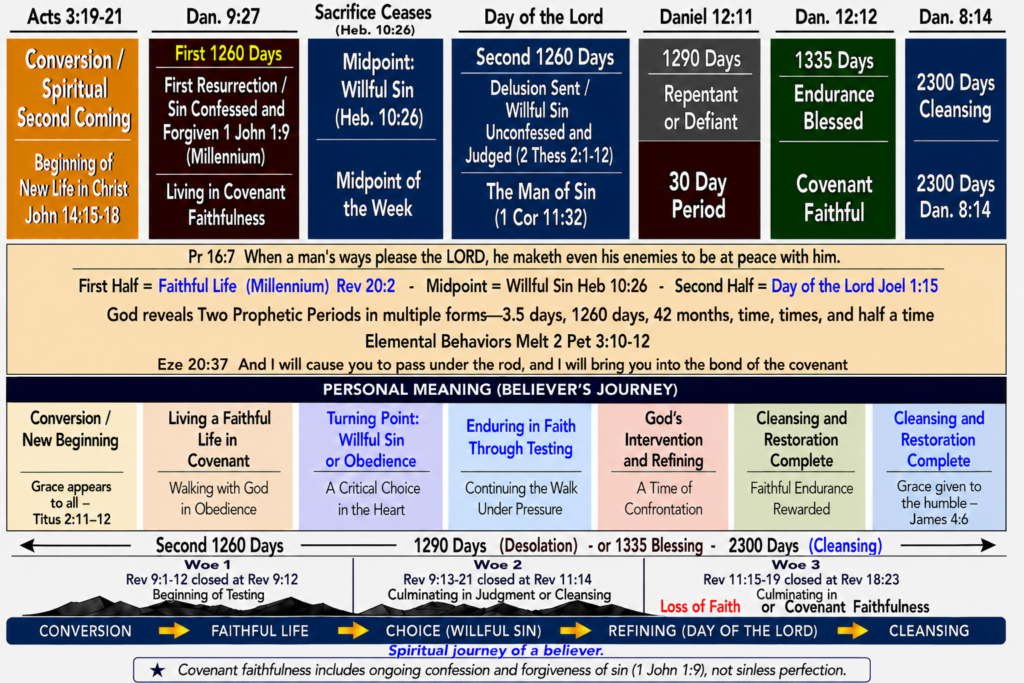
Daniel’s 70th Week: It symbolizes a believer’s lifetime of faith, split into two phases: the first marked by covenantal obedience, followed by a midpoint (when sacrifice ceases, Heb. 10:26) as willful, unconfessed sin begins, and the second marked by disobedience and discipline.
Revelation’s Cycles: The different cycles in Revelation (Seals, Trumpets, Woes, Bowls) are not a linear timeline but retellings of the same spiritual drama, describing the believer’s descent into willful sin (the second half of Daniel’s 70th week), and the symbolic escalating process of divine correction.
The 1260/1290/1335 Days: In Daniel, these prophetic timeframes represent deliberate spiritual sin during the second half of the 70th week (1260), followed by either the desolation and proclamation of the sin at 1290 or the blessing for those who endure until 1335.
The Beast and the Man of Sin: This can be seen as a fallen believer who has returned to willful sin and elevates their own self-will. The “Beast” and the “False Prophet” symbolize a false religious identity and a delusion that can be spread to others.
Part IV: Second Coming & Judgment
This section reframes the traditional understanding of eschatological events, emphasizing spiritual realities over physical or future events.
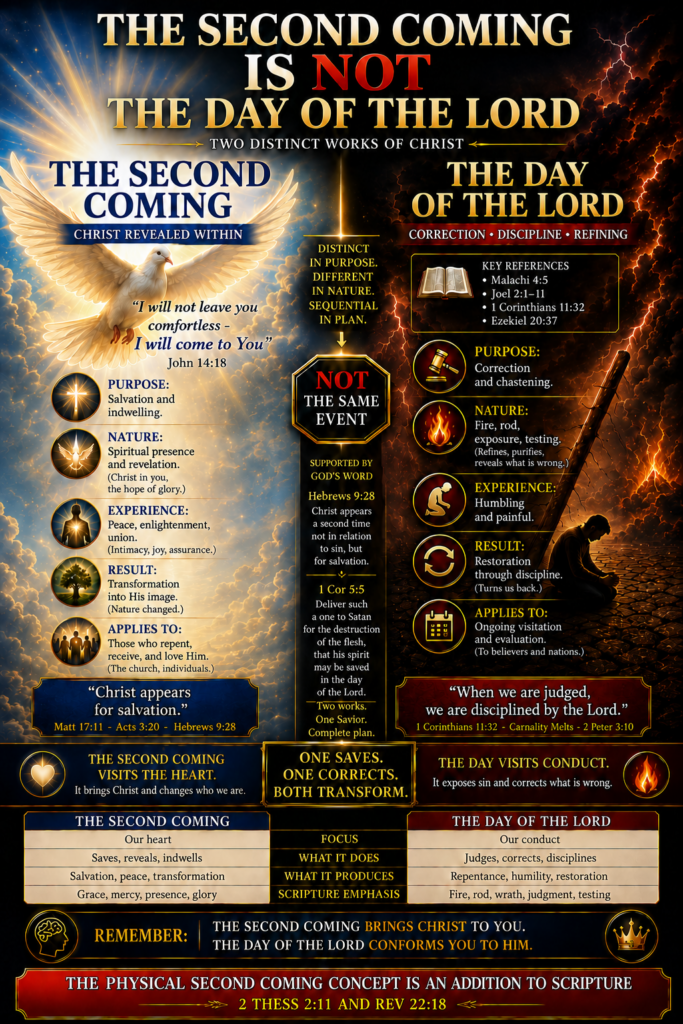
The Second Coming: Presented as a spiritual event, occurring when an individual repents and Jesus comes to dwell in their heart through the Holy Spirit, Acts 3:20 and for salvation Heb 9:28. It is distinct from the Day of the Lord described as judgment in Joel 1:15.
The Day of the Lord: Reaffirmed as a time of disciplinary judgment for believers, not a physical end-times event. “Every eye will see him” means all people will experience God’s evaluation or judgment, whether they accept Christ or not.
Armageddon: Interpreted as a spiritual battle fought within the believer against willful sin and the false self, not a geopolitical war.
The Final State: This doctrine believes in the annihilation of the wicked (the soul perishes Matt 10:28 and Rev 18:23), not the traditional concept of eternal conscious torment.
Hell: is described as the presence of the devil and his angels. These fallen angels are the fire that is everlasting, Humans however, lost immortality in the garden of Eden, Gen 3:22.
The presence: of these fallen eternal beings is “Hell” and the place of discipline from which a Christian can be released through repentance, Matt 5:26.
Daniel 9:27: declares that God will cause wickedness to be consumed and brought to its end, while Revelation 20:9 shows the final expression of that judgment when fire from heaven devours and eats down (Consumes) the enemies of God completely.
The confrontation: in Revelation 20:9 and 2 Thessalonians 2:8 is the same spiritual event pictured in the Gog‑Magog pattern: God’s fire removes the wickedness from those dwelling carelessly in the isles, consuming the rebellion within the believer until the consummation.
Christians grow in Grace: to reflect the nature of Christ as they keep their focus on Him, much like Peter did when he walked on water, and as we’re encouraged to do in 1 Corinthians 15:52.
1 Corinthians 15:52: in a moment (undivided), in the twinkling of an eye (Casting of the eye), at the last trumpet (Jesus) ; for the trumpet will sound, the (spiritually) dead will be raised incorruptible, and we (Paul and the Christians on earth) will be changed.
Part V: Parables, Patterns, and Symbolic Doctrine
This section explores the symbolic language and patterns used throughout Scripture.
Parables: Matt 13:11-12 is seen as a method God uses to conceal truth (Speaking in Tongues) from the “wise and prudent” while revealing it to “babes” (the humble). Understanding parables requires a spiritual gift (Interpretation of Tongues) and alignment with the simple truths of Scripture.
The Thief-Lightning Framework: The Day of the Lord comes as a thief, and God corrects the fallen believer using this time of discipline, 1 Cor 5:5.
Falling away: The Believer enters willful sin and stops confessing their sin 2 Thess 2:3.
Delusion sent: The Day of the Lord begins quietly, like a thief, 2 Thess 2:11.
Spiritual sleep: results in a believer who has backslidden, as referenced in 1 Thessalonians 4:13.
Torment/Prison: Discipline is corrective, Matt 18:34 and Matt 5:26.
Faithful believers: are reminded “not to go before” those who have fallen back (Isaiah 28:13) as is mentioned in 1 Thessalonians 4:15. Verses like “Come out from among them” (Matthew 25:33–Revelation 18:4) and “Don’t even eat with them” (1 Corinthians 5:11) reinforce this idea.
Psalm 110:67: Before I was afflicted I went astray: but now have I kept thy word.
Leading believers: to confess their sins and return to fellowship, as referenced in 1 Thessalonians 4:17 and 2 Cor 2:6-8.
If faith is maintained: the “wickedness” is consumed out of the Believer (Dan 9:27 until the consummation) and 2 Thess 2:8.
The Two Witnesses (Rev 11): Symbolize God’s covenant people in their priestly and kingly roles. Their “death” represents spiritual discipline, and their “resurrection” represents restoration to obedience during this lifetime.
These symbols: reflect the same cleansing confrontation described throughout Scripture, where God consumes the rebellion within the believer until the consummation.
In essence, the entire framework presents a cohesive biblical theology where the primary focus is on the believer’s internal spiritual condition, their covenant relationship with God, and God’s loving, restorative discipline designed to lead them to repentance, obedience, and eternal life.