🕒 63 min read · 📝 12433 words
Understanding Daniel and Revelation Through the Covenant Pattern
PART ONE
FOUNDATIONS
Chapter 1
The Knowledge of God
The Purpose of This Book
The book of Revelation has often been approached as a prediction of future world events. As a result, many readers have come to view it primarily as a timeline of disasters, political upheaval, and the end of human history.
This book follows a different approach.
It proposes that Revelation is first and foremost the unveiling of Jesus Christ within His covenant people. Rather than presenting disconnected visions of future catastrophes, Revelation uses symbolic language to describe the work of Christ as He exposes, disciplines, refines, and restores those who belong to Him.
This approach does not treat Revelation as an isolated book. Instead, it understands Revelation as the culmination of a covenant pattern that appears throughout the whole of Scripture. Daniel, the prophets, the Gospels, and the apostles repeatedly describe the same divine work using different images, symbols, and literary forms.
Although the language changes, the pattern remains remarkably consistent.
God reveals.
God corrects.
God refines.
God restores.
The goal is always the same:
the revelation of Jesus Christ within His people.
What Is the Knowledge of God?
In Scripture, the knowledge of God is far more than the accumulation of information.
A person may know many Bible verses without understanding how Scripture fits together.
The biblical writers describe true knowledge as recognizing God’s character, His ways, and His consistent activity throughout history.
Because God does not change, His dealings with His people follow recognizable covenant patterns.
These patterns appear repeatedly throughout Scripture.
Sometimes they are presented as historical events.
Sometimes they are described through prophecy.
Sometimes they appear as parables.
Sometimes they are expressed through symbolic visions.
Although the imagery changes, the divine work remains the same.
The prophets, Jesus, and the apostles each describe different aspects of one covenant process through which God forms His people into the image of His Son.
This is the knowledge this book seeks to explore.
One Story Told Many Ways
One of the greatest difficulties readers experience when studying prophecy is assuming that every new vision describes a different event.
Scripture often does the opposite.
It tells the same story repeatedly while changing the imagery.
Daniel uses prophetic kingdoms.
Ezekiel uses symbolic actions.
Jesus teaches through parables.
Paul explains spiritual realities through doctrine.
John records symbolic visions.
Each writer emphasizes different details, yet all describe God’s continuing work among His covenant people.
Recognizing this literary pattern allows Scripture to interpret itself.
Instead of treating every prophecy as an isolated prediction, readers begin to recognize recurring covenant themes woven throughout the Bible.
The Language of Revelation
Revelation announces itself as a book communicated through signs and symbols.
Its imagery draws heavily from the Old Testament, where mountains, seas, trees, stars, beasts, cities, horns, winds, fire, and harvests frequently represent spiritual realities rather than merely physical objects.
This symbolic language allows Revelation to describe the inner spiritual life of God’s people using vivid prophetic pictures.
Rather than asking first, “What physical event does this represent?” this book asks, “What covenant reality does this symbol reveal?”
That question becomes the key to understanding the book.
A Covenant Pattern
Throughout Scripture, God consistently works through a recognizable pattern.
He reveals what is hidden.
He exposes the condition of the heart.
He calls His people to repentance.
He disciplines those who resist Him.
He refines those who respond.
He restores those who humble themselves before Him.
Judgment, therefore, is never presented as an end in itself.
It serves the larger purpose of revealing truth and producing righteousness.
As Paul explains in 1 Corinthians 11:32, God’s people are judged so that they will not be condemned with the world.
This covenant pattern forms the interpretive foundation for every chapter that follows.
The Goal of Revelation
The goal of Revelation is not merely to explain future events.
Its purpose is to reveal Jesus Christ.
That revelation is not limited to His glory in heaven.
It includes His continuing work among His people.
Throughout Revelation, Christ uncovers hidden motives, confronts compromise, warns the disobedient, strengthens the faithful, and ultimately brings His people into complete conformity with Himself.
Seen from this perspective, the seals, trumpets, bowls, beasts, Babylon, the millennium, and the New Jerusalem are not disconnected subjects.
Each contributes to the same unfolding story:
the revelation of Jesus Christ within His covenant people.
Reading the Chapters That Follow
The chapters that follow build upon one another.
Early chapters establish the language and patterns of Scripture.
Later chapters apply those principles to Daniel and Revelation.
Rather than treating every vision as an independent prophecy, this book approaches the biblical text as a unified covenant testimony in which the same divine pattern is revealed through many different prophetic pictures.
The aim is not simply to understand prophecy.
The aim is to understand the God who gave it, to recognize His ways, and to see His transforming work more clearly within the lives of His people.
Chapter 2
One Covenant Pattern Told Many Ways
Introduction
One of the greatest obstacles to understanding biblical prophecy is the assumption that every new vision describes a new event. This assumption has led many readers to treat Daniel, Revelation, and the prophets as collections of unrelated predictions arranged in chronological order.
This book proposes a different approach.
Throughout Scripture, God repeatedly reveals the same covenant process through different literary forms. Historical narratives, prophetic visions, parables, poetry, and apostolic teaching often describe the same spiritual reality from different perspectives. The symbols change, but the pattern does not.
Recognizing this principle provides a consistent framework for understanding prophecy and explains why so many passages, though different in appearance, arrive at the same spiritual destination.
God Does Not Change
The Bible declares that God is unchanging. Because His character remains constant, His dealings with His covenant people also display remarkable consistency.
Whether we read Moses, the prophets, the Gospels, the letters of Paul, or Revelation, we repeatedly encounter the same divine activity.
God calls.
God reveals.
God examines.
God exposes.
God disciplines.
God refines.
God restores.
The outward imagery varies from book to book, but God’s purpose remains the same: to conform His people to the image of His Son.
Different Pictures of the Same Reality
Scripture frequently presents one truth through many different illustrations.
Daniel describes kingdoms, horns, and prophetic time periods.
Ezekiel portrays symbolic actions, watchmen, and the passing under the rod.
Jesus teaches through parables of seeds, vineyards, servants, weddings, and harvests.
Paul explains the same realities through doctrine, describing the putting off of the old man and the putting on of the new.
John gathers these themes together in Revelation, where seals, trumpets, bowls, beasts, Babylon, and the New Jerusalem portray the same covenant journey through prophetic imagery.
These are not competing stories. They are complementary witnesses.
The Progressive Revelation of One Pattern
As Scripture unfolds, each writer contributes another layer of understanding.
Earlier revelation introduces the pattern.
Later revelation enlarges it.
Daniel establishes the prophetic framework.
The Gospels reveal the ministry of Christ within that framework.
The apostles explain its application to the life of the Church.
Revelation gathers these themes into one final symbolic vision.
Rather than replacing earlier revelation, Revelation brings it together into a unified prophetic portrait.
Why Revelation Repeats Itself
Many readers notice that Revelation appears to describe judgment more than once.
Instead of treating these repetitions as separate chronological events, this book understands them as complementary portrayals of the same covenant process.
The seals reveal.
The trumpets warn.
The bowls complete.
Each series examines the covenant people from a different perspective while advancing the same divine purpose.
This literary structure explains why similar imagery, themes, and outcomes appear repeatedly throughout the book.
The Unity of Daniel and Revelation
Daniel and Revelation are often studied separately, yet they continually illuminate one another.
Daniel introduces prophetic symbols.
Revelation expands them.
Daniel establishes the covenant framework.
Revelation unfolds its spiritual significance.
Together they describe one continuous testimony concerning God’s work among His people.
Reading either book apart from the other leaves the picture incomplete.
The Purpose of Judgment
Throughout Scripture, divine judgment reveals what already exists within the human heart.
It does not create rebellion.
It exposes it.
Judgment brings hidden things into the light so that truth may be seen clearly.
For those who respond in humility, judgment becomes the means of refinement and restoration.
For those who continually resist God, the same revelation exposes increasing hardness of heart.
In this way, judgment serves the larger purpose of revealing truth and advancing God’s covenant work.
Reading the Rest of This Book
The remaining chapters apply this interpretive principle to specific passages of Scripture.
Rather than asking whether two visions describe the same historical event, we will ask whether they describe the same covenant pattern.
As this approach is applied consistently, connections begin to emerge across the whole of Scripture.
Daniel and Revelation cease to appear as isolated prophetic puzzles.
Instead, they become harmonious witnesses to one unfolding work of God.
Chapter Summary
The Bible tells one covenant story through many different literary forms.
History, prophecy, parable, doctrine, and apocalyptic vision are not independent messages but complementary witnesses to the same divine purpose.
Recognizing this pattern provides the foundation for understanding Daniel and Revelation as unified testimonies rather than disconnected prophetic timelines.
The chapters that follow will demonstrate this principle by tracing the same covenant pattern through the prophetic books, the teachings of Christ, the apostolic writings, and the Revelation of Jesus Christ.
PART ONE — FOUNDATIONS
Chapter 3
Daniel and Revelation Tell One Story
Introduction
No two prophetic books have generated more discussion than Daniel and Revelation. They are often studied independently, with each treated as though it presents a separate prophetic system. Yet the books themselves invite a different conclusion.
Revelation continually echoes the language, symbols, and themes first introduced in Daniel. Rather than replacing Daniel, Revelation builds upon it. Together they present one unified prophetic testimony.
This chapter proposes that Daniel provides the prophetic framework, while Revelation expands and completes that framework through symbolic vision. They are not competing voices but complementary witnesses to the same covenant work of God.
Daniel: The Foundation of Biblical Prophecy
Daniel occupies a unique place in Scripture.
It stands at the meeting point between Israel’s historical experience and the prophetic unveiling that reaches its fullest expression in Revelation.
The visions given to Daniel introduce many of the symbolic images that later appear throughout the New Testament.
Kings.
Kingdoms.
Beasts.
Horns.
Books.
Thrones.
Angelic messengers.
Periods of testing.
The coming Kingdom of God.
These themes do not end with Daniel. They continue through the teaching of Christ and reach their fullest symbolic expression in Revelation.
For this reason, Revelation should not be read apart from Daniel. It should be read as its companion.
Revelation Assumes the Reader Knows Daniel
Unlike many biblical books, Revelation rarely explains its symbols.
Instead, it expects the reader to recognize imagery already established throughout the Old Testament, especially in Daniel.
This explains why Revelation often appears difficult.
The difficulty does not lie primarily within Revelation itself but in reading it apart from the prophetic language that came before it.
When Daniel supplies the vocabulary, Revelation becomes far more coherent.
One Pattern, Different Perspectives
Although Daniel and Revelation use different literary styles, both describe the same covenant realities.
Daniel often presents the framework.
Revelation enlarges the picture.
Daniel introduces symbolic kingdoms.
Revelation explores their spiritual significance.
Daniel establishes prophetic patterns.
Revelation develops those patterns through additional symbolic imagery.
Rather than repeating history, Revelation repeatedly revisits the same covenant realities from different perspectives.
The symbols become richer, but the underlying message remains consistent.
Progressive Revelation
God did not reveal every aspect of His purpose at once.
Throughout Scripture, revelation unfolds progressively.
Each generation received enough light for its own calling while pointing toward a fuller understanding yet to come.
Daniel received visions that remained only partially understood.
The prophets expanded that understanding.
Jesus revealed their fulfillment in Himself.
The apostles explained their application to the Church.
Finally, Revelation gathered these themes together into one comprehensive prophetic vision.
Seen this way, Revelation is not an isolated prophecy but the culmination of everything that came before it.
The Consistency of God’s Ways
One reason Daniel and Revelation harmonize so naturally is because both reveal the character of the same unchanging God.
God consistently calls His people into covenant.
He reveals truth.
He exposes what is hidden.
He tests faithfulness.
He disciplines disobedience.
He refines those who respond.
He restores those who return to Him.
These covenant actions appear throughout both books, although expressed through different symbols and literary forms.
Recognizing this consistency allows Scripture to interpret Scripture.
Daniel Prepares the Reader for Revelation
Daniel teaches the reader to think symbolically before Revelation ever begins.
Beasts represent more than animals.
Horns represent more than horns.
Kings represent more than individuals.
Time periods carry theological significance beyond simple chronology.
By the time Revelation opens, the reader has already been introduced to this symbolic method.
John therefore continues speaking the same prophetic language rather than inventing a new one.
A Unified Testimony
When Daniel and Revelation are read together, a remarkable unity begins to emerge.
The prophetic images support one another.
The covenant themes reinforce one another.
The symbolic language remains consistent.
Instead of seeing dozens of disconnected prophecies, readers begin recognizing one continuous testimony concerning God’s work among His people.
This unity forms the foundation upon which the remainder of this book is built.
Looking Ahead
The following chapters will apply these principles to specific passages of Scripture.
Rather than approaching Daniel and Revelation as separate prophetic systems, we will examine them as complementary witnesses describing one covenant pattern through many symbolic forms.
As the evidence unfolds, recurring themes will begin to appear with increasing clarity.
The same God speaks through both books.
The same covenant purpose governs both books.
The same revelation of Jesus Christ shines through both books.
Chapter Summary
Daniel and Revelation should not be read as independent prophetic systems.
Daniel establishes the symbolic language and covenant framework that Revelation assumes its readers already understand.
Together they present one continuous testimony of God’s dealings with His covenant people.
Recognizing this relationship allows Scripture to interpret Scripture and prepares the reader for the detailed studies that follow.
PART ONE — FOUNDATIONS
Chapter 4
Understanding the Literary Structure of Daniel’s Visions
Introduction
One of the greatest obstacles to understanding biblical prophecy is the expectation that every vision introduces a new sequence of future events. This assumption often leads readers to divide Daniel into separate prophecies, each describing different historical timelines.
A careful reading of Daniel suggests another possibility.
Rather than presenting unrelated prophecies, Daniel repeatedly describes the same covenant reality through different literary forms. Each vision contributes a unique perspective, adding depth and clarity without abandoning the central theme.
Instead of moving forward chronologically from one vision to the next, the book continually circles back, revealing the same divine work through progressively richer symbolism.
Recognizing this literary structure provides one of the most important keys for understanding both Daniel and Revelation.
Daniel Is a Unified Book
Although Daniel contains several visions, they should not be treated as independent prophecies.
Each vision contributes another perspective to one unified testimony concerning God’s dealings with His covenant people.
The symbols change.
The emphasis changes.
The literary style changes.
But the underlying covenant pattern remains remarkably consistent.
Rather than asking, “What new event is Daniel describing?” the reader should first ask,
“What aspect of the same covenant process is Daniel emphasizing here?”
This question transforms the way the entire book is read.
Four Views of One Covenant Pattern
Daniel presents the covenant journey through four complementary perspectives.
Each contributes something unique while remaining part of one unified revelation.
Daniel 8
The Symbolic Vision
Daniel 8 introduces the covenant struggle through symbolic imagery.
The ram, the goat, the little horn, and the sanctuary communicate spiritual realities using prophetic symbols.
Rather than emphasizing historical sequence, the vision establishes the symbolic language that will govern later chapters.
It teaches the reader to think symbolically.
Daniel 9
The Chronological Framework
Daniel 9 supplies the covenant timeline.
The prophecy of the seventy weeks provides the structural framework within which the covenant journey unfolds.
Here the emphasis shifts from symbolic imagery to covenant progression.
The confirmation of the covenant.
The ceasing of sacrifice.
The resulting desolation.
These become structural milestones that illuminate later prophetic passages.
Daniel 9 therefore functions as the chronological backbone of the prophetic narrative.
Daniel 10
The Spiritual Dimension
Daniel 10 moves behind visible events.
Instead of describing earthly kingdoms, it reveals the unseen spiritual conflict surrounding divine revelation.
The chapter demonstrates that understanding Scripture itself becomes the object of spiritual resistance.
Daniel seeks understanding.
A heavenly messenger is delayed.
Michael intervenes.
The Man clothed in linen strengthens His servant.
The focus is no longer earthly events but the spiritual forces influencing human understanding.
This prepares the reader to recognize that prophetic revelation always possesses both visible and invisible dimensions.
Daniel 11–12
The Narrative Explanation
The final vision transforms symbolic imagery into narrative.
The covenant struggle unfolds as an extended story.
Kings rise and fall.
Conflicts increase.
The sanctuary is affected.
The faithful endure.
Periods of testing are measured.
The vision concludes where earlier visions also conclude—with God’s ultimate purpose accomplished.
Rather than replacing the earlier visions, Daniel 11–12 explains them through narrative form.
One Message Through Four Literary Forms
When viewed together, these four sections reveal a remarkable literary design.
Daniel 8 gives the symbols.
Daniel 9 gives the covenant framework.
Daniel 10 reveals the unseen spiritual conflict.
Daniel 11–12 narrates the covenant struggle.
Each section enriches the others.
None stands alone.
Together they present one complete prophetic testimony.
Preparing the Reader for Revelation
This literary structure becomes especially significant when reading Revelation.
Like Daniel, Revelation repeatedly revisits the same covenant realities through different visionary cycles.
The seals.
The trumpets.
The bowls.
The woes.
Each contributes another perspective on the same divine work rather than introducing an entirely new prophetic chronology.
Daniel therefore prepares the reader to understand Revelation’s own literary structure.
The method remains the same.
Only the imagery becomes richer.
Progressive Revelation
Each successive vision in Daniel contributes additional understanding without abandoning what has already been established.
This principle appears throughout Scripture.
God does not discard earlier revelation.
He enlarges it.
The later visions explain the earlier ones.
The symbols become clearer.
The covenant purpose becomes more fully revealed.
By the time Revelation is reached, this pattern has been developing throughout the biblical record for centuries.
Why This Matters
Understanding Daniel’s literary structure changes more than one’s interpretation of Daniel.
It changes how prophecy itself is read.
Instead of searching for disconnected predictions, readers begin recognizing recurring covenant patterns expressed through different literary forms.
This approach allows Scripture to interpret Scripture.
It also explains why Revelation repeatedly revisits similar themes without requiring multiple independent prophetic timelines.
The Bible is not repeating itself because it has run out of material.
It is repeating itself because each vision contributes another perspective to one unfolding revelation.
Chapter Summary
Daniel is carefully arranged as one unified prophetic testimony.
Its visions are not isolated prophecies but complementary literary presentations of one covenant pattern.
Daniel 8 establishes the symbolic language.
Daniel 9 provides the covenant framework.
Daniel 10 reveals the unseen spiritual conflict behind revelation.
Daniel 11–12 narrates the covenant struggle to its completion.
Recognizing this structure prepares the reader to approach Revelation with the same literary expectations, seeing not disconnected timelines but one covenant story told through many prophetic visions.
Chapter 5
The Day of the Lord: God’s Judgment That Reveals and Restores
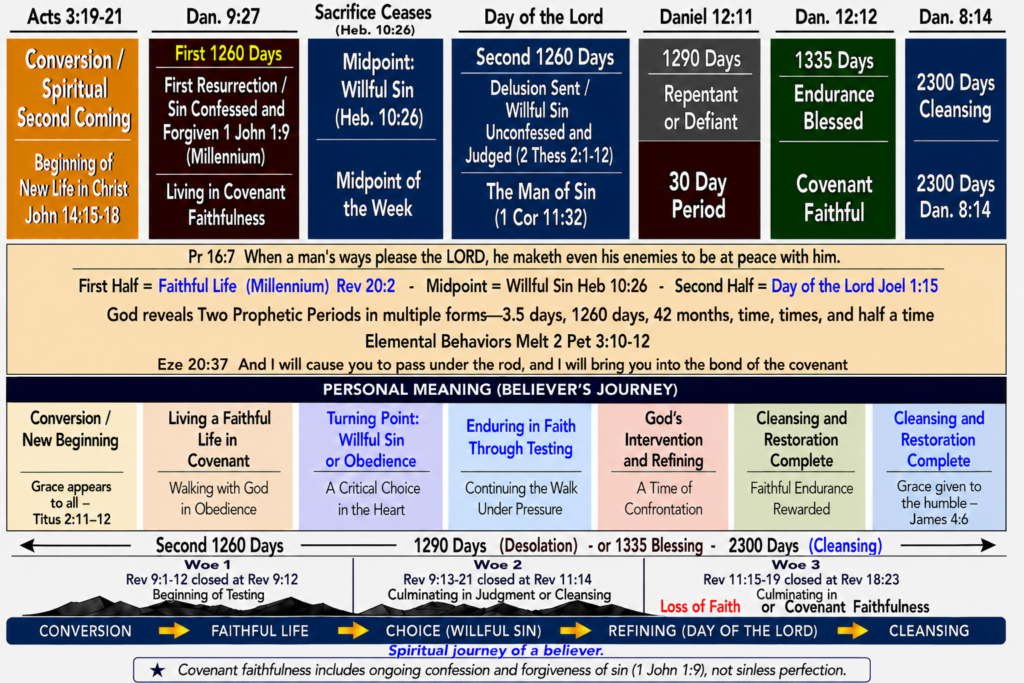
The phrase “the Day of the Lord” appears throughout Scripture as one of the most misunderstood prophetic expressions. Many readers immediately associate it with a future moment of worldwide destruction. However, when examined through the consistent pattern of Scripture, the Day of the Lord is not primarily about the destruction of creation — it is about the revealing, judging, and restoring work of God within His covenant people.
The Day of the Lord is the moment when what is hidden is brought into the light.
“For the day will disclose it, because it will be revealed with fire, and the fire will test what sort of work each one has done.”
— 1 Corinthians 3:13
God’s judgment does not create what is inside a person. It reveals what is already present.
The same fire that destroys what is corrupt also purifies what belongs to God.
Judgment Reveals the Heart
Throughout Scripture, God repeatedly brings His people into situations that expose their true spiritual condition.
Job experienced this when his righteousness was tested. Daniel experienced it when seeking understanding. Israel experienced it when brought into covenant discipline. The purpose was never merely punishment; it was revelation.
God says:
“I will bring you into the wilderness of the peoples, and there I will enter into judgment with you face to face.”
— Ezekiel 20:35
The wilderness was not the end of God’s relationship with His people. It was the place where He separated rebellion from faithfulness.
The same pattern appears in Revelation. The seals, trumpets, and bowls are not random disasters. They reveal what exists within those who claim to belong to God.
The question is not merely, “What happens to the world?”
The deeper question is:
What is revealed within the person when Christ examines the heart?
The Day of the Lord as Covenant Discipline
The New Testament continues this covenant pattern.
Paul writes:
“But when we are judged by the Lord, we are disciplined so that we may not be condemned along with the world.”
— 1 Corinthians 11:32
Notice the purpose of judgment:
Discipline leads to restoration.
God’s judgment upon His people is not the same as condemnation of the world. The believer is corrected because God desires holiness.
Hebrews explains:
“The Lord disciplines the one he loves, and chastises every son whom he receives.”
— Hebrews 12:6
The Day of the Lord therefore represents a divine intervention where Christ confronts what opposes His character within His people.
The Coming of the Lord as Revelation
Many passages describing Christ’s coming use language of appearing, revealing, and uncovering.
Paul writes:
“When Christ who is your life appears, then you also will appear with him in glory.”
— Colossians 3:4
The appearing of Christ is not merely an external event. It is the revelation of Christ’s life within those who belong to Him.
This agrees with Paul’s statement:
“My little children, for whom I am again in the anguish of childbirth until Christ is formed in you!”
— Galatians 4:19
The ultimate purpose of God’s work is not simply removing evil. It is forming Christ within His people.
The Thief in the Night
Scripture often describes the Day of the Lord as coming unexpectedly.
“For you yourselves are fully aware that the day of the Lord will come like a thief in the night.”
— 1 Thessalonians 5:2
A thief does not announce his arrival. He exposes what was unprepared.
Jesus uses this imagery:
“If you do not wake up, I will come like a thief, and you will not know at what hour I will come against you.”
— Revelation 3:3
Christ is not the thief. The comparison describes the suddenness of His revealing work.
The Day of the Lord uncovers what people thought was hidden. It separates genuine faith from outward appearance.
Fire: Destruction or Purification?
Biblical fire must always be understood according to its purpose.
Fire can consume what is opposed to God:
“For our God is a consuming fire.”
— Hebrews 12:29
But fire also purifies:
“He will sit as a refiner and purifier of silver.”
— Malachi 3:3
The same divine presence that destroys rebellion purifies those who surrender to God.
This is why Revelation describes judgment imagery through symbols of fire, wrath, and suffering. These images reveal the seriousness of resisting God’s transforming work.
The purpose is not merely destruction.
The purpose is the removal of everything that prevents the believer from reflecting Christ.
The Day of the Lord in Revelation
Revelation presents a repeated covenant pattern:
Christ reveals → the believer is tested → the heart responds → the outcome is determined.
The Lamb opens the seals, revealing what is hidden.
The trumpets announce warnings and judgments.
The bowls bring the fullness of consequences.
At every stage, humanity is confronted with a choice: repentance or continued rebellion.
Revelation repeatedly shows that judgment reveals character.
Some repent.
Others harden their hearts.
“The rest of mankind, who were not killed by these plagues, did not repent of the works of their hands.”
— Revelation 9:20
The judgments reveal the response already present within them.
The Goal of the Day of the Lord
The Day of the Lord is ultimately about preparation.
God is preparing a people who reflect His nature.
Peter writes:
“But according to his promise we are waiting for new heavens and a new earth in which righteousness dwells.”
— 2 Peter 3:13
Before the new creation is revealed, God deals with everything that opposes righteousness.
Therefore:
The Day of the Lord is not merely a day of destruction.
It is the day when God reveals truth, removes corruption, disciplines His people, and prepares them for His kingdom.
The question every person must answer is not:
“When will the Day of the Lord come?”
The more important question is:
“What will the Day of the Lord reveal when it comes?”
Chapter 6
The Lamb Opens the Book: Revelation Begins With Christ Revealing What Is Hidden
The book of Revelation does not begin with the destruction of the world.
It begins with a revelation of Jesus Christ.
“The revelation of Jesus Christ, which God gave him to show to his servants the things that must soon take place.”
— Revelation 1:1
The purpose of Revelation is not simply to reveal future events. The purpose is to reveal Jesus Christ and His work among His people.
The central figure of Revelation is not the beast, the dragon, or the judgments.
The central figure is the Lamb.
The Lamb Who Is Worthy
In Revelation chapter 5, John sees a scroll sealed with seven seals.
“And I saw in the right hand of him who was seated on the throne a scroll written within and on the back, sealed with seven seals.”
— Revelation 5:1
The question is asked:
“Who is worthy to open the scroll and break its seals?”
— Revelation 5:2
No one in heaven or earth is found worthy.
Then John sees:
“A Lamb standing, as though it had been slain.”
— Revelation 5:6
Only Christ can open the scroll because only Christ has overcome sin, death, and rebellion.
The Lamb does not open the scroll because He is bringing destruction.
He opens it because He alone has the authority to reveal and complete God’s purpose.
The Scroll Represents God’s Revealed Purpose
Throughout Scripture, God’s written word represents His covenant purposes.
The prophet Ezekiel received a scroll containing lamentation and judgment:
“And he spread it before me. And it had writing on the front and on the back, and there were written on it words of lamentation and mourning and woe.”
— Ezekiel 2:10
Daniel also saw prophetic revelation sealed until the appointed time:
“But you, Daniel, shut up the words and seal the book, until the time of the end.”
— Daniel 12:4
The sealed scroll represents something hidden that must be revealed.
In Revelation, Christ alone opens what humanity cannot understand apart from Him.
The Seals Reveal the Condition of the Heart
The opening of the seals begins the process of revelation.
Each seal exposes something connected to the spiritual condition of humanity.
The first seal reveals conquest.
The second reveals conflict.
The third reveals scarcity.
The fourth reveals death.
The fifth reveals the cry of the faithful.
The sixth reveals the shaking of what appears secure.
The seventh introduces silence before God.
These are not merely external events.
They describe spiritual realities that occur when Christ examines what is within His people.
The Lamb’s judgment begins with revelation.
Judgment Begins With the House of God
The pattern of Scripture is that God begins His corrective work among those who belong to Him.
Peter writes:
“For it is time for judgment to begin at the household of God.”
— 1 Peter 4:17
This does not mean God abandons His people.
It means He loves them enough to expose what prevents them from becoming what He created them to be.
The purpose of judgment is transformation.
God reveals what is hidden so that it can be healed.
The Martyrs’ Cry: “How Long?”
When the fifth seal is opened, John sees the souls of those who had been faithful unto death.
They cry:
“O Sovereign Lord, holy and true, how long before you will judge and avenge our blood?”
— Revelation 6:10
The phrase “How long?” appears throughout Scripture.
It is not merely a question about a calendar date.
It is a cry asking:
When will God complete His appointed work?
The answer given to the martyrs is not an immediate end to all things. They are told to rest until God’s purpose is fulfilled.
The pattern is consistent:
God does not act randomly.
He acts according to His covenant purpose.
The Seal Judgments and the Revelation of Christ
The opening of the seals reveals a spiritual process:
The Lamb reveals what is hidden.
The revelation exposes what is within.
The response determines the outcome.
Those who surrender are refined.
Those who resist become increasingly hardened.
This same pattern appears throughout Scripture.
Pharaoh witnessed God’s signs but hardened his heart.
Israel experienced God’s deliverance but repeatedly returned to rebellion.
The people of Revelation experience judgments but many refuse repentance.
The judgments do not create rebellion.
They reveal it.
The Lamb Versus the Beasts
A major theme of Revelation is the contrast between the Lamb and the beasts.
The Lamb represents sacrificial love, humility, and obedience.
The beasts represent human systems and spiritual influences that seek power apart from God.
The battle of Revelation is therefore not simply between earthly kingdoms.
It is between two opposing spiritual realities:
The reign of the Lamb
versus
the rule of the beastly nature.
This conflict takes place both in the world and within every person.
The Purpose of Revelation
The opening of the scroll begins a process that continues throughout Revelation.
Christ reveals.
Christ judges.
Christ purifies.
Christ restores.
The book of Revelation is therefore not primarily a warning about escaping the earth.
It is a call to allow the Lamb to complete His work within His people.
The final goal is not merely survival through judgment.
The final goal is transformation into the image of Christ.
“And we all, with unveiled face, beholding the glory of the Lord, are being transformed into the same image from one degree of glory to another.”
— 2 Corinthians 3:18
The Lamb opens the book because He alone can reveal what must be changed — and He alone has the power to make all things new.
Chapter 7
The Trumpets of Revelation: God’s Warnings Before Final Consequence
After the Lamb opens the seals, Revelation introduces another series of judgments: the seven trumpets.
Many readers approach the trumpet judgments as descriptions of future disasters that will happen to the physical world. However, Revelation itself presents a deeper pattern.
The trumpets are not simply announcements of destruction.
They are warnings from God designed to awaken His people.
Throughout Scripture, the sound of a trumpet announces that God is calling attention to something important.
“Blow a trumpet in Zion; sound an alarm on my holy mountain!”
— Joel 2:1
The trumpet is a call to awareness, repentance, and preparation.
The Purpose of the Trumpet
In the Old Testament, trumpets served several purposes:
- They gathered God’s people.
- They announced significant events.
- They warned of approaching danger.
- They called people to respond.
When Israel was approaching judgment, God did not remain silent.
He sent warnings.
“I appointed watchmen over you, saying, ‘Pay attention to the sound of the trumpet!’”
— Jeremiah 6:17
The trumpet judgments of Revelation follow this same covenant pattern.
God reveals the seriousness of rebellion before allowing the full consequences of that rebellion to arrive.
The Four Winds of Judgment
The first four trumpets affect the earth, the sea, the rivers, and the heavens.
These images are often interpreted as literal ecological disasters. However, Revelation uses symbolic language throughout the book, and these images connect with biblical descriptions of spiritual forces and divine judgment.
Jeremiah describes judgment using the imagery of destructive winds:
“Behold, disaster is going forth from nation to nation, and a great tempest is stirring from the farthest parts of the earth.”
— Jeremiah 25:32
The wind represents movement, influence, and power.
God’s judgments are not uncontrolled forces.
They are directed actions that expose and confront what opposes Him.
The First Four Trumpets: A Progressive Warning
The trumpet judgments follow a pattern.
They do not immediately bring complete destruction.
They affect only a portion.
“A third of the earth was burned up…”
— Revelation 8:7
The repeated limitation is important.
God’s purpose is not immediate annihilation.
The judgments are warnings.
They demonstrate that creation itself is under God’s authority and that rebellion cannot continue forever without consequence.
The partial nature of the judgments reveals God’s mercy.
He warns before He completes judgment.
The Woes: A More Intense Exposure
After the first four trumpets, Revelation announces:
“Woe, woe, woe to those who dwell on the earth, at the blasts of the other trumpets.”
— Revelation 8:13
The remaining trumpet judgments are called “woes” because they move from general warning into direct confrontation with spiritual rebellion.
The purpose is exposure.
God brings hidden realities into the light.
The fifth trumpet reveals torment associated with the release of destructive spiritual influences.
The sixth trumpet reveals the consequences of hardened rebellion.
These judgments show what happens when people continue resisting God’s correction.
The Locusts: A Spiritual Picture
The locusts of Revelation 9 are often misunderstood.
They are not ordinary insects.
Their description is symbolic:
“They had tails and stings like scorpions, and their power to hurt people for five months was in their tails.”
— Revelation 9:10
Their power is limited.
They are permitted to torment but not destroy completely.
This imagery connects with biblical themes of spiritual oppression and deception.
The locusts represent forces that torment those who have rejected God’s truth.
Yet even during this judgment, repentance remains possible.
The Tragedy of Refusing Repentance
One of the most important statements in Revelation appears after these judgments:
“The rest of mankind, who were not killed by these plagues, did not repent…”
— Revelation 9:20
This reveals the purpose of judgment.
The judgments were intended to lead to repentance.
But many refused.
The problem was not a lack of evidence.
The problem was the condition of the heart.
Judgment reveals what is already present.
The Angel With the Little Scroll
Between the sixth and seventh trumpets, John sees a mighty angel holding a little scroll.
John is told:
“Take it and eat; it will make your stomach bitter, but in your mouth it will be sweet as honey.”
— Revelation 10:9
This repeats the pattern seen in Ezekiel.
God’s word is sweet because it reveals truth.
But it is bitter because truth exposes rebellion.
The message of God brings both comfort and conviction.
It comforts those who surrender.
It confronts those who resist.
The Seventh Trumpet: The Kingdom Revealed
When the seventh trumpet sounds, heaven declares:
“The kingdom of the world has become the kingdom of our Lord and of his Christ.”
— Revelation 11:15
The goal of all God’s judgments is the restoration of His rightful rule.
The trumpet judgments are not merely about punishment.
They prepare the way for the Kingdom of God.
They reveal what must be removed so that Christ may reign fully.
The Trumpets and the Covenant Pattern
The trumpet judgments follow the same pattern found throughout Scripture:
God reveals.
God warns.
God calls for repentance.
The response determines the outcome.
The trumpets are therefore not random acts of destruction.
They are divine alarms calling humanity to recognize the authority of the Lamb.
The question Revelation places before every reader is:
When God reveals what is hidden, will we repent or resist?
The trumpets announce that the King is coming — and they call His people to prepare.
Chapter 8
The Witnesses of God: Testimony, Conflict, and Spiritual Victory
After the opening of the seals and the sounding of the trumpets, Revelation reveals another essential part of God’s covenant process: the testimony of His people.
Before God completes His work, He establishes witnesses who testify to His truth.
This pattern appears throughout Scripture.
God does not judge without first revealing.
He does not correct without first warning.
He does not complete His work without first establishing a faithful witness.
The Two Witnesses
Revelation 11 introduces two witnesses:
“And I will grant authority to my two witnesses, and they will prophesy for 1,260 days, clothed in sackcloth.”
— Revelation 11:3
The identity of these witnesses has often been debated. Some interpret them as two literal individuals in a future event. However, Revelation frequently uses symbolic numbers and images to describe spiritual realities.
The number two is significant because Scripture establishes that:
“Every charge must be established by the evidence of two or three witnesses.”
— Deuteronomy 19:15
The witnesses represent the established testimony of God.
They stand as a confirmation of truth.
The Spirit of the Witness
The witnesses are described as having power like the prophets Elijah and Moses.
“They have the power to shut the sky, that no rain may fall during the days of their prophesying, and they have power over the waters to turn them into blood.”
— Revelation 11:6
These images connect the witnesses with the prophetic ministry of Scripture.
Elijah confronted spiritual rebellion.
Moses confronted false authority.
Both revealed the difference between the authority of God and the authority of human systems.
The witnesses therefore represent the continuing testimony of God against rebellion.
The Death and Resurrection of the Witnesses
Revelation says:
“And when they have finished their testimony, the beast that rises from the bottomless pit will make war on them and conquer them and kill them.”
— Revelation 11:7
The witness is opposed by the beast.
This reveals an important truth:
The greatest conflict in Revelation is not merely between nations.
It is between the testimony of God and the spirit of rebellion.
The beast attacks the witness because truth exposes darkness.
But the victory of the beast is temporary.
“But after the three and a half days a breath of life from God entered them, and they stood up on their feet.”
— Revelation 11:11
God’s testimony cannot ultimately be destroyed.
The Pattern of Three and a Half
Revelation repeatedly uses the numbers:
- 1,260 days
- 42 months
- 3½ years
- 3½ days
These expressions represent a limited period of testing and opposition.
The number is incomplete.
It represents something interrupted before reaching fullness.
God allows opposition for an appointed time, but evil does not have the final word.
The pattern appears throughout Scripture.
Daniel experienced opposition but received understanding.
Job experienced testing but was restored.
Christ suffered death but was raised.
The pattern is:
Testing → endurance → victory.
The Woman and the Dragon
Revelation 12 reveals another symbolic picture:
“A great sign appeared in heaven: a woman clothed with the sun, with the moon under her feet, and on her head a crown of twelve stars.”
— Revelation 12:1
The woman represents God’s covenant people.
She gives birth to the male child who will rule the nations.
The dragon seeks to destroy the child.
“And the dragon stood before the woman who was about to give birth, so that when she bore her child he might devour it.”
— Revelation 12:4
This represents the continuing conflict between God’s purpose and Satan’s opposition.
The Dragon’s Defeat
The dragon is identified:
“That ancient serpent, who is called the devil and Satan, the deceiver of the whole world.”
— Revelation 12:9
The battle is not simply external.
Satan’s greatest weapon is deception.
He seeks to influence humanity away from God’s truth.
The victory of God’s people comes through:
“They have conquered him by the blood of the Lamb and by the word of their testimony.”
— Revelation 12:11
The blood of the Lamb provides redemption.
The testimony provides faithfulness.
Together they overcome the enemy.
The Wilderness: A Place of Preservation
After the dragon is defeated, the woman is taken into the wilderness.
“The woman fled into the wilderness, where she has a place prepared by God.”
— Revelation 12:6
The wilderness is often where God forms His people.
Israel was shaped in the wilderness.
Moses encountered God in the wilderness.
Jesus overcame temptation in the wilderness.
The wilderness represents a place where God separates His people from worldly dependence and prepares them for His purpose.
The Real Battle of Revelation
Revelation reveals that the greatest battle is not simply outside of humanity.
It is a battle over the heart.
Paul describes this conflict:
“For we do not wrestle against flesh and blood, but against the rulers, against the authorities, against the cosmic powers over this present darkness.”
— Ephesians 6:12
The beast, the dragon, and the false prophet represent spiritual influences that oppose the reign of God.
The Lamb represents the Spirit of God working within His people.
The Victory of the Witness
The witnesses overcome not because they avoid suffering.
They overcome because they remain faithful.
The message of Revelation is not that God’s people will never face testing.
The message is that testing cannot defeat those who belong to the Lamb.
The testimony of God survives every attack.
The witness may appear defeated.
The Lamb may appear slain.
But resurrection follows.
This is the central pattern of Revelation:
Death does not have the final word.
The Lamb reigns.
Chapter 9
The Beasts of Revelation: The Battle for the Heart
One of the most recognizable images in Revelation is the appearance of the beasts.
For many readers, the beasts represent future political powers or individual rulers. While Revelation can speak to earthly systems that oppose God, the deeper message is spiritual.
The beasts represent the nature, authority, and influence of rebellion against God.
The central question of Revelation is not merely:
“Who is the beast?”
The deeper question is:
“What spirit governs the heart?”
The Dragon Gives Authority to the Beast
Revelation 13 begins:
“And I saw a beast rising out of the sea, with ten horns and seven heads…”
— Revelation 13:1
The beast receives its power from the dragon.
“And the dragon gave him his power and his throne and great authority.”
— Revelation 13:2
Revelation identifies the dragon as Satan:
“The great dragon was thrown down, that ancient serpent, who is called the devil and Satan, the deceiver of the whole world.”
— Revelation 12:9
The beast therefore represents authority that appears powerful but is ultimately derived from rebellion against God.
It imitates the authority of God while opposing God’s character.
The Lamb and the Beast: Two Opposing Images
Throughout Revelation, two figures are placed in contrast:
The Lamb
and
The Beast
The Lamb:
- sacrifices Himself
- serves others
- speaks truth
- overcomes through obedience
The beast:
- seeks power
- demands worship
- deceives others
- overcomes through force
The conflict is not simply between two kingdoms.
It is between two ways of living.
One is centered on surrender to God.
The other is centered on self-exaltation.
The Wounded Beast
John writes:
“And one of its heads seemed to have a mortal wound, but its mortal wound was healed, and the whole earth marveled as they followed the beast.”
— Revelation 13:3
The beast imitates the Lamb.
Christ was slain and raised.
The beast appears wounded and restored.
This imitation reveals one of Satan’s primary methods:
Counterfeit what belongs to God.
The enemy does not usually appear openly opposed to God.
He deceives by appearing similar.
The Second Beast: Religious Deception
Revelation then introduces another beast:
“Then I saw another beast rising out of the earth. It had two horns like a lamb and it spoke like a dragon.”
— Revelation 13:11
This image is significant.
It looks like a lamb.
But it speaks like the dragon.
This represents false spirituality — something that appears godly outwardly but is governed by a different spirit.
Jesus warned:
“Beware of false prophets, who come to you in sheep’s clothing but inwardly are ravenous wolves.”
— Matthew 7:15
The greatest danger is not always obvious evil.
It is deception that imitates righteousness.
The Image of the Beast
The second beast causes people to make an image of the first beast.
“And it was allowed to give breath to the image of the beast, so that the image of the beast might even speak.”
— Revelation 13:15
An image represents likeness.
Scripture tells us humanity was originally created in the image of God:
“Let us make man in our image, after our likeness.”
— Genesis 1:26
The conflict of Revelation is therefore about restoration of the true image.
Will humanity reflect the image of God?
Or will humanity reflect the image of the beast?
The Mark of the Beast
The mark of the beast is one of Revelation’s most discussed subjects.
“It causes all, both small and great, both rich and poor, both free and slave, to be marked on the right hand or the forehead.”
— Revelation 13:16
The mark represents belonging and identification.
Throughout Scripture, God also marks those who belong to Him.
Ezekiel describes God placing a mark upon those who grieve over sin:
“Put a mark on the foreheads of the men who sigh and groan over all the abominations that are committed.”
— Ezekiel 9:4
The forehead represents thought, understanding, and allegiance.
The hand represents action and obedience.
The question is:
What governs the mind and what directs the actions?
The Number 666
Revelation says:
“This calls for wisdom: let the one who has understanding calculate the number of the beast.”
— Revelation 13:18
The number six falls short of seven.
Throughout Scripture, seven often represents completion or fullness.
Six represents humanity apart from God’s perfection.
The repetition of six emphasizes human effort, human authority, and human wisdom attempting to replace God.
The beast represents humanity seeking identity and power apart from the Creator.
The Spirit of the Beast
The beastly nature existed before Revelation was written.
Cain displayed it when he killed Abel.
Babel displayed it when humanity sought greatness apart from God.
Pharaoh displayed it when he hardened his heart.
The religious leaders displayed it when they rejected Christ while claiming to serve God.
The beast is not merely an external enemy.
It is the fallen nature within humanity that must be overcome.
The Victory of the Lamb
Revelation does not leave humanity without hope.
The Lamb overcomes.
Those who belong to Him overcome with Him.
“They have conquered him by the blood of the Lamb and by the word of their testimony.”
— Revelation 12:11
The victory is not achieved by human strength.
It comes through surrender to Christ.
The Lamb transforms what the beast corrupts.
The beast seeks worship.
The Lamb receives worship because He first gave Himself.
The Choice Before Every Person
Revelation presents every person with a choice:
Will we be shaped by the Lamb?
Or will we be shaped by the beast?
Will our thoughts belong to God?
Will our actions reflect His character?
The mark of the beast and the seal of God represent two opposing identities.
Every person is being formed into the image of something.
The purpose of Revelation is to reveal that only the image of Christ leads to true life.
The final battle is not merely about surviving the beast.
It is about allowing the Lamb to conquer the beastly nature within us.
Chapter 10
The Harvest of Revelation: Separation, Maturity, and the Winepress of God’s Wrath
Revelation presents several images of harvest.
These images are often interpreted as describing the final destruction of the wicked. However, the biblical meaning of harvest is broader.
Harvest represents a time when what has been growing is revealed.
The seed has matured.
The fruit has appeared.
The true condition of the crop becomes visible.
Jesus used this same pattern when explaining the kingdom of God.
“The harvest is the end of the age, and the reapers are angels.”
— Matthew 13:39
The harvest does not create the condition of the field.
It reveals what the field has produced.
The Firstfruits of God
Before describing judgment, Revelation presents those who belong to the Lamb.
“It is these who have not defiled themselves with women, for they are virgins. It is these who follow the Lamb wherever he goes.”
— Revelation 14:4
The imagery represents spiritual faithfulness.
These are those who have been formed by the Lamb rather than by the beast.
They stand with the name of the Father written on their foreheads.
“His name and his Father’s name written on their foreheads.”
— Revelation 14:1
This contrasts with the mark of the beast.
The question throughout Revelation is one of identity:
Whose image is being formed within a person?
The Everlasting Gospel
Before the harvest begins, an angel proclaims:
“Fear God and give him glory, because the hour of his judgment has come.”
— Revelation 14:7
Notice that judgment is connected with the proclamation of the gospel.
God does not judge without revealing truth.
The gospel announces both salvation and accountability.
The presence of judgment does not contradict God’s mercy.
It reveals the seriousness of rejecting His mercy.
The Two Harvests
Revelation 14 describes two harvests.
The first is the harvest of the earth’s grain.
“So he who sat on the cloud swung his sickle across the earth, and the earth was reaped.”
— Revelation 14:16
The second is the harvest of the grapes:
“So the angel swung his sickle across the earth and gathered the grape harvest of the earth.”
— Revelation 14:19
These two harvests reveal two different outcomes.
One represents those gathered into God’s kingdom.
The other represents the consequences of persistent rebellion.
The difference is not that God treats people differently.
The difference is their response to God’s revealing work.
The Winepress of God’s Wrath
The second harvest is taken to the great winepress:
“And the winepress was trodden outside the city, and blood flowed from the winepress.”
— Revelation 14:20
This imagery comes from the Old Testament.
Isaiah writes:
“I have trodden the winepress alone, and from the peoples no one was with me.”
— Isaiah 63:3
The winepress represents the crushing of rebellion.
It is a picture of God confronting everything opposed to His righteousness.
However, the imagery is not merely about punishment.
It reveals the complete removal of corruption.
Armageddon: The Battle Within
Revelation later describes the gathering of the nations at Armageddon.
“And they assembled them at the place that in Hebrew is called Armageddon.”
— Revelation 16:16
Many interpret Armageddon as a future military conflict between earthly armies.
But Revelation’s battle imagery consistently points to a deeper spiritual reality.
The battle is between:
The reign of Christ
and
the rebellious nature that opposes God.
Paul describes this inner conflict:
“I have been crucified with Christ. It is no longer I who live, but Christ who lives in me.”
— Galatians 2:20
The old nature must be defeated so that Christ may reign.
The Seven Bowls of Wrath
Revelation 16 introduces the seven bowls:
“Then I heard a loud voice from the temple telling the seven angels, ‘Go and pour out on the earth the seven bowls of the wrath of God.’”
— Revelation 16:1
The bowls represent the fullness of judgment.
The seals reveal.
The trumpets warn.
The bowls complete.
The progression shows God’s patience, but also the certainty of His judgment.
Wrath Is the Consequence of Resistance
The wrath of God is often misunderstood.
God’s wrath is not uncontrolled anger.
It is His righteous response to persistent rebellion.
Paul explains:
“The wrath of God is revealed from heaven against all ungodliness and unrighteousness of men.”
— Romans 1:18
God’s wrath is revealed when humanity refuses truth and chooses darkness.
The bowls expose the result of rejecting God’s correction.
The Hardened Heart
One of the most sobering statements in Revelation occurs during the bowl judgments:
“They cursed the name of God who had power over these plagues. They did not repent and give him glory.”
— Revelation 16:9
The judgments reveal the condition of the heart.
The same circumstances that lead one person to repentance can lead another person to greater resistance.
The difference is not the judgment.
The difference is the heart’s response.
The Call to Remain Awake
In the middle of the bowl judgments, Christ declares:
“Behold, I am coming like a thief! Blessed is the one who stays awake.”
— Revelation 16:15
Again, the thief imagery points to unexpected revelation.
The question is whether a person is spiritually prepared.
Those who walk with the Lamb welcome His appearing.
Those who cling to rebellion experience His judgment.
The Purpose of the Harvest
The harvest of Revelation is not simply about ending history.
It reveals the completion of a process.
Every person is being formed.
Every heart is producing fruit.
Every life is moving toward a final expression of what it has chosen.
The Lamb gathers what belongs to Him.
The winepress removes what opposes Him.
The final purpose of God’s judgment is the restoration of righteousness.
Revelation is not merely a warning of what will happen.
It is an invitation to become what God created humanity to be.
Chapter 11
Babylon the Great: The Fall of False Worship and Human Dominion
After the judgments of Revelation, John is shown another great symbol:
Babylon the Great.
Babylon represents everything that seeks to establish life, identity, and power apart from God.
It is not merely a city.
It is a spiritual system.
Throughout Scripture, Babylon represents humanity attempting to replace God’s rule with its own.
The Spirit of Babylon
The first appearance of Babylon in Scripture is found in the account of the Tower of Babel.
“Come, let us build ourselves a city and a tower with its top in the heavens, and let us make a name for ourselves.”
— Genesis 11:4
The desire was not simply to build.
The deeper issue was humanity seeking greatness apart from dependence upon God.
The spirit of Babylon says:
“We will establish ourselves.”
The kingdom of God says:
“We surrender ourselves to Him.”
This conflict continues throughout Scripture and reaches its symbolic conclusion in Revelation.
Babylon Versus the Kingdom of God
Babylon and the New Jerusalem represent two opposing realities.
Babylon represents:
- human pride
- self-exaltation
- worldly wisdom
- spiritual deception
- dependence upon earthly power
The New Jerusalem represents:
- God’s presence
- righteousness
- faithfulness
- restored relationship
- the life of the Spirit
Revelation presents these two cities as contrasting identities.
The question is not simply where someone lives.
The question is:
What kingdom shapes the heart?
The Woman Sitting on the Beast
Revelation 17 describes a woman sitting on a scarlet beast.
“I will show you the judgment of the great prostitute who is seated on many waters.”
— Revelation 17:1
The imagery represents false worship joined with worldly power.
The woman and the beast work together.
Religion without obedience to God becomes a tool of human ambition.
Power without God becomes destructive.
Together they create a counterfeit kingdom.
Spiritual Adultery
The language of prostitution in Scripture often describes covenant unfaithfulness.
God repeatedly described Israel’s idolatry as spiritual adultery because His people turned away from Him.
“You trusted in your beauty and played the whore because of your renown.”
— Ezekiel 16:15
The issue is not merely immoral behavior.
The deeper issue is misplaced devotion.
Humanity gives its worship, trust, and identity to something other than God.
The Cup of Babylon
John writes:
“The woman was arrayed in purple and scarlet, and adorned with gold and jewels and pearls, holding in her hand a golden cup full of abominations and the impurities of her sexual immorality.”
— Revelation 17:4
Babylon appears attractive.
It offers pleasure, security, and influence.
This is why deception is dangerous.
False systems rarely present themselves as evil.
They present themselves as desirable.
The outward appearance hides the inward corruption.
Babylon’s Great Wealth
Revelation 18 describes Babylon’s merchants mourning her fall.
“The merchants of the earth weep and mourn for her, since no one buys their cargo anymore.”
— Revelation 18:11
The passage reveals a system built upon material desire.
The problem is not wealth itself.
The problem is when wealth becomes the foundation of identity and security.
Jesus warned:
“You cannot serve God and money.”
— Matthew 6:24
Babylon represents everything that competes with God for the heart.
The Call to Come Out
Before Babylon falls, God gives a warning:
“Come out of her, my people, lest you take part in her sins.”
— Revelation 18:4
This command is not merely geographic.
It is spiritual separation.
Paul gives the same principle:
“Therefore go out from their midst, and be separate from them, says the Lord.”
— 2 Corinthians 6:17
God calls His people to leave behind the values, desires, and thinking that oppose His kingdom.
The Fall of Babylon
Revelation announces:
“Fallen, fallen is Babylon the great!”
— Revelation 18:2
The repetition emphasizes certainty.
Everything built upon pride, deception, and self-exaltation will eventually collapse.
Human kingdoms rise and fall.
God’s kingdom remains.
The Deeper Meaning of Babylon’s Judgment
Babylon’s fall reveals a spiritual truth:
Anything that competes with God must eventually be removed.
This includes external systems, but also internal attitudes.
Pride.
Self-reliance.
Greed.
The desire for control.
The need for human approval.
These are expressions of the Babylonian spirit.
The final battle is not only against what surrounds us.
It is against what seeks to rule within us.
The Bride Versus Babylon
Revelation presents two women:
Babylon the prostitute.
The Bride of Christ.
Babylon represents false union.
The Bride represents covenant faithfulness.
Babylon seeks power through control.
The Bride receives life through surrender.
Babylon is adorned by earthly riches.
The Bride is clothed with righteousness.
The contrast reveals the ultimate choice before humanity.
Will we belong to the system of Babylon?
Or will we belong to the Lamb?
The Victory of God’s Kingdom
The fall of Babylon prepares the way for the final revelation of Christ’s kingdom.
Every false foundation must be removed before the fullness of God’s presence is revealed.
The message of Revelation is not simply:
“Babylon will fall.”
The deeper message is:
Everything that opposes God’s reign must fall.
Only what is built upon Christ will remain.
“The world is passing away along with its desires, but whoever does the will of God abides forever.”
— 1 John 2:17
Babylon represents humanity trying to build without God.
The kingdom of God represents God rebuilding humanity through Christ.
Chapter 12
The Victory of the Lamb: Christ Reigns and the Beast Is Defeated
After Babylon falls, Revelation reveals the culmination of God’s purpose:
The Lamb receives His bride.
The kingdoms of this world are confronted by the King of kings.
The beast and false prophet are defeated.
Christ’s reign is revealed.
The message of Revelation has always been moving toward this moment:
God restores what rebellion has corrupted.
The Marriage Supper of the Lamb
Revelation 19 begins with worship in heaven:
“Hallelujah! Salvation and glory and power belong to our God.”
— Revelation 19:1
The fall of Babylon is followed by rejoicing because deception and corruption do not have the final word.
Then John hears:
“Let us rejoice and exult and give him the glory, for the marriage of the Lamb has come, and his Bride has made herself ready.”
— Revelation 19:7
The marriage imagery represents the completion of covenant relationship.
Throughout Scripture, God describes His relationship with His people through marriage language.
The goal of redemption is not merely forgiveness.
It is union.
God is forming a people who reflect His character.
The Bride Makes Herself Ready
John writes:
“It was granted her to clothe herself with fine linen, bright and pure — for the fine linen is the righteous deeds of the saints.”
— Revelation 19:8
The Bride’s clothing represents righteousness.
This does not mean humanity earns salvation through works.
Rather, genuine transformation produces righteous living.
The outward expression reveals the inward work of God.
Jesus taught:
“You will recognize them by their fruits.”
— Matthew 7:16
The Bride is prepared because Christ has transformed her.
The Rider on the White Horse
John then sees heaven opened:
“Behold, a white horse! The one sitting on it is called Faithful and True.”
— Revelation 19:11
Many identify this rider as Christ, and the description clearly points to Him.
He is called:
- Faithful and True
- The Word of God
- King of kings
- Lord of lords
This is not the humble Lamb of Revelation 5 being replaced.
It is the Lamb revealed in victory.
The One who first came in sacrifice now appears as the One who judges and reigns.
The Sword From His Mouth
John writes:
“From his mouth comes a sharp sword with which to strike down the nations.”
— Revelation 19:15
The sword represents His word.
Hebrews explains:
“The word of God is living and active, sharper than any two-edged sword.”
— Hebrews 4:12
Christ conquers through truth.
His judgment exposes what is false.
His word separates righteousness from rebellion.
The Battle Against the Beast
The beast and the kings of the earth gather against Christ.
“And I saw the beast and the kings of the earth with their armies gathered to make war against him who was sitting on the horse.”
— Revelation 19:19
The outcome is immediate.
The beast is defeated.
The false prophet is judged.
The rebellion of humanity cannot overcome the authority of God.
The important point is that Christ does not defeat evil by becoming like evil.
He conquers through righteousness.
The Binding of Satan
Revelation 20 begins with the binding of Satan.
“And he seized the dragon, that ancient serpent, who is the devil and Satan, and bound him for a thousand years.”
— Revelation 20:2
The imagery represents the limitation of Satan’s ability to deceive the nations.
The thousand years, like many prophetic numbers in Revelation, represents a complete period determined by God.
The emphasis is not merely the length of time.
The emphasis is that Satan’s authority is restricted under the reign of Christ.
The Thousand-Year Reign
John sees those who reign with Christ:
“They came to life and reigned with Christ for a thousand years.”
— Revelation 20:4
The kingdom of Christ is not based on earthly power.
Jesus explained:
“My kingdom is not of this world.”
— John 18:36
The reign of Christ is the reign of righteousness, peace, and the Spirit of God.
Paul describes the kingdom:
“For the kingdom of God is not a matter of eating and drinking but of righteousness and peace and joy in the Holy Spirit.”
— Romans 14:17
The true kingdom begins wherever Christ rules.
Satan Is Released
After the thousand years, Revelation says Satan is released for a short time.
“And when the thousand years are ended, Satan will be released from his prison.”
— Revelation 20:7
This final release reveals what remains in the heart of those who have not fully surrendered to God.
Again, judgment reveals.
It does not create.
The release exposes whether rebellion has truly been removed.
The Final Defeat of Deception
Satan gathers the nations once more.
But fire comes from heaven and consumes the rebellion.
“Fire came down from heaven and consumed them.”
— Revelation 20:9
The message is clear:
Rebellion cannot overcome God.
Every false kingdom eventually ends.
Every deception is eventually exposed.
Every opposing power is ultimately defeated.
The Great White Throne
Revelation then reveals the great white throne judgment.
“Then I saw a great white throne and him who was seated on it.”
— Revelation 20:11
The throne represents the final authority of God.
Nothing remains hidden.
Everything is brought into the light.
Jesus said:
“Nothing is hidden that will not be made manifest.”
— Luke 8:17
God’s judgment is perfect because He sees completely.
The Victory of the Lamb
The story of Revelation ends where it began:
with Christ.
The Lamb who opened the scroll.
The Lamb who redeemed His people.
The Lamb who overcame the beast.
The Lamb who prepares His Bride.
The victory of Revelation is not the victory of human strength.
It is the victory of God’s transforming love.
The final question is not:
“Who wins the battle?”
Revelation already answers that.
The Lamb wins.
The question is:
Will we surrender to the Lamb before His victory is revealed?
Chapter 13
The New Creation: God Dwells With His People
The final vision of Revelation is not centered on destruction.
It is centered on restoration.
After the judgments, after the defeat of rebellion, and after the removal of everything opposed to God, John sees the ultimate purpose of God:
A restored creation where God dwells with His people.
“Then I saw a new heaven and a new earth, for the first heaven and the first earth had passed away.”
— Revelation 21:1
The conclusion of Revelation is not an escape from creation.
It is the renewal of creation.
God’s purpose has always been restoration.
The New Jerusalem
John writes:
“And I saw the holy city, new Jerusalem, coming down out of heaven from God, prepared as a bride adorned for her husband.”
— Revelation 21:2
The New Jerusalem represents the completed people of God.
Earlier, Revelation showed the Bride preparing herself.
Now the Bride is revealed.
The city is not merely a location.
It represents a people in whom God’s presence fully dwells.
This fulfills God’s covenant promise:
“I will make my dwelling among them and walk among them, and I will be their God, and they shall be my people.”
— 2 Corinthians 6:16
God Dwells With Humanity
The greatest statement in Revelation is:
“Behold, the dwelling place of God is with man. He will dwell with them, and they will be his people.”
— Revelation 21:3
From the beginning, God’s desire has been fellowship with humanity.
In Eden, God walked with Adam and Eve.
Through the tabernacle, God dwelt among Israel.
Through Christ, God came near in the flesh.
Through the Spirit, God dwells within believers.
The New Creation is the completion of this covenant purpose.
God is no longer separated from His people.
No More Death, Mourning, or Pain
John continues:
“He will wipe away every tear from their eyes, and death shall be no more, neither shall there be mourning, nor crying, nor pain anymore.”
— Revelation 21:4
This promise is the opposite of everything produced by rebellion.
Sin brought separation.
Rebellion brought suffering.
Death entered through disobedience.
But Christ restores what was lost.
The final result of God’s work is complete healing.
The Former Things Pass Away
God declares:
“Behold, I am making all things new.”
— Revelation 21:5
Notice the wording.
God does not say He is merely making new things.
He is making all things new.
The purpose of redemption is transformation.
The old order of sin, corruption, and rebellion passes away.
The life of God becomes fully revealed.
The Temple Is God Himself
John says:
“And I saw no temple in the city, for its temple is the Lord God the Almighty and the Lamb.”
— Revelation 21:22
This is one of the most important statements in Revelation.
The temple was always the place where God’s presence was revealed.
But in the New Creation, God’s presence fills everything.
The separation is gone.
The purpose of the sanctuary is fulfilled.
God’s people become the dwelling place of God.
The Light of the Lamb
John writes:
“The city has no need of sun or moon to shine on it, for the glory of God gives it light, and its lamp is the Lamb.”
— Revelation 21:23
The Lamb who opened the scroll now illuminates the entire creation.
The same Christ who reveals hidden things becomes the light by which all things are understood.
Truth no longer competes with darkness.
Darkness has been removed.
The River of Life
Revelation 22 begins:
“Then the angel showed me the river of the water of life, bright as crystal, flowing from the throne of God and of the Lamb.”
— Revelation 22:1
This returns to the imagery of Eden.
In Genesis, humanity lost access to the tree of life.
In Revelation, access is restored.
The story begins with humanity separated from life.
The story ends with humanity restored to life.
The Tree of Life Restored
John writes:
“Through the middle of the street of the city; also, on either side of the river, the tree of life…”
— Revelation 22:2
The curse is removed.
The purpose of God is completed.
Humanity is no longer defined by rebellion.
Humanity is restored to communion with God.
His Servants Will Worship Him
The final promise is:
“They will see his face, and his name will be on their foreheads.”
— Revelation 22:4
This is the ultimate contrast with the mark of the beast.
The beast marked those who belonged to rebellion.
God marks those who belong to Him.
The final identity of humanity is not determined by power, wealth, or achievement.
It is determined by belonging to God.
The End of the Covenant Pattern
The entire message of Revelation follows one consistent pattern:
God reveals.
Humanity responds.
God restores.
The seals reveal.
The trumpets warn.
The bowls complete judgment.
Babylon falls.
The beast is defeated.
The Bride is prepared.
The New Creation appears.
Every step moves toward one purpose:
God dwelling with a people who reflect His character.
The Final Invitation
Revelation ends with an invitation:
“The Spirit and the Bride say, ‘Come.’”
— Revelation 22:17
The final word of Scripture is not destruction.
It is invitation.
God calls humanity into restored fellowship with Him.
The Lamb has overcome.
The Kingdom has come.
The dwelling place of God is with humanity.
The journey of Revelation ends not with fear, but with hope:
God has made all things new.
Conclusion
The Revelation of Jesus Christ: God’s Purpose From Beginning to End
The book of Revelation begins with a simple but profound statement:
“The revelation of Jesus Christ…”
— Revelation 1:1
This is the key to understanding everything that follows.
Revelation is not primarily a book about disasters, symbols, or timelines.
It is a revelation of Jesus Christ.
The Lamb is the center of the entire vision.
He opens the scroll.
He reveals what is hidden.
He judges what opposes God.
He prepares His people.
He makes all things new.
One Covenant Pattern Throughout Scripture
From Genesis to Revelation, Scripture reveals the same covenant pattern:
God calls.
Humanity responds.
God reveals what is hidden.
God restores what is surrendered.
This pattern appears throughout the Bible.
Adam and Eve were tested in the garden.
Israel was tested in the wilderness.
Job was tested through suffering.
Daniel was tested through persecution.
The disciples were tested through faith.
The church is tested through endurance.
The purpose of testing is not merely to discover information.
God already knows the heart.
The purpose is to reveal the heart so that transformation can take place.
Daniel and Revelation: The Same Message Revealed
Daniel and Revelation are not separate stories.
They are two expressions of the same covenant process.
Daniel reveals kingdoms, beasts, and spiritual conflict.
Revelation reveals the Lamb who overcomes them.
Daniel asks:
“How long shall be the fulfillment of these wonders?”
— Daniel 12:6
Revelation reveals the answer:
God’s purpose is completed through Christ.
The kingdoms of men rise and fall.
The kingdom of God remains forever.
The Sanctuary Pattern
Throughout Scripture, God’s work centers around the sanctuary.
The sanctuary reveals God’s desire to dwell among His people.
But before His presence fully dwells within humanity, purification must take place.
The Day of the Lord is therefore not merely a day of destruction.
It is a day of examination and cleansing.
Peter writes:
“For it is time for judgment to begin at the household of God.”
— 1 Peter 4:17
God removes everything that prevents His people from reflecting His character.
Judgment Reveals Rather Than Creates
One of the most important truths in Revelation is this:
Judgment reveals what already exists.
The seals reveal.
The trumpets warn.
The bowls complete.
The harvest reveals the fruit that has grown.
The fire exposes the quality of what has been built.
Paul writes:
“The fire will test what sort of work each one has done.”
— 1 Corinthians 3:13
God’s judgment does not arbitrarily condemn.
It brings reality into the light.
The Two Images: The Lamb and the Beast
The entire message of Revelation is built around a contrast.
The Lamb and the beast.
The Lamb represents:
- humility
- obedience
- sacrifice
- truth
- the character of God
The beast represents:
- pride
- self-exaltation
- deception
- human authority apart from God
Every person is being formed into one image or the other.
Paul describes God’s purpose:
“We are being transformed into the same image from one degree of glory to another.”
— 2 Corinthians 3:18
The question Revelation places before every person is:
Whose image is being formed within us?
The Purpose of the Day of the Lord
The Day of the Lord is often feared because it is associated with judgment.
But Scripture reveals a greater purpose.
God disciplines because He loves.
“The Lord disciplines the one he loves.”
— Hebrews 12:6
The Day of the Lord confronts rebellion so that righteousness may remain.
It removes what is false so that what is true may stand.
It burns away corruption so that the image of Christ may be revealed.
The Final Victory
Revelation ends with victory.
Not the victory of human kingdoms.
Not the victory of worldly power.
Not the victory of the beast.
The victory belongs to the Lamb.
The Lamb defeats the beast.
Babylon falls.
Satan is defeated.
Death is removed.
The New Jerusalem appears.
God dwells with His people.
The promise given throughout Scripture is fulfilled:
“They will be his people, and God himself will be with them as their God.”
— Revelation 21:3
The Invitation of Revelation
The final words of Revelation are not a warning of destruction.
They are an invitation.
“The Spirit and the Bride say, ‘Come.’”
— Revelation 22:17
The purpose of prophecy is not merely to predict events.
It is to prepare a people.
God is calling humanity into a restored relationship with Him.
The Lamb has opened the book.
The truth has been revealed.
The choice remains before every person:
Will we resist the revealing work of God?
Or will we surrender and allow Christ to transform us?
The Revelation of Jesus Christ
The greatest revelation of Scripture is not a timeline.
It is a Person.
Jesus Christ is the beginning and the end.
He is the Lamb who was slain.
He is the King who reigns.
He is the light of the New Creation.
He is making all things new.
“I am the Alpha and the Omega, the first and the last, the beginning and the end.”
— Revelation 22:13
The message of Revelation can be summarized in one truth:
God is restoring humanity through Christ, and the Lamb will complete what He has begun.