
🕒 19 min read · 📝 3800 words
Introduction
Introduction: Revelation’s Answer to the Martyrs’ Cry
The trumpet judgments of Revelation are not random ecological disasters. They are part of the divine response to the cry of the saints in Revelation 6:10: “How long, O Lord, until You judge and avenge our blood?”
The words “How long?” in Greek and Hebrew literally mean “Until when?” Throughout Scripture, however, this cry is more than a question about time. It expresses the longing for God to act and is often followed by the revelation of how He will intervene.
Revelation follows this same pattern. The martyrs ask when God will bring justice, and the remainder of Revelation unfolds the answer through the seals, trumpets, and bowls. These judgments reveal the divinely appointed process through which God exposes corruption, brings correction, and ultimately vindicates His servants.
By the conclusion of Revelation, the heavenly declaration is that God “has judged the great prostitute who corrupted the earth” and “has avenged on her the blood of His servants” (Revelation 19:2). The judgments throughout Revelation therefore form a unified response to the martyrs’ plea rather than unrelated chronological events.
The seals, trumpets, and bowls function as three literary layers revealing the same covenant-discipline pattern:
- The seals reveal the agents and instruments operating under Christ’s authority.
- The trumpets announce warnings and partial judgments that call God’s covenant people to repentance.
- The bowls reveal the completion of the divine vindication of His servants and the full exposure of what has resisted God’s correction.
This page examines how Revelation’s trumpet judgments reveal God’s directed winds and spiritual forces operating under His authority to refine, correct, and ultimately restore His covenant people.
The trumpet judgments of Revelation are not random ecological disasters.
They are directed winds or spirits — divinely‑summoned spiritual forces — released in targeted warning judgments against willfully sinful believers, as shown in the attached image regarding Daniel’s 70th week.
Revelation 17:15–17 teaches that God actively directs the hearts of His enemies. The kings who support the Beast and destroy Babylon do so because God “put it into their hearts” to fulfill His purpose. Their political unity, their allegiance to the Beast, and their destructive actions are not independent; they are divinely orchestrated judgments.
This passage shows that even the most hostile powers in Revelation ultimately serve God’s sovereign plan until His words are fulfilled.
Revelations seals, trumpets, and bowls are not three separate chronological events.
They operate concurrently (at the same time) as three literary layers describing the same covenant‑discipline process.
- Revelation presents a three‑stage progression:
- The seals release the agents/tools
- The trumpets warn the targets through partial one-third judgments
- The bowls apply the seven last plagues in the full retributive judgment that the saints requested (Rev 6:10 → 16:6 → 18:20–24).
- The retributive markers in Revelation show that the bowls avenge the blood of saints by disciplining God’s own covenant people who have become willfully sinful; they are not judgments poured out on unbelievers.
Throughout Scripture, God’s warnings and judgments are directed first and foremost toward His own people, not toward unbelievers. The Bible consistently shows that God speaks to those who are in covenant with Him, calling them back to faithfulness when they drift into sin. Revelation follows this same pattern: the seals protect faithful believers, the trumpets warn and correct those who are becoming disobedient, and the bowls bring full discipline to covenant members who have hardened themselves in willful sin. This reflects the principle Paul teaches in 1 Corinthians 11:32 — God judges His people in order to restore them, not to condemn them with the world.
- When the martyrs cry out for justice in Revelation 6:10, God comforts them by beginning a process of discipline within His own people rather than pouring out wrath on unbelievers. The seals protect faithful believers, the trumpets warn and correct those who are drifting into sin, and the bowls bring full discipline to those who have become willfully disobedient. This follows Paul’s teaching in 1 Corinthians 11:32, where God’s judgment on His people is meant to correct them and bring them back to faithfulness, not to condemn them with the world.
Revelation separates them for definition, not for timeline.
The following chart illustrates the broader covenant‑discipline structure that underlies the seals, trumpets, and bowls, demonstrating how God’s directed winds operate throughout Daniel’s prophetic periods to refine, correct, and ultimately restore His covenant people.
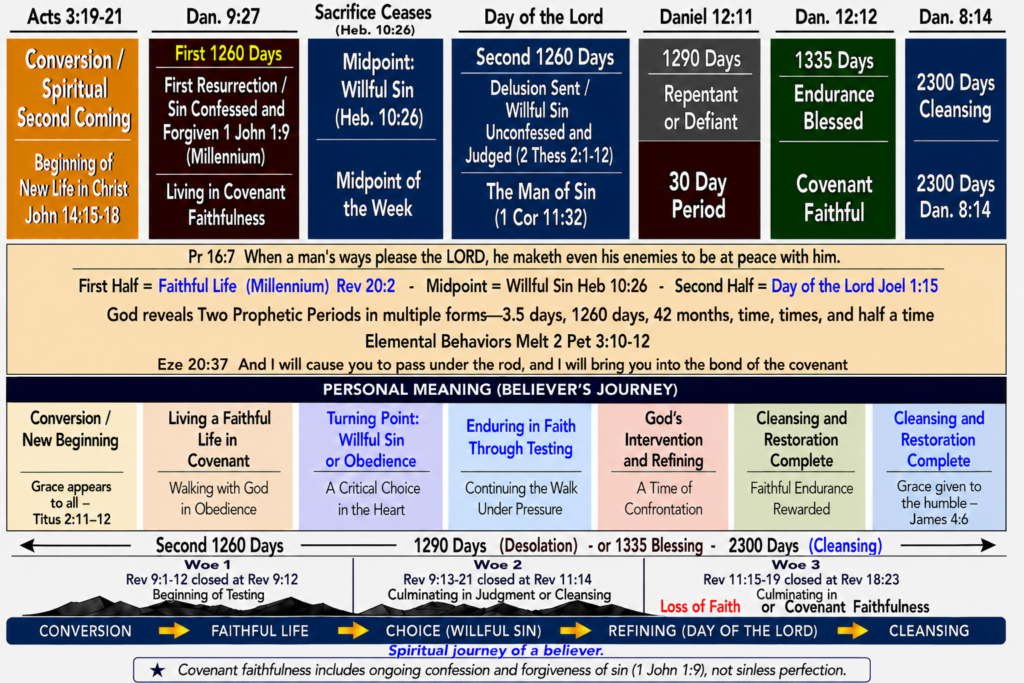
“The prophetic numbers of Daniel are treated throughout this site not primarily as mathematical quantities, but as literary signposts pointing toward covenant realities such as desolation (1290), endurance and blessedness (1335), and cleansing and restoration (2300).”
This pattern is rooted in the Old Testament and follows the symbolic grammar Jesus taught in Matthew 13:11–12, where environmental imagery conceals deeper spiritual realities.
1. TRUMPETS announce the destroying winds withheld by Angels until they are no longer restrained.
This restraint aligns with the seal command, “Do not harm the oil and the wine,” showing that God protects faithful, sealed (obedient) believers while allowing winds to operate only where covenant disobedience removes restraint.
- This restraint mirrors Paul’s teaching in 2 Thessalonians 2:1–4, where the believer’s steadfast obedience and refusal to fall into willful sin act as a restraining force until the appointed time.
- This pattern shows that God’s release of the winds is covenant‑responsive: obedience restrains their activity, while willful sin removes restraint and allows the winds to operate.
- Trumpets announce divine intervention
- Trumpets announce God’s disciplinary warnings against covenant sinfulness.
These winds are the “winds” held back in Revelation 7:1 until God authorizes their release.
2. THE RESTRAINED WINDS OF REVELATION 7
Revelation 7:1 shows four angels holding back the winds of judgment — until the obedient servants of God are sealed. This restraint proves:
- The seals don’t release all judgment; they just describe the tools used in judgment.
- Revelation repeatedly uses the phrase “was given” in the seal descriptions to show that every rider, wind, and force acts only under God’s delegated authority. Nothing in the seals operates independently; each agent receives its mission, limits, and power from Christ Himself. This confirms that the seals release directed tools, not autonomous or chaotic judgments.
- The trumpets are nested within the seal program; they announce and warn the targets of the coming discipline.
- The winds are directed, not chaotic
- Judgment is targeted, not indiscriminate
- The bowls pour out or administer the judgment.
3. TRUMPETS TARGET SPECIFIC COVENANT GROUPS
Each trumpet announces disciplinary warning on a symbolic group, using environmental imagery as concealment— exactly the way Jesus used parables.
Trumpet 1 — Trees & Grass (Revelation 8:7)
- Trees = established believers / mature growth
- Grass = new believers / emerging growth
- Grass frequently symbolizes transient or immature life. Within the covenant context of Revelation, it may point particularly to vulnerable or newly established believers.
One‑third of trees are affected (partial disruption). All grass is burned (new growth curtailed completely).
This matches Jesus’ warning in Matthew 24:19: new life suffers most in times of judgment.
New growth suffers but the “woe is directed towards those providing the milk of the word. I.e. the teachers.
The newborn believer experiences the effects of the trial, but the woe falls chiefly upon those entrusted with feeding the flock. The milk is not the problem; the stewardship of the milk is.
New growth may suffer during times of covenant testing, but Scripture consistently directs its heaviest accountability toward those entrusted to nourish, teach, and oversee the people of God.
Trumpet 2 — Sea & Ships (Revelation 8:8–9)
- Sea = nations/peoples (Revelation 20:8; Isaiah 17:12; Daniel 7:2–3)
- Ships = covenant representatives moving among the nations
- Scripture frequently uses ships as representations of organized human enterprises directed toward a destination (James 3:4). Within Revelation’s symbolic framework, ships may therefore represent covenant representatives or ministries navigating among the nations.
- Within the present covenant model, the ships of Revelation are best understood as believers or covenant ministries subject to divine discipline.
This trumpet wind announces judgment upon the covenant believer—the ‘ships’ navigating the sea of nations. The “ships” are navigating the “sea” of nations, per James 3:4 (ships directed by a small rudder).
These ships represent disobedient believers and indicate their discipline per 1 Cor 11:32.
Jesus Walking on the Sea — Obedient Covenant Members Overcoming Worldly Influence
Jesus walking on the sea (Matthew 14:25; Mark 6:48; John 6:19) is symbolic:
- The sea represents the unstable, rebellious world
- Jesus walking on the sea represents mastery over worldly influences
- Peter walking briefly on the sea represents obedient covenant followers overcoming the world when focused on Christ
- Sinking represents covenantal failure
This imagery integrates directly with Revelation’s symbolism:
- Ships on the sea = believers operating within worldly influences
- Jesus walking on the sea = the obedient covenant community rising above worldly influence
- Those who overcome the world (1 John 5:4–5)
- Those deluded by sin (1 John 1:9; 2 Thessalonians 2:11–12) sink beneath the waves of worldly influence
Thus, the second trumpet’s judgment on “ships” symbolizes the discipline of covenant people that have become compromised by worldly influence.
Jesus walking upon the sea illustrates covenant mastery over the world’s instability.
Those united to Him likewise overcome the world rather than being overwhelmed by it.
Trumpet 3 — Rivers & Springs (Revelation 8:10–11)
- Rivers may symbolize teaching streams
- Springs may represent doctrinal sources. This trumpet corrupts teaching at its source.
- Jeremiah 2:13
- John 7:38
- Amos 8:11
- Wormwood as bitterness/deception.
- The third trumpet therefore depicts the bittering of the covenant community’s sources of nourishment, resulting in spiritual sickness and death among those who drink from corrupted streams
Trumpet 4 — Sun, Moon, Stars (Revelation 8:12)
- Sun = primary spiritual authority
- Moon = reflected authority
- Stars = teachers/leaders
- Genesis 37. Daniel 8. Matthew 24. Revelation 12.
- This may be describing a partial collapse of covenant leadership and spiritual illumination:
Sun struck = primary authority concealed.
Moon struck = subordinate authority diminished.
Stars struck = teachers and representatives affected.
One-third = partial judgment, not total destruction.
Thus, Trumpet Four may not primarily concern astronomy at all. It may represent God partially darkening the covenant community’s sources of guidance and understanding, 2 Thess 2:11.
“Throughout Scripture, celestial imagery frequently represents rulers, authorities, and covenant representatives.”
One‑third darkened = partial loss of spiritual light.
Trumpets 5–6 — Direct Judgment on Unsealed/Disobedient Believers (Revelation 9)
Hostile spiritual forces are released as instruments of discipline — consistent with Job 1–2, 1 Kings 22:19–23, Luke 22:31, and Matthew 25:41.
God does not partner with evil, but He uses hostile powers as instruments of discipline. He does not afflict willingly, per Lamentations 3:33.
4. Jeremiah 4:11–12 — The wind is sent not to cleanse, but to pronounce judgment against God’s people in Jerusalem, as part of the covenant judgment.
Jeremiah describes a wind sent by God:
“A dry wind… not to fan nor to cleanse… a full wind shall come unto me.”
This appears to anticipate the pattern of Revelation’s trumpets: winds released not for cleansing but for covenant judgment.
5. DAY OF THE LORD “AS A THIEF” = SUDDEN SPIRITUAL INTERVENTION
The Day of the Lord comes suddenly, invisibly, and disruptively. This matches the sudden release of wind at the trumpets.
It is not merely physical judgment — it is spiritual forces unleashed suddenly.
6. JESUS EMPLOYING THE DEVIL AND HIS ANGELS (MATTHEW 25:41)
Matthew 25:41 shows Jesus has authority over the devil and his angels.
Throughout Scripture, hostile powers are used as instruments of divine discipline:
- Job 1–2
- 1 Kings 22
- Luke 22:31
- Revelation 9
This is not partnership — it is sovereign employment of hostile forces for covenant correction.
7. COVENANT DISCIPLINE (1 CORINTHIANS 11:32)
Paul explains:
“When we are judged, we are disciplined by the Lord, so that we will not be condemned with the world.”
This is the entire structure of Revelation:
- Seals — illustrate the tools of discipline
- Trumpets — warn the covenant community through partial one‑third judgments.
- Bowls — discipline poured out on the believer
The trumpets are disciplinary winds/spirits.
Ezekiel 20:37 KJV — And I will cause you to pass under the rod, and I will bring you into the bond of the covenant:
8. SYMBOLIC CONCEALMENT (MATTHEW 13:11–12)
Jesus said He used parables to conceal truth from the unprepared and reveal truth to the spiritually awakened. Revelation uses the same symbolic grammar:
- Trees = people
- Grass = new believers. Grass frequently symbolizes transient or immature life. Within the covenant context of Revelation, it may point particularly to vulnerable or newly established believers.
- Sea = nations
- Ships = believers
- Rivers = doctrine
- Sun/Moon/Stars = spiritual authority
- Earth = Dry Land
- Winds = directed spirits
Refined Description of “Earth” in Revelation (with full canonical references)
In Revelation, “earth” symbolizes the fallen covenant condition — the realm where disobedient or shaken covenant members land when divine winde dislodges them from their heavenly standing. It is the spiritual ground of judgment, not the realm of obedience.
This meaning is reinforced by multiple passages:
- Revelation 6:13 — stars (covenant leaders) fall to the earth when shaken by the wind of The Day of the Lord, just as figs fall from a tree shaken by a strong wind.
- Revelation 12:9 — the dragon casts stars down to the earth, symbolizing the collapse of covenant authority into judgment.
- Revelation 13:8, 12, 14 — “earth‑dwellers” are consistently those in a fallen, deceived covenant condition, contrasted with heaven‑dwellers.
- Revelation 8–9 — trumpet judgments repeatedly strike “the earth,” meaning the covenant community in its flesh‑bound, disobedient state.
- Ezekiel 9:4 — the faithful remnant remain spiritually “in heaven,” marked and protected, while the unfaithful fall into the realm of judgment.
- Nahum 3:12 — figs shaken by wind fall “into the mouth of the eater,” paralleling Revelation’s imagery of figs/stars falling into judgment.
Together these passages show:
Earth is not the physical planet but the symbolic realm where covenant members fall when shaken out of heavenly alignment. It is the place where judgment lands, where delusion operates, and where disobedience is exposed.
This definition preserves the simplicity of “dry ground” while giving the full canonical depth behind the symbol.
Revelation employs symbolic concealment in the same manner as Christ’s parables.
Summary
The trumpet judgments reveal the breathtaking scope of God’s covenant work: He directs His wind across the whole earth while simultaneously shaping, correcting, and sustaining each believer individually. The same winds that discipline nations also refine hearts. The same judgments that strike compromised ministries also strengthen obedient followers who rise above worldly influence, as symbolized by Jesus walking on the sea. Revelation’s imagery shows that God never loses sight of the individual while governing the many. Every believer is personally known, personally disciplined, personally protected, and personally invited to overcome. The immensity of God’s work is this: He executes global covenant judgment and intimate personal refinement at the same time, with perfect precision, perfect justice, and perfect love.
Before moving into the personal implications of these trumpet judgments, it is helpful to see how all of Revelation 6–20 fits together as a single covenant‑discipline pattern. The following expanded synthesis brings together the martyrs’ plea, the linguistic meaning of divine vengeance, the collapse of Babylon’s internal corruption, and the unified operation of the seals, trumpets, and bowls. Readers who want the full integrated framework may open the section below.
How the Seals, Trumpets, and Bowls Fulfill the Martyrs’ Cry
In Revelation 6–20 the cry of the “beheaded” saints—understood as those who have died to the flesh and to Babylon’s internal corruption—asks God “How long?” not for personal retaliation but for the full execution of divine vengeance, a term linguistically rooted in the Greek ekdikēsis (“to bring out justice, to vindicate, to restore what was violated”) and the Hebrew nāqām (“to restore holiness, to purify what was defiled, to act on behalf of the oppressed”), meaning God’s intervention to liberate His people and destroy the corrupting Babylonian system within them; and although some object that “beheaded” must refer only to literal martyrs and that vengeance must be directed primarily at unbelievers, Revelation’s own symbolic grammar (e.g., stars falling, earth‑dwellers, Babylon as a harlot city) and its covenant focus (churches addressed first, discipline beginning with God’s house) show that internal covenant corruption is a primary target of judgment, with literal martyrdom standing as the sharp edge of a broader spiritual reality of dying to the world; likewise, while many read the seals, trumpets, and bowls as strictly sequential and aimed mainly at the wicked world, the repeated one‑third patterns, shared imagery, and interlocking retributive markers (Rev 6:10; 16:6; 18:20–24) argue strongly for a concurrent, layered description of one covenant‑discipline process rather than three unrelated timelines, and the objection that vengeance language must mean sheer punitive wrath is answered by the consistent canonical pattern in Jeremiah, Ezekiel, Daniel, and Paul (1 Corinthians 11:32), where God’s “vengeance for His temple” purifies His people so they are not condemned with the world; thus God answers the martyrs’ plea through the seals, trumpets, and bowls, which function as His vengeance for His temple by shaking, exposing, and collapsing the spiritual architecture of Babylon inside His people while leaving the external world‑system in place to be used in the lives of other believers who still struggle to depart from Babylon, even as Christ Himself treads the winepress of God’s wrath (Rev 19:15) in the final destruction of the man of sin in 2 Thessalonians 2:8. The Sin or wickedness is removed from the indiuvidual in 2 Thess.
The judgments become not acts of arbitrary retaliation but the progressive dismantling of Babylon’s influence within the faithful individual, freeing those still entangled, refining them through fire, vindicating the spiritually beheaded saints, and preparing the entire community of believers for the ultimate external overthrow of the corrupting powers and the full establishment of Christ’s kingdom within the Christian individual.
9. THE IMMENSITY OF GOD’S SIMULTANEOUS WORK IN EVERY BELIEVER
The trumpet judgments reveal not only the structure of covenant discipline but also the staggering immensity of God’s personal involvement in the life of every believer. Scripture shows that God’s wind does not move impersonally or mechanically. It moves with perfect precision, touching each covenant member exactly where discipline, correction, or strengthening is needed.
God’s dealings are never generic. They are individual, simultaneous, and perfectly measured.
- He searches every heart at once (Jeremiah 17:10).
- He weighs every spirit (Proverbs 16:2).
- He disciplines each believer personally (1 Corinthians 11:32).
- He exposes delusion in the disobedient (2 Thessalonians 2:11–12).
- He restores the repentant instantly (1 John 1:9).
- He empowers the obedient to rise above the world (Matthew 14:25; 1 John 5:4–5).
The same sovereign God who directs the trumpet judgments also directs the sanctification, correction, and preservation of every believer, applying discipline, correction, protection, and refinement with infinite accuracy. Jesus walking on the sea symbolizes this mastery: He stands above the nations, above the instability of the world, and He enables His obedient followers to do the same. At the very same moment, He disciplines those sinking beneath worldly influence, calling them back to covenant faithfulness.
The immensity is this: God executes global covenant discipline while simultaneously guiding, correcting, and sustaining every individual believer — all at once, without strain, without confusion, and without delay.
The trumpets reveal not only the structure of judgment but the breathtaking scope of God’s personal involvement. Every believer is seen. Every believer is known. Every believer is disciplined in perfect measure. And every believer is invited to rise above the sea of the world, walking where Christ walks, overcoming where He overcomes.
Conclusion
The trumpet judgments of Revelation are directed winds/spirits, summoned by God, released suddenly like the Day of the Lord, employing even hostile spiritual powers under Christ’s authority, and aimed at specific covenant groups for discipline — not final destruction. The imagery is symbolic, consistent with Jesus’ parabolic method, and deeply rooted in the Old Testament’s wind/spirit‑driven pattern of judgment. Jesus walking on the sea reinforces this symbolic grammar: obedient covenant followers rise above worldly influence.
In this way, the covenant‑discipline pattern revealed in Daniel and Revelation leads the believer into what Proverbs 2:5 calls ‘the knowledge of God.’
As Scripture declares, ‘Then shalt thou understand the fear of the LORD, and find the knowledge of God’ (Proverbs 2:5).
In Revelation 6–20 the cry of the “beheaded” saints—understood as those who have died to the flesh and to Babylon’s internal corruption—asks God “How long?” not simply as a question about time but also, in the original languages, as a question about manner and means, since both Hebrew and Greek allow “how long?” to mean “By what means will You act?” or “In what way will You intervene?”; and although some object that “beheaded” must refer only to literal martyrs and that vengeance must be directed primarily at unbelievers, Revelation’s symbolic grammar (stars falling, earth‑dwellers, Babylon as a harlot city) and its covenant focus (churches addressed first, discipline beginning with God’s house) show that internal covenant corruption(Babylon Rev and Jer 51:49) is a primary target of judgment, with literal martyrdom standing as the sharp edge of a broader spiritual reality of dying to the world; likewise, while many read the seals, trumpets, and bowls as strictly sequential and aimed mainly at the wicked world, the repeated one‑third patterns, shared imagery, and interlocking retributive markers (Rev 6:10; 16:6; 18:20–24) argue strongly for a concurrent, layered description of one covenant‑discipline process rather than three unrelated timelines, and the objection that vengeance language must mean sheer punitive wrath is answered by the consistent canonical pattern in Jeremiah, Ezekiel, Daniel, and Paul (1 Corinthians 11:32), where God’s “vengeance for His temple” purifies His people so they are not condemned with the world; thus God answers the martyrs’ question—not only “How long?” but “By what means?”—through the seals, trumpets, and bowls, which together reveal the method of His intervention: the seals release the agents of discipline, the trumpets warn and shake the covenant community, and the bowls apply the full corrective judgment that the saints requested, shaking, exposing, and collapsing the spiritual architecture of Babylon inside His people while leaving the external world‑system in place to be used in the lives of believers who still struggle to depart from Babylon, even as Christ Himself treads the winepress of God’s wrath (Rev 19:15) in preparation for the final destruction of the man of sin in 2 Thessalonians 2:8, so that the judgments become not acts of arbitrary retaliation but the progressive dismantling of Babylon’s influence within the faithful individual, freeing those still entangled, refining them through fire, vindicating the spiritually beheaded saints, and preparing the entire community of believers for the ultimate external overthrow of the corrupting powers and the full establishment of Christ’s kingdom
.
Although the words “How long?” in Greek and Hebrew literally mean “Until when?”, throughout Scripture this cry is more than a question about time. It expresses a longing for God to act and is often followed by the revelation of how He will intervene. Revelation follows this same biblical pattern. The martyrs cry, “How long?” (Revelation 6:10), and God answers by unfolding the seals, trumpets, and bowls, revealing the divinely appointed process through which He brings judgment, correction, and ultimately deliverance.