
🕒 7 min read · 📝 1382 words
By God’s grace: for years I have studied Scripture with one guiding conviction: that the Bible must be allowed to interpret itself, even when its patterns lead us away from familiar doctrinal paths.
As I traced the covenant rhythms, prophetic structures, and the warnings of Jesus, I found that many long‑standing theological assumptions could not bear the weight of Scripture’s own internal logic.
What emerged was a framework that departs from nearly every major doctrinal system—not for the sake of novelty, but because the text itself consistently pressed me toward a different, unified pattern.
These pages, Images, charts and videos, along with the book I wrote, preserve that journey as it unfolded.
These pages were not written as a traditional book, nor were they shaped to fit a predetermined theological system.
They were formed through discovery—layer by layer, passage by passage, pattern by pattern.
For that reason and for convience, I have chosen to present them as they are, without rewriting them into a single linear argument.
Their original structure, tone, and progression remain intact because they reflect the actual process by which these insights were uncovered.
You will notice that this work differs sharply from the doctrinal positions most Christians inherit from their fathers’ generations.
A brief clarification is needed here, because one inherited assumption sits so deeply in the Christian imagination that it can distort everything that follows if left unaddressed.
Many believers equate the “eternal fire” of judgment with the idea that humans consciously burn forever.
Scripture does not teach this.
The fire is eternal because it was prepared for eternal beings—the devil and his angels (Matt 25:41).
Humans, by contrast, were created mortal, capable of entering that realm of punishment but not of existing eternally within it.
Jesus Himself teaches that a person may be released after judgment has accomplished its purpose (Matt 5:26), and that both soul and body can be destroyed in Gehenna (Matt 10:28).
For this reason, references to “eternal punishment” describe the permanence of the outcome, not an unending experience of torment.
This distinction is essential for understanding the patterns traced throughout these pages.
As Jesus Himself said, there are truths that cannot be borne all at once.
Joh 16:12 I have yet many things to say unto you, but ye cannot bear them now.
(KJV)
The traditional view of Hell has been reinforced over a lifetime for many believers, and its refutation cannot be absorbed in a single moment.
The clarification offered here is simply meant to remove an obstacle, not to settle the entire matter.
The fuller pattern will become clear as the pages unfold.
This interpretation challenges assumptions about the covenant community, exposes patterns of delusion and discipline within the church, reframes familiar passages such as Matthew 24, and emphasizes the training work of grace in ways rarely taught today.
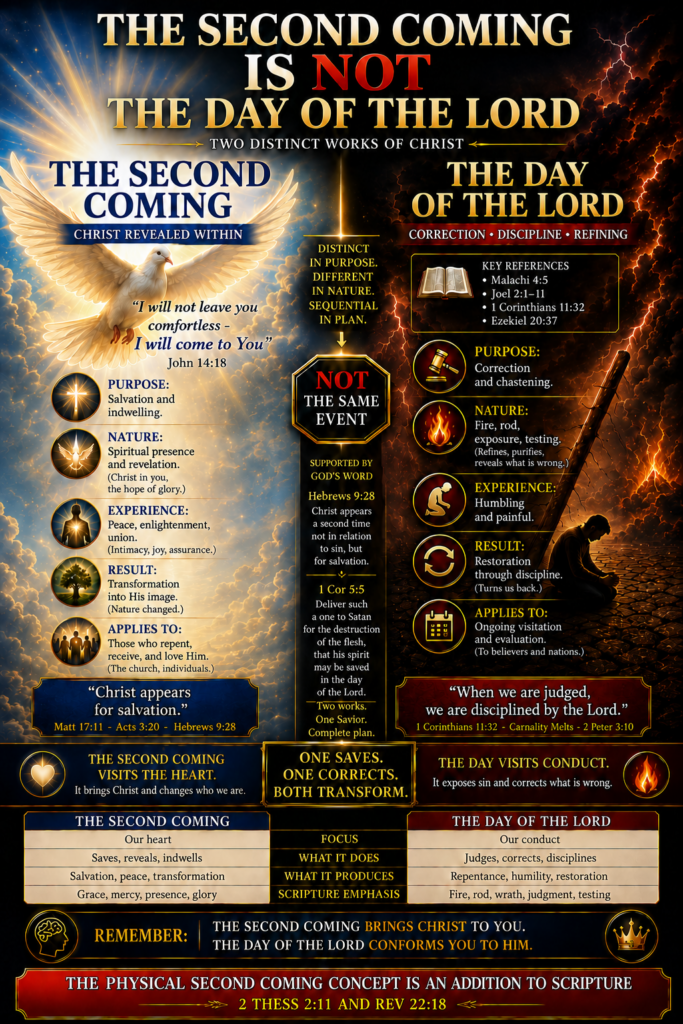
These departures are intentional, not reactionary.
They arise from allowing Scripture to speak on its own terms, even when its voice cuts across the grain of tradition.
My aim is to preserve these insights.
These pages represent the structure, clarity, and coherence that emerged through years of study, and they are gathered here so that nothing is lost.
I invite you to walk through them slowly, testing everything against the Word of God.
If you do, I believe you will see the same patterns that compelled me to rethink nearly everything I had assumed.
This is not a system. It is not a movement.
This interpretation is simply the record of what God, through Scripture, revealed when I allowed it to speak without forcing it into inherited categories.
My hope is that this compilation will serve as a faithful witness to that process, and as a resource for any who desire to see the covenant patterns of God with fresh eyes.
Because these patterns are not abstract but deeply rooted in Scripture’s own symbolic grammar, it is fitting to begin with the place where God first revealed this structure with clarity: Daniel’s 70th week.
God showed this pattern of the Christian life to Daniel in what is called Daniel’s 70th week illustration –
The “confirmation” week in Daniel 9:27 stands as the Old Testament pattern that anticipates and explains the New Testament work of “conforming” believers to the image of Christ (Rom 8:29). As this process unfolds, the natural outcome is the revelation of Christ within the believer—what Scripture describes as “Christ in you, the hope of glory.”
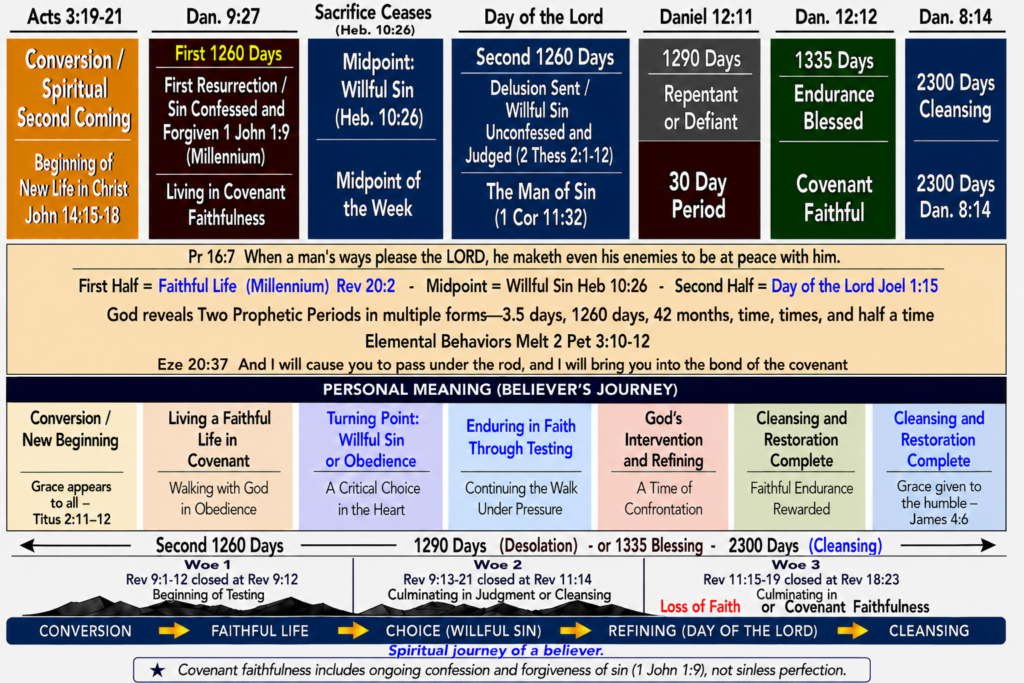
These Patterns are seen throughout scripture in various symbolic representations, particularly in Revelation.
The latter half of Daniel’s 70th week is symbolized by the three woes described in Revelation.
Hebrews 10:26 explains the end of the sacrifice as the moment a believer willfully sins. When God sees this, He begins the process of cleansing the person from that sin, just as He dealt with Job’s self-righteousness.
The first step in this discipline process (which by the way is called the Day of the Lord) is the sending of delusion seen in 2 Thess 2:11 as the Christian man of sin falls from their obedience position into disobedience.
The person is deluded, and this delusion facilitates judgment intended for cleansing per 1 Cor 11:32.
The first woe is discipline after that willful sin, the second is further discipline, including and up to the point of the loss of faith, and the third is the loss of faith seen in Rev 18:23.
The entire process can be summed up as the grace of God teaching a Believer to deny ungodliness Titus 2;11-12.
One of the most surprising patterns that emerged in this study is that delusion is not only a form of covenant judgment—it is also a form of covenant protection.
When a believer willfully turns from obedience, God sends delusion (2 Thess 2:11) not merely to expose the heart but to shield the person from a fuller awareness that would bring greater guilt.
This veil prevents them from seeing clearly while they are in rebellion, limiting their accountability until the discipline has accomplished its purpose.
1Ti 1:13 Who was before a blasphemer, and a persecutor, and injurious: but I obtained mercy, because I did it ignorantly in unbelief.
In this way, delusion functions as both a severe mercy and a protective barrier, preserving the believer from deeper condemnation while God works to bring them to repentance and restoration.
This also helps explain why unbelievers cannot grasp the things of God (Matt 13:11–12).
Just as delusion veils the disobedient believer for protection and eventual restoration, spiritual blindness veils the unbeliever until God grants understanding.
In both cases, the inability to see is not merely human weakness—it is a sovereign act of God that limits accountability until the heart is prepared to receive truth.
As you move through these pages, my hope is that the same scriptural patterns that reshaped my understanding will open before you with the clarity and weight they carried for me.
Not through persuasion, but through the quiet authority of Scripture interpreting Scripture—its covenant rhythms, prophetic structures, and gracious disciplines forming a single, unified testimony.
If these studies accomplish anything, may they draw you toward the God who corrects in mercy, restores in faithfulness, and trains His people through every rise and fall of their covenant walk.
May the patterns preserved here help you see His ways with renewed eyes, so that your own journey may be shaped by the same grace that has shaped mine.
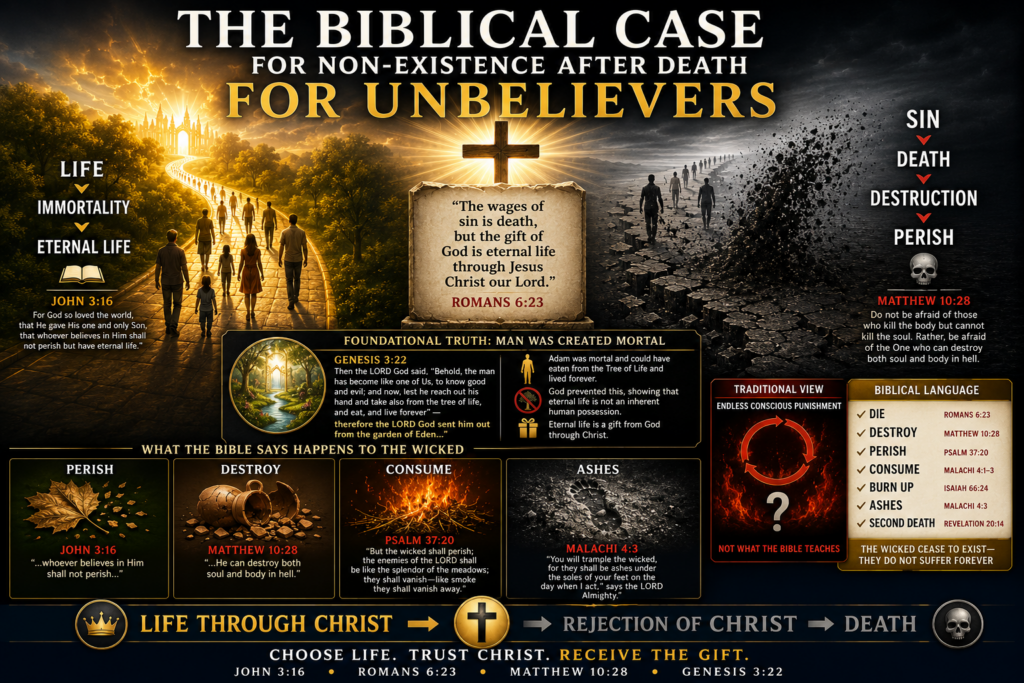
Adam and Eve were not created immortal. They were created mortal, with access to the Tree of Life. The Tree of Life was the means by which immortality could be received. Christ is that Tree.