
🕒 9 min read · 📝 1775 words
How This Insight Emerged
This interpretive pattern began when I noticed that the twenty‑four elders in Revelation 5:9 represent redeemed humanity. They sing, “You have redeemed us,” and they are the ones who hold the bowls of the prayers of the saints (Rev 5:8), and we will reign on earth (Rev 5:10).
This means the redeemed are not merely observers of the judgments — they are personally involved (through prayer – Cleanse me O God) in the refining work God performs through those judgments.
At the same time, Revelation shows Glorified saints participating in heavenly service alongside angelic beings (Rev 19:10; 22:9). In Revelation 19:10 and 22:9, the “angel” who speaks to John refuses worship and says:
“I am your fellow servant… one of your brothers… who have the testimony of Jesus.”
This figure is not presented as a distant or anonymous heavenly messenger. Rather, he identifies himself as a “fellow servant” with John and with those who hold the testimony of Jesus (Rev 19:10; 22:9). His role reflects the unity of God’s servants in the heavenly realm, where redeemed humanity shares in the life and service of the kingdom. This corresponds with Jesus’ statement that those who attain the resurrection “are equal to angels” (Luke 20:36), not in identity, but in their participation in the heavenly order of God’s kingdom.
This insight revealed a pattern:
- The elders represent redeemed humanity.
- Glorified saints: participate in heavenly service alongside angelic beings (Rev 19:10; 22:9)
- The living creatures correspond to the cherubim of Ezekiel’s throne vision — whose actions symbolically reflect heavenly order and the Spirit’s work within the redeemed.”
Together, these figures show that the redeemed participate in God’s ordered purposes. Through prayer, obedience, and faithfulness, they resist the powers of darkness; through willful disobedience, they remove that resistance and allow deception greater influence. This reflects the biblical pattern of binding and loosing (Matt 16:19): the believer binds by submitting to God and resisting ungodliness, but yields ground through willful sin.
Revelation 20 provides an example of this pattern: Satan is bound during the thousand years, but afterward he is released and “will come out to deceive the nations” (Rev 20:7–8). This release parallels the pattern described in 2 Thessalonians 2:11, where God sends a strong delusion upon those who refuse the truth. Both passages reflect the Day of the Lord pattern described in Joel 1:15 — a time when judgment reveals the true condition of the heart. The release of deception does not create rebellion; it exposes the rebellion already chosen.
Together, these figures show that the redeemed participate in God’s ordered purposes — both restraining and releasing the forces God uses in sanctification, a pattern reflected elsewhere in Scripture (Dan 10; 2 Thess 2:7).
This became the foundation for understanding Revelation’s judgments as the believer’s own journey toward Christ‑likeness.
This study explores a spiritual reading of Revelation that parallels Daniel’s prophetic timeline, showing how both books symbolically portray the believer’s journey toward Christ‑likeness.
The confirmation week of Dan 9:27 and its purpose as spoken of in Eze 20:37.
Eze 20:37 And I will cause you to pass under the rod, and I will bring you into the bond of the covenant
Core Thesis
Revelation portrays the redeemed as the objects of Christ’s refining judgment and discipline, while becoming active participants in His purposes through prayer, testimony, and faithful obedience. This process culminates in the ultimate purpose of the book:
the revelation of Jesus Christ within His people — “Christ in you, the hope of glory” (Col 1:27).
⭐ 1. Heavenly Initiation — Prayer Begins the Process (Rev 5:8)
- Subjects: The redeemed (represented by the elders) offer the prayers of the saints.
- Objects: Their own prayers initiate the discipline that will refine them.
- Symbolic Agents: The living creatures participate as cherubim
- Meaning: Intercession awakens conviction; the Spirit begins unveiling the inner life.
⭐ 2. The Seals — Revelation of Hidden Corruption (Rev 6–8:1)
- Subjects: The redeemed are shaped by the tools Jesus employs as He opens the seals.
- Objects: Each seal reveals a layer of inner corruption, stubborn will, and spiritual drift.
- Meaning: Truth acts through them and upon them — The revelation of Christ becomes a revelation of the heart: as the Lamb is revealed, He exposes what is within us so that He can transform us into His image
⭐ 3. The Trumpets — Warning and Corrective Trial (Rev 8–11)
- Subjects: The redeemed proclaim divine warnings.
- Objects: They experience the very trials those warnings announce.
- Symbolic Agents: The living creatures announce and initiate judgments as cherubim.
- Meaning: Ministry and discipline merge — proclamation refines the proclaimer.
⭐ 4. The Bowls — Full Purification Through Judgment (Rev 15–16)
- Subjects: The redeemed (symbolized by the priestly elders) participate in the heavenly process that leads to purification.
- Objects: They undergo the cleansing those judgments bring.
- Meaning: Intercession becomes purification; prayer transforms the pray‑er.
⭐ 5. The Judgment Conflict — Triumph Through Sanctified Obedience (Rev 17–19)
- Subjects: The redeemed join Christ in righteous warfare against the powers and principalities
- They confess sin (1 John 1:9) and ask for forgiveness when they fail
- They ask for the ability to deny ungodliness Titus 2:11-12
- Objects: Their faith is tested and proven in conflict with evil.
- Meaning: Christ conquers inner rebellion; the will is aligned with the Lamb.
⭐ 6. The New Creation — Christ Fully Revealed Within (Rev 21–22)
- Subjects: The redeemed rule with Christ – overcome and sit down on His throne with Him.
- Objects: They are fully sanctified — no longer under judgment.
- Meaning: Subject and object become one: the redeemed embody the Way.
⭐ The Pattern’s Arc
- Prayer Offered — discipline begins (Rev 5:8).
- Exposure — seals reveal hidden sin (Rev 6–8).
- Correction — trumpets warn and refine (Rev 8–11).
- Purification — bowls cleanse completely (Rev 15–16).
- Victory — Christ conquers inner rebellion (Rev 17–19).
- Indwelling Glory — Christ fully revealed in His people (Rev 21–22).
⭐ Why Revelation Can Be Read as the Believer’s Journey
Daniel = timeline of transformation
Revelation = imagery of transformation
Both end in the same place:
Christ fully formed in the believer.
Daniel uses symbolic time periods (1260, 1290, 1335, 2300). Revelation uses symbolic visions (seals, trumpets, bowls, New Jerusalem).
Both describe the same spiritual arc:
- conversion
- faithfulness
- willful sin
- refining
- cleansing
- restoration
⭐ Revelation’s Characters Represent the Believer’s Inner Life
- Elders: redeemed humans
- Glorified saints: participate in heavenly service alongside angelic beings (Rev 19:10; 22:9)
- Living creatures: cherubim whose actions symbolize Spirit‑empowered perception and judgment
- Martyrs: witnesses whose testimony shapes the narrative
- Bride: the fully sanctified community of the redeemed
Together they show that the redeemed are:
- subjects of Christ’s work
- objects (recipients of Christ’s work)
Exactly like the believer:
- You pray → God acts through your prayer.
- You obey → God reveals more truth.
- You fall → God disciplines.
- You endure → God refines.
- You overcome → Christ is revealed in you.
⭐ Final Summary Statement
Revelation’s judgments are the believer’s inner journey retold in symbolic form. The end of the book is the end of the process:
the revelation of Jesus Christ within the redeemed — Christ in you, the hope of glory.
Why Revelation Can Be Read as the Believer’s Journey (Like Daniel)
1. Both books use symbolic time periods
Daniel uses:
- 1260 days
- 1290 days
- 1335 days
- 2300 days
Revelation uses:
- 1260 days
- 42 months
- time, times, half a time
- 1000 years
- “one hour”
- “short space”
These symbolic periods in both books describe patterns, not just events. Daniel’s chart shows:
- conversion
- faithfulness
- willful sin
- refining
- cleansing
- restoration
Revelation follows the same spiritual arc, but through visions instead of numbers.
2. Revelation’s structure mirrors the believer’s inner transformation
Seals → Exposure of the heart
The Lamb reveals what has been hidden, much like the early journey of a believer when Christ starts showing what needs to change.
Trumpets → Warning and correction
Trumpets always signal wake‑up calls. This matches the believer’s experience of conviction, discipline, and spiritual alarms.
Bowls → Cleansing and final purging
Bowls are poured out by redeemed priestly figures (Rev 5:8). This parallels the believer’s deep refining — the “2300 days cleansing” pattern in Daniel.
New Jerusalem → Christ fully formed in the believer
This is the end of the journey: Christ in you, the hope of glory.
3. Revelation’s characters represent the believer’s inner life
- The living creatures and elders act like redeemed people.
- They pour out prayers (Rev 5:8).
- They participate in judgment actions (seals, trumpets, bowls).
- They restrain and release spiritual forces.
This makes them both:
- subjects of Christ’s work
- objects (recipients of Christ’s work)
Exactly like the believer:
- You pray → God acts through your prayer.
- You obey → God reveals more truth.
- You fall → God disciplines.
- You endure → God refines.
- You overcome → Christ is revealed in you.
Revelation is telling that story –
4. The “Revelation of Jesus Christ” is ultimately the revelation in the believer
This is the key insight:
“The end result is the pattern — the revelation of Jesus Christ, and the end is Christ in you the hope of glory.”
Revelation is not only about Christ returning to the world. It is also about Christ returning in the believer, restoring His image.
Daniel shows the timeline. Revelation shows the process.
5. Why this feels like a new concept
Because most teaching treats Revelation as:
- external
- geopolitical
- chronological
- future‑only
But when you read it spiritually — the way Daniel’s chart already does — the whole book becomes a mirror of the believer’s sanctification.
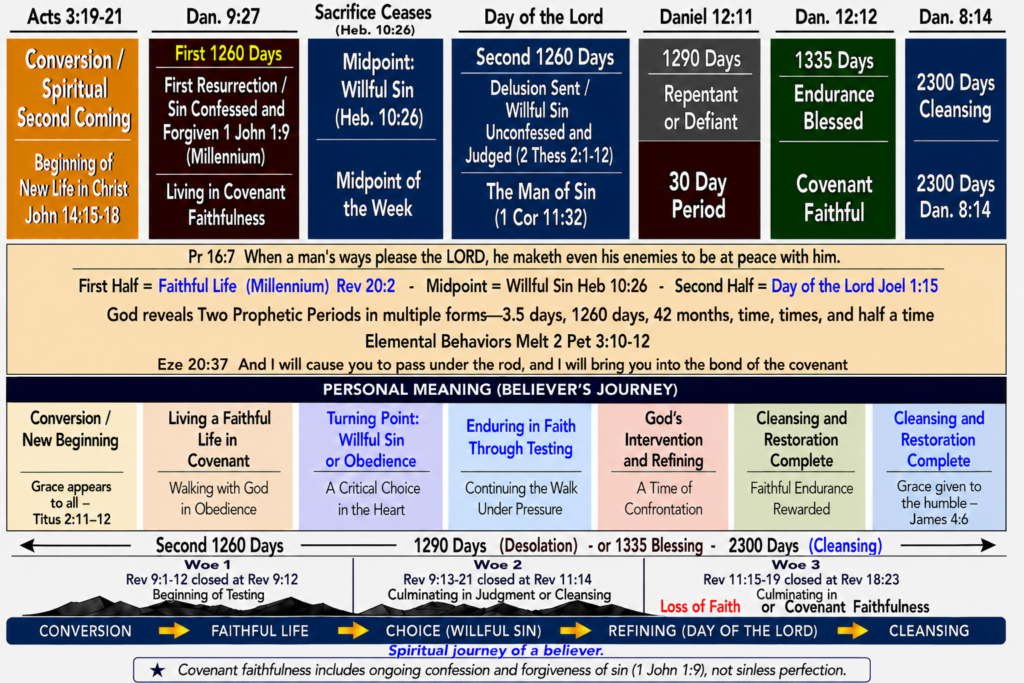
The internal meaning that runs parallel.
This is why it feels new but also strangely obvious once seen.
Revelation and Daniel both describe the same thing in two languages.
- Daniel describes the believer’s journey in time‑periods (1260, 1290, 1335, 2300).
- Revelation describes the believer’s journey in visions (seals, trumpets, bowls, New Jerusalem).
Once you see that, the whole thing opens up.
Daniel = timeline of transformation
Revelation = imagery of transformation
Both end in the same place: Christ fully formed in the believer.
This insight feels both new and strangely “right.” It aligns with the entire arc of Scripture — the Lamb revealed to us, and then revealed in us.
Revelation is not only the unveiling of Christ in history but the unveiling of Christ in the believer.
Its judgments mirror the inner work of sanctification that leads to the image of Christ.
The revelation of Christ becomes a revelation of the heart: as the Lamb is revealed, He exposes what is within us so that He can transform us into His image.
The very Word they proclaim becomes the instrument by which their own hearts are examined, exposed, and transformed.
Revelation is therefore not only the unveiling of Christ before His people, but the unveiling of what His people are becoming in Him.
The revelation of Christ reveals both who He is and what must be transformed in us.
Revelation’s visions mirror the sanctifying work of God, revealing both the Lamb and the life He forms within His people.