
🕒 10 min read · 📝 1858 words
“Thus saith the Lord GOD; I will yet for this be enquired of by the house of Israel, to do it for them; I will increase them with men like a flock.” — Ezekiel 36:37
Ezekiel 36 reveals a profound covenant principle: God promises restoration, renewal, multiplication, cleansing, and the return of His presence — yet He declares that His people must ask Him to do the very things He has already promised.
This is not because God is reluctant. It is because covenant restoration is relational. God acts for His name’s sake, but He does so through the obedient asking of His Spirit‑renewed people.
Ezekiel 36:37 confronts the idea that God’s promises unfold automatically. Instead, the Lord says:
“I will do it — but I will be enquired of to do it.”
This page gathers the doctrinal and prophetic implications of that truth.
📜 What We’ve Been Taught—And Why It’s Worth Rethinking
Embedded Doctrinal Drift: A Historical Snapshot
Darby (1830s): Introduced dispensationalism and pre‑tribulation rapture, shifting prophecy away from transformation and toward distant predictions.
John Nelson Darby mistakenly viewed the revelation of Jesus as an external, future event rather than an internal reality for believers.
John 14:23 and Colossians 1:27 teach that through love and obedience, Christians experience the indwelling of the Father and the Son, and that “Christ in you” is the hope of glory.
Brookes (1830–1897): A Presbyterian minister and early dispensationalist who mentored C.I. Scofield and helped institutionalize futurist eschatology.
Scofield (1909): Embedded Darby’s views into American evangelical study habits through the Scofield Reference Bible.
Branham (1946–1965): Merged dispensational themes with charismatic revivalism, claiming prophetic authority.
Seminary Adoption (1950s–present): These interpretations became mainstream through repetition, institutional endorsement, and emotional appeal.
These views became dominant not through Scripture alone, but through tradition and reinforcement, often distorting the original context of prophetic texts.
For many believers, the prophetic landscape has been muddied for 150 years — not by Scripture, but by the traditions built around it.
⭐ The Angel‑of‑Light Delusion and the Rise of the False Prophet
1. How False Illumination Produces the False Prophet Identity
When God withdraws His protective presence, Satan is permitted to operate “as an angel of light” (2 Cor 11:14). He offers false illumination — deception that feels like revelation. Error feels like insight. Misreading feels like clarity. Prophetic fantasy feels like spiritual discernment.
This is the beginning of spiritual delusion:
• deception feels like revelation • error feels like insight • misreading feels like clarity • fantasy feels like prophecy • self‑confidence feels like faithfulness
The person is not malicious — they are mis‑illuminated.
This delusion is the God‑permitted disciplinary blindness of 2 Thessalonians 2:11 — sent not for condemnation but for judgment (2 Thess 2:12), so that the hidden offense may finally be seen.
This is the same pattern God used with Job: before his ordeal the inner “man of sin” was enthroned within him, unseen by Job but fully seen by God. Through pressure God exposed the concealed self‑righteousness, illustrating the offense so repentance could occur — just as Leviticus 16:21 shows that sin must be identified before it can be carried away.
This is why God says in Jeremiah 3:13, “Only acknowledge your guilt.” The delusion is the mechanism that brings the hidden sin into awareness so acknowledgment becomes possible.
This is also why biblical authors pray, “Search me… show me the wicked way in me” (Psalm 139:23–24).
No one can repent of what they cannot see. God may use the intercession of other believers to reveal the hidden offense, but the individual must choose how to respond to the knowledge given.
The intercession of other believers can open the door, but acknowledgment and repentance belong to the person themselves.
This writing follows that same pattern. Its purpose is not to condemn but to illuminate. Scripture teaches that God often uses teaching, discipline, and intercession to reveal what a person cannot see on their own. Yet the individual must choose how to respond.
The Word teaches that God “disciplines everyone He accepts as a son.” This is simply the normal experience of every believer. We all need His correction because we rarely perceive our own faults clearly.
Paul also notes that “there must be differences among you to show which of you has God’s approval.” These differences are not weapons for accusation but tools God uses to reveal hearts and guide His people toward repentance and maturity.
Why Pressure Makes Us Ask “Why?”
Every human being instinctively asks “Why?” when under pressure.
This universal reaction is not rebellion — it is the soul encountering revelation.
Pressure is the moment God brings us to the edge of our blindness. The heart senses that something hidden is being touched, and the question “Why?” rises automatically.
Pressure exposes what we could not see, so that acknowledgment (Jer 3:13) becomes possible.
This is exactly what happened to Job: his “why?” was the doorway through which God revealed the concealed self‑righteousness that needed repentance.
How Delusion Hardens Under Pressure
As pressure increases, the person:
• doubles down • reinterprets Scripture to protect the delusion • rejects correction • gathers followers • feels “called” to defend their insight • believes they are helping the church • becomes emotionally invested in the system
This is where the false‑prophet identity begins to form — not from malice, but from the stubborn refusal to repent of the false light they have embraced.
How the False Prophet Rises
At this hardened stage:
• the delusion becomes a prophetic identity • the person becomes an “advocate” (Rev 9:19; 13:5–6) • they speak confidently in God’s name • they teach the delusion as truth • they recruit others • they reinterpret all Scripture through the false light • they believe they are defending God • they cannot see their own danger
This is the biblical false prophet:
• not a cartoon villain • not a pagan sorcerer • but a deluded covenant insider • animated by false illumination • functioning prophetically in the wrong direction
2. Matthew 24 and the Deluded Groups Inside the Covenant Community
Jesus’ warnings in Matthew 24 are directed not at pagans but at deluded covenant insiders who have embraced false illumination.
These are the very groups Jesus commands His faithful ones to separate from:
• false christs — offering counterfeit revelation • false prophets — speaking confidently from false illumination • misled brethren — following the delusion • betrayers — turning against the faithful • the many who fall away — hardened under pressure
Jesus’ command to “flee” is a call to covenantal separation from these deluded groups, not a geographical escape.
The danger is internal, not external — the false light spreads within the covenant body, and the faithful must discern and withdraw.
⚠️Covenant Discipline and Separation: A Simple Explanation: Flee to the Mountains
The warnings of Jesus in Matthew 24:15–16, Paul in 1 Thessalonians 4:15 and 1 Corinthians 5:11, and the heavenly call of Revelation 18:4 are directed toward covenantal believers—those who confess sin and receive forgiveness.
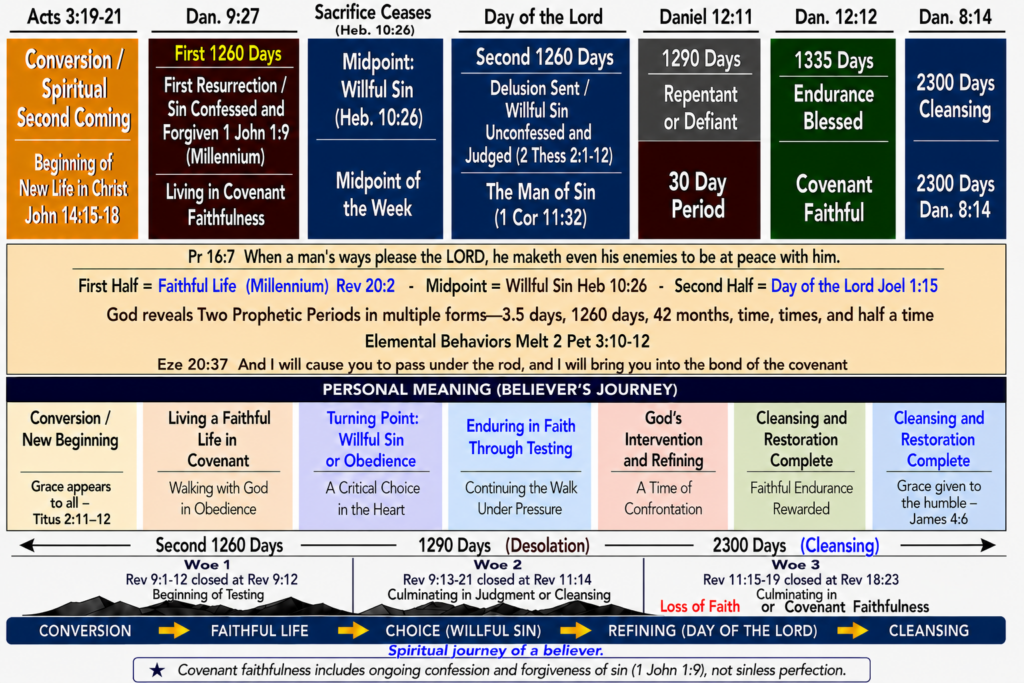
Scripture presents a covenant cycle in which obedience and disobedience unfold symbolically through Daniel’s 70th week.
The first half of the week represents covenantal obedience, the period symbolized by the Millennium, during which Satan is bound in the life of the believer (Rev 20:3).
The midpoint occurs when the “sacrifice” ceases—an image of willful, unconfessed sin (Heb 10:26).
This transition begins the second half of the week, the Day of the Lord (Joel 1:15), when God initiates the disciplinary response described in 2 Thessalonians 2.
His purpose is to cleanse His temple—the believer (1 Cor 6:19; 11:32).
Within this covenant framework, the prophetic time markers function symbolically.
In Scripture, “half a week,” “3.5,” “42 months,” and “1260 days” all describe the same symbolic covenant period—a pattern that can represent either obedience (First half of the Week) or disobedience (Second Half of the week).
These moments happen again and again throughout a person’s life, rather than unfolding in a strict, step-by-step sequence.
The second 1260 represents the structured period of willful sin and divine discipline—the Day of the Lord phase in which the believer is chastened but not yet hardened.
The 1290 marks the moment hardened unbelief is set up, while the 1335 marks the blessed endurance of covenant faithfulness.
After the 1335, the believer has re‑entered covenantal obedience—not sinlessness, but the restored posture of confession and faithfulness. This 1335‑to‑2300 phase mirrors the first half of the week, showing that obedience can be re‑entered throughout a believer’s lifetime.
1 Thessalonians 4:17 describes the covenantal re‑entry of the believer after discipline — the same restored‑obedience phase symbolized by the 1335 in Daniel 12.
The 2300 represents the point of cleansing (Dan 8:14).
Jesus’ warnings in Matthew 24 concern our posture toward willfully sinful brethren—believers who refuse to confess their sin and persist in obstinacy (1 John 1:9).
Scripture teaches that obedient believers are not to “go before” (1 Thess 4:15) or remain in close fellowship with those who have hardened themselves in unrepentant sin (1 Cor 5:11).
Yet this separation is not commanded during the initial disciplinary period.
During the second 1260, the church tolerates the willfully sinful believer under divine correction, for the Lord disciplines every son He receives.
Grace teaches us to deny ungodliness, and confession restores forgiveness (1 John 1:9).
The 1260, the 1290, and the Moment of Separation
This admonition unfolds in two stages.
The second half of Daniel’s 70th week—the Day of the Lord—is the symbolic 3.5‑day span represented by the 1260‑day period.
This 1260‑day discipline period corresponds to the first two woes of Revelation (Woe 1 and Woe 2), while the 1290 marks the third woe (Woe 3), the moment hardened unbelief is set up.
It corresponds to the stage pictured as vultures gathering around a corpse (Matt 24:28; Luke 17:37) and echoed again in Revelation 20:9.
At this point, willful sin is present, and corruption is visible; the believer sees the devourers circling.
Yet separation is not commanded, for the abomination has not been set up. This is the period of divine discipline and testing, not hardened rebellion.
Hardened unbelief occurs only at day 1290, when the abomination is “set up”—when willful sin becomes embraced, defended, and proclaimed as truth.
Daniel 12:11 is the only place in Scripture where the 1290 is mentioned, and it marks the installation of hardened unbelief.
At this point, Jesus’ command to “flee to the mountains” becomes active. Separation becomes mandatory, for the abomination has moved from behavior to proclamation—from sin to doctrine, from transgression to truth‑claim.
Daniel 12:11 is the only place in Scripture where the 1290 is mentioned, and it marks the moment the abomination is “set up” — a symbol of hardened, installed unbelief.
Summary: The second 1260 is the Day‑of‑the‑Lord discipline period where believers remain together, and Jesus’ command to flee applies only when hardened unbelief is set up at the 1290.
Closing Reflection
Ezekiel 36:37 teaches that God’s promised restoration is not automatic. It is activated through the obedient asking of His renewed people.
This page gathers the doctrinal, prophetic, and pastoral implications of that truth:
- God restores when His people enquire of Him.
- False illumination spreads when His people stop enquiring of Him.
- Separation becomes necessary when delusion becomes hardened unbelief.
- Discernment is essential because the danger is internal, not external.
Ezekiel 36:37 is not merely a verse about prayer. It is a covenantal pattern for the people of God.