
🕒 4 min read · 📝 618 words
Summary: Why There Is Delusion in the Christian Church
De 29:27 And the anger of the LORD was kindled against this land, to bring upon it all the curses that are written in this book:
De 29:28 And the LORD rooted them out of their land in anger, and in wrath, and in great indignation, and cast them into another land, as it is this day.
The modern Christian church has fallen into widespread doctrinal delusion.
Scripture shows that many believers are experiencing judgment because they have embraced teachings that are not grounded in the Bible.
According to passages such as 1 Corinthians 11:32 – and – 2 Thessalonians 2:12, God allows this delusion as discipline for those who reject truth.
A major cause of confusion is the failure to interpret parables correctly.
Jesus taught that parables conceal truth from the unlearned and unbelieving (Mark 4:11–12).
When believers persist in sin or pride, God may veil understanding as judgment (Isaiah 6:9–10; 2 Thessalonians 2:11).
Knowledge is given gradually, and only as believers are spiritually able to receive it (John 16:12–13; 2 Corinthians 3:18).
Generations of Christians have inherited untested traditions, allowing errors to become entrenched.
The “rapture” doctrine is one example.
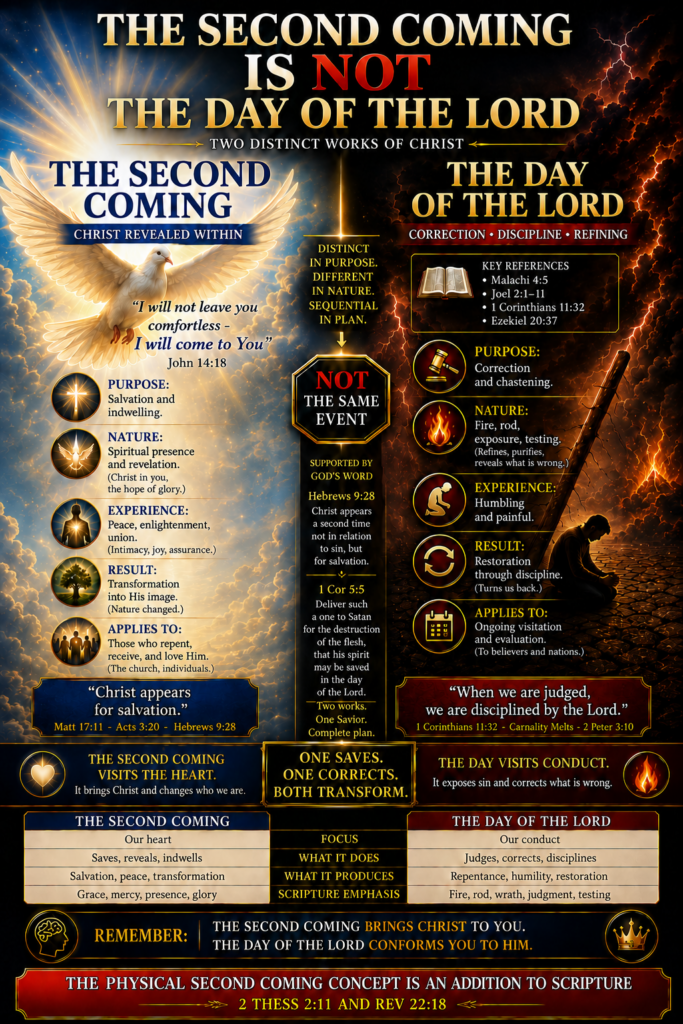
When examined carefully, Scripture also shows that the Day of the Lord is not the same as the Second Coming.
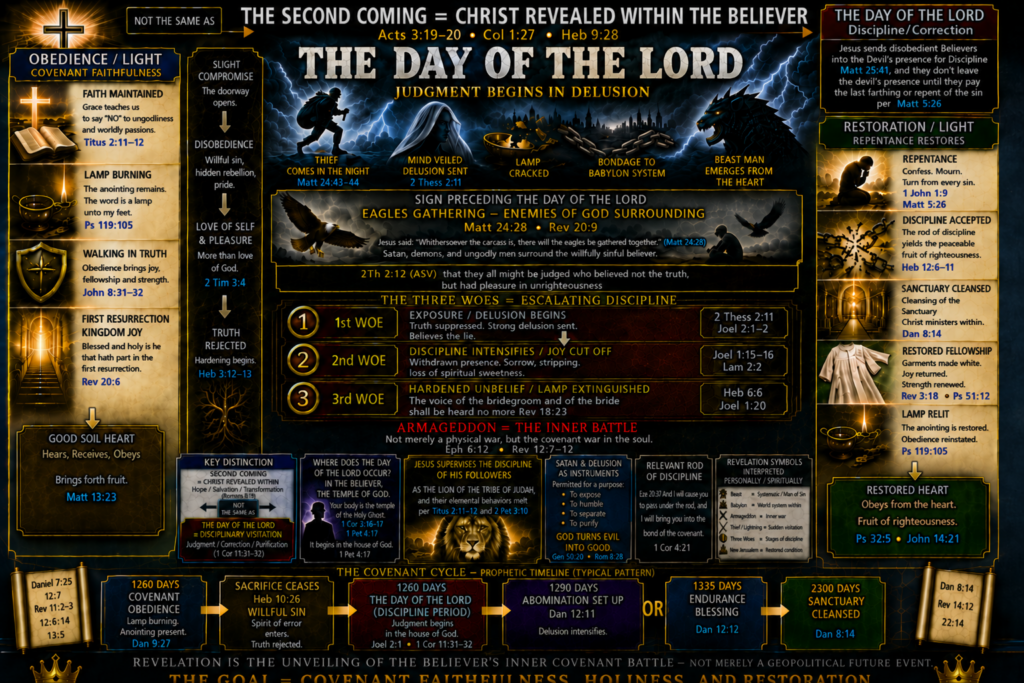
Jesus’ return is not a physical reappearance but a spiritual visitation through the Holy Spirit (Acts 1:9; Acts 3:20; 2 Timothy 4:8; Hebrews 9:28).
Embedded Doctrinal Drift: A Historical Snapshot
Darby (1830s): Introduced dispensationalism and pre-tribulation rapture, shifting prophecy away from allusions towards personal transformation and toward distant predictions.
John Nelson Darby mistakenly viewed the revelation of Jesus as an external, future event rather than an internal reality for believers.
The passages in John 14:23 and Colossians 1:27, however, teach that through love and obedience, Christians experience the indwelling of the Father and the Son, and that “Christ in you” is the “hope of glory”.
Brookes (1830–1897): A Presbyterian minister and early dispensationalist, Brookes mentored C.I. Scofield and helped shape American pretribulational thought. His verse-by-verse expositions and leadership in the Niagara Bible Conference laid the groundwork for institutionalizing futurist eschatology.
Scofield (1909): Amplified Darby’s views via the Scofield Reference Bible, embedding them into American evangelical study habits.
Branham (1946–1965): Merged dispensational themes with charismatic revivalism, claiming prophetic authority and end-time revelation.
Seminary Adoption (1950s–present): These interpretations became institutionalized through theological education and popular media.
These views, once fringe, became mainstream— not through Scripture alone, but through repetition, institutional endorsement, and emotional appeal—often distorting the original context of prophetic texts.
Misunderstandings about tongues also arise from ignoring Acts 2:11, where tongues involved speaking about the works of God—not unintelligible speech.
Much confusion stems from leaders who know tradition well but lack scriptural understanding (Lamentations 1:10; Isaiah 28:7; 2 Thessalonians 2:3).
The solution is repentance and a return to genuine biblical study.
Joel 2:17 calls leaders to humble themselves and seek God’s mercy so that His people are no longer ruled by confusion.