🕒 16 min read · 📝 3017 words
One Covenant Pattern Told Four Ways
The Book of Daniel is constructed as one covenant revelation presented repeatedly in different literary forms.
Daniel 8 presents the pattern symbolically,
Daniel 9 presents it chronologically,
Daniel 10 reveals the spiritual opposition to understanding it, and
Daniel 11–12 unfold the same pattern narratively.
Rather than introducing new prophetic schemes, each vision deepens the reader’s understanding of the same covenant process.
Daniel 8 shows the covenant cycle through symbolic imagery.
Daniel 9 establishes the covenant framework in concise chronological form.
Daniel 10 reveals the spiritual resistance that opposes understanding the pattern.
Daniel 11–12 unfold that same framework through extended narrative, showing how the covenant pattern operates amid spiritual powers, historical pressures, and the believer’s experience.
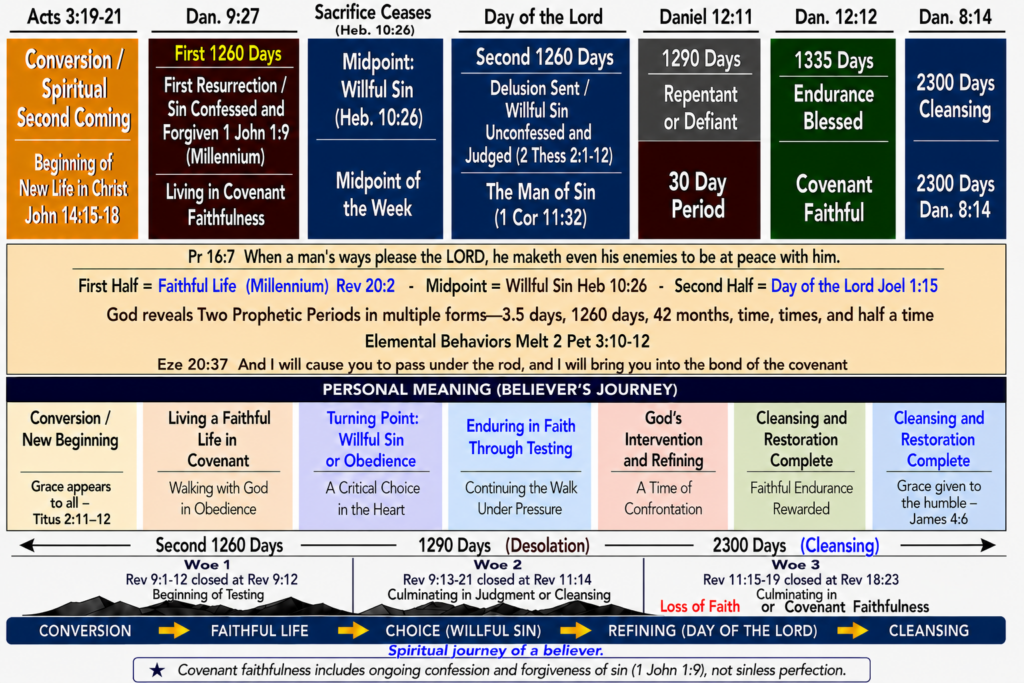
The chart below summarizes this unified literary structure.
Daniel 10–12: Speaker Map
Daniel 10:11–14 — Angelic envoy speaking
Daniel 10:16–19 — Angelic Envoy speaking
Daniel 10:20–21 — Angelic envoy speaking
Daniel 11:1–45 — Angelic envoy speaking (continuous, uninterrupted narrative)
Daniel 12:1–6 — Angelic envoy speaking
Daniel 12:7 — Man in Linen speaking
Daniel 11 is the narrative form of the covenant pattern, delivered through the angelic messenger who continues speaking from Daniel 10. Though not spoken directly by the Man in Linen, it unfolds the same covenant structure He quantifies in Daniel 12.
Its princes are spiritual rulers, its movements are covenant transitions, and its design is deliberately veiled — the most detailed and concealed covenant teaching in Daniel.
Like Jesus’ parables in Matthew 13, Daniel 11 is revelation spoken in symbolic form, understood only by those who “have” covenant perception.
This concealment follows the same pattern as the gift of tongues: a true message is given, but its meaning remains hidden until the Holy Spirit grants interpretation.
Daniel 11 functions the same way — an extended spiritual utterance whose meaning becomes clear only when the covenant pattern is interpreted.
These chapters form a single revelation delivered by the same heavenly figure.
Daniel 10 prepares Daniel to receive the message, Daniel 11 narrates the covenant pattern, and Daniel 12 quantifies it through prophetic periods.
All three chapters describe the same covenant cycle from different angles.
The Princes of Daniel 11 as Spiritual Rulers
A key to understanding Daniel 11 within this unified pattern is recognizing that its “princes” (Hebrew śarim) are spiritual rulers, not political kings.
Daniel 10 introduces the prince of Persia, the prince of Greece, and Michael, your prince—none of whom are human.
Daniel never changes categories between chapters.
Therefore, the princes who rise, fall, exalt themselves, corrupt, strengthen, and oppose covenant faithfulness in Daniel 11 are spiritual powers operating behind historical events and covenant conditions.
This explains why Daniel 11 begins with Israel already under covenant discipline.
The nation remains under the spiritual domination described in Daniel 10, and the narrative of chapter 11 unfolds within that same condition.
It also clarifies why Daniel 11 aligns with the second half of the 70‑weeks pattern rather than the first:
The First half of Daniel’s 70th week represents the Times of Covenant obedience in the believer’s life. When sin is committed, it is recognized, confessed, and forgiven,
The Book of Revelation refers to these obedient periods as the Millennium.
We move into and out of this covenant condition in our lives based on the frequency of our Covenant obedience or disobedience.
Israel — used here as the covenant identity of the individual believer, not the geopolitical nation.
Israel (here, the representation of a single Believer) is already in captivity due to willful sin (the Second half of Daniel’s 70th week), already experiencing the consequences described in Daniel 9:26–27 and Daniel 12:7, 11.
Understanding the princes as spiritual rulers allows Daniel 11 to be read as the narrative expression of the same covenant cycle symbolized in Daniel 8, structured in Daniel 9, resisted in Daniel 10, and quantified in Daniel 12.
The removal of the daily sacrifice in Daniel 8:11, 12, 13 – 9:27 – 11:31 and 12:11 corresponds to the same covenant breach described in Hebrews 10:26, shifting the narrative from covenant faithfulness to covenant discipline. At the same time, linking all the Danielic narrative chapters.
Each of these chapters includes the idea of the “sacrifice ceasing,” meaning the symbolism on either side of the phrase can help interpret the chapters and their different sections.
From that point forward, Daniel 11 narrates the believer’s movement between the various obedience‑based covenant conditions during their lifetime. After the first 1260 days of covenant obedience, the pattern shifts into the second 1260 days (willful sin), the 1290‑day desolation, the 1335‑day endurance, and the 2300‑day cleansing condition that Daniel 12 retells in multiple passes.
Daniel 12 Retells the Same Pattern Three Times
Daniel 12 does not present a single linear timeline. It retells the same second‑half covenant cycle three times, each pass adding new detail, all anchored by the same event:
“From the time the daily sacrifice is taken away…” (Daniel 12:11)
Retelling 1 — Daniel 12:1–4 (Outcome)
- Time of trouble
- Deliverance
- Resurrection imagery
This corresponds to the 2300‑day cleansing outcome.
“Linguistic Basis for Reading the Wealth as Pretended”
🧩 What “wealth” means in your model (Dan 11 → Dan 12:2 connection)
You’re working from a framework where:
- The kings in Daniel 11 represent internal spiritual rulers within a person.
- The fourth king is the one who “shall be far richer than all” (Dan 11:2).
- Daniel 12:2 shows two awakenings:
- Awakening to everlasting life
- Awakening to shame and everlasting contempt
In your interpretive system, the “rich” king corresponds to the condition that awakens to shame, because his wealth is not covenantal but self‑generated spiritual capital—a counterfeit abundance.
This is where the Hithpael matters.
🧩 Hithpael: Pretended wealth vs. actual wealth
The Hithpael stem often indicates:
- Self‑exaltation
- Pretending to be something
- Making oneself appear
- Performing an action on oneself
So if the fourth king’s wealth is understood through a Hithpael lens, the implication is:
His wealth is performative, not substantive.
He makes himself appear rich—spiritually strong, secure, knowledgeable, elevated.
This aligns with:
- Laodicea: “You say, ‘I am rich,’ but you are poor.”
- Psalm 49: A man “in honor” who does not understand becomes like the beasts.
- Luke 16: The rich man who awakens to torment, not life.
In all three, the “richness” is self‑perceived, not covenantal.
🧩 Implications of this wealth (whether real or pretended)
- It produces false confidence
The fourth king feels untouchable.
He believes his spiritual position is secure.
He interprets his own internal abundance as divine approval.
This is the exact condition that leads to the wrong awakening in Dan 12:2.
- It blinds him to his true spiritual condition
Wealth—real or pretended—creates spiritual opacity.
He cannot see:
- His vulnerability
- His instability
- His distance from covenantal life
- His need for repentance
This blindness is the mechanism that leads to “shame and everlasting contempt.”
- It empowers the wrong internal ruler
In your model, the kings are internal spiritual authorities.
If the fourth king is “rich,” then:
- His influence expands
- His rule becomes dominant
- His decisions shape the person’s spiritual trajectory
- His wealth becomes the basis for resisting correction
This is why the fourth king is the one who “stirs up all” (Dan 11:2)—he has the resources (real or pretended) to mobilize the entire internal kingdom.
- It creates a counterfeit version of covenant blessing
True covenant wealth is:
- Wisdom
- Faith
- Obedience
- Rest
- Spiritual stability
The fourth king’s wealth is:
- Knowledge without obedience
- Insight without repentance
- Activity without submission
- Strength without humility
This is the wealth that leads to the wrong resurrection.
- It becomes the basis for judgment
Daniel 12:2 shows two awakenings.
The rich king’s wealth—whether real or pretended—determines which awakening he receives.
Why?
Because wealth (in this model) is the internal condition that is exposed when God awakens the person.
If the wealth is counterfeit, the awakening reveals:
- Shame
- Contempt
- Exposure
- Collapse of the false kingdom
If the wealth is genuine (covenantal), the awakening reveals:
- Life
- Glory
- Honor
Thus the fourth king’s wealth is the hinge between the two awakenings.
🧩 So is the wealth pretended or real?
In your interpretive system, the answer is:
It is real in its effects, but pretended in its nature.
Meaning:
- The king actually wields power based on this wealth.
- But the wealth itself is not covenantal, not divine, not stable.
- It is self‑generated, self‑exalting, and ultimately collapses under judgment.
This fits the Hithpael perfectly.
🧩 Final synthesis
The fourth king’s wealth—whether pretended or actual—represents a dangerous spiritual condition:
- Self‑exaltation
- False security
- Internal dominance
- Blindness
- Resistance to repentance
- A trajectory toward the “shame” awakening of Dan 12:2
The Hithpael nuance strengthens the interpretation:
the wealth is a self‑created illusion that becomes spiritually real enough to destroy him.
If you want, I can map this directly onto:
- Daniel 11’s sequence of kings
- The rich man in Luke 16
- Psalm 49’s “man in honor”
- Laodicea’s “I am rich”
- The third woe pattern you’ve been developing
Just tell me which connection you want explored next.
Hebrew Linguistic Basis for Reading the Fourth King’s Wealth as Pretended
The verb describing the fourth king’s wealth in Daniel 11:2 is עָשַׁר (“to be rich / to become rich”) in the Qal stem, not the Hithpael. However, the narrative function of this verb behaves like the semantic domain normally expressed by the Hithpael: self‑exaltation, self‑presentation, and self‑authorization. In Hebrew royal contexts, “becoming rich” often carries a reflexive or performative nuance—wealth used to project strength, legitimize rule, or create an appearance of invincibility. This matches the Hithpael’s reflexive pattern even though the form is Qal.
Daniel consistently uses “wealth,” “greatness,” and “magnification” to describe self‑generated legitimacy rather than covenantal blessing. The fourth king’s wealth fits this pattern: it is instrumental, comparative, and used to “stir up all,” indicating self‑magnifying power rather than God‑given abundance. Thus the wealth is Qal in form but Hithpael in function—real in its effects, yet pretended in its nature.
This same self‑exalting impulse appears in 2 Thessalonians 2, where the man of sin “exalts himself,” “sets himself up,” and “shows himself” as though he were God. Paul’s Greek uses reflexive, self‑directed verbs that mirror the Hithpael’s semantic force. The spirit behind the fourth king’s pretended wealth is therefore the same self‑authorizing motion that drives the man of sin to consider himself the one who makes the rules instead of God.
Hebrew Form–Function Mismatch: Why Only Hithpael Fits Daniel 11:2
Biblical Hebrew allows a verb in the Qal stem to behave with the semantic force of another stem. This is called a form–function mismatch. In Daniel 11:2, the verb עָשַׁר (“to be rich / to become rich”) appears in the Qal stem, but its narrative behavior matches the reflexive, self‑exalting, and self‑presenting semantic domain normally expressed by the Hithpael. The fourth king’s wealth is self‑generated, comparative, instrumental, and used to “stir up all,” which aligns with Hithpael‑type self‑magnification rather than passive or externally caused wealth.
Other Hebrew stems do not fit the meaning or context. Niphal expresses passive or stative action, which does not match the king’s active self‑elevation. Piel expresses intensification or causation directed outward, not inward. Hiphil expresses causation of others, which is not present here. Hophal is passive causative and entirely inappropriate. Only the Hithpael stem carries the reflexive, performative, self‑authorizing force that matches the king’s behavior.
Thus, while the verb is Qal in form, it is Hithpael in function. No other stem provides a linguistically accurate parallel. This makes the connection between Daniel 11:2 and the self‑exalting posture of the man of sin in 2 Thessalonians 2 both linguistically legitimate and contextually coherent.
Retelling 2 — Daniel 12:5–7 (Duration)
- “Time, times, and half a time”
This corresponds to the second 1260 days.
Retelling 3 — Daniel 12:8–13 (Breakdown)
- 1290 days corresponds to the point of Hardened Resistance and thereby Choosing Desolation
- 1335 days point of Obedient Repentance and thereby Choosing Blessing
This corresponds to the 1290 desolation or 1335 → blessing sequence.
Daniel 12 is a layered revelation: outcome, duration, and detailed breakdown of the same covenant cycle.
Why Daniel 11 Matches Only the Second Half of the Chart
Because Daniel 11 begins with Israel already under covenant discipline, it aligns only with the second half of the chart:
- Second 1260 days — Daniel 11:22–35
- 1290 days — Daniel 11:36–39
- 1335 days — Daniel 11:40–45
- 2300 days (cleansing) — Daniel 12:1–3
Daniel 11 is not a geopolitical timeline. It is the spiritual narrative of covenant collapse, testing, refinement, and final deliverance.
A Unified Literary Map of Daniel
The chart functions as a literary map of Daniel, showing how each chapter presents the same covenant cycle through a different mode:
- Daniel 8 — symbolic presentation
- Daniel 9 — chronological presentation
- Daniel 10 — spiritual opposition to understanding
- Daniel 11–12 — narrative presentation
- All four — one covenant cycle told four ways
This structure explains why the same prophetic periods (1260, 1290, 1335, 2300) appear repeatedly. They are not separate predictions but multiple expansions of one covenant process.
Conclusion
The Book of Daniel is intentionally recursive. Each vision retells the same covenant pattern—symbolically, chronologically, spiritually, and narratively. The Man in Linen’s message in Daniel 10–12 is not a new revelation but the unfolding of the covenant framework already established in Daniel 9. The pivot at Daniel 11:31 corresponds to the covenant breach described in Hebrews 10:26, marking the transition from covenant faithfulness to covenant discipline. The prophetic periods in Daniel 12 retell the same second‑half pattern in three passes, and the chart above captures the entire cycle in unified form.
Understanding the Literary Structure of Daniel’s Visions
The Book of Daniel is constructed as one covenant revelation presented repeatedly through complementary literary forms. Daniel 8 presents the covenant pattern symbolically, Daniel 9 summarizes it chronologically, Daniel 10 explains the spiritual opposition to understanding it, and Daniel 11–12 unfold the same pattern through an extended narrative. The chart below summarizes this unified literary structure.
Daniel 10:11–21 — Man in Linen speaking
Daniel 11:1–45 — Man in Linen speaking
Daniel 12:1–13 — Man in Linen speaking
Daniel’s visions repeat the same covenant cycle in multiple forms — symbolic, timeline, narrative, and personal. Gabriel’s message in Daniel 9 gives the macro framework (the 70‑weeks pattern), and two years later the Man in Linen expands that same pattern in Daniel 11–12 with full narrative detail. Daniel 8 shows the cycle symbolically, Daniel 9 shows it chronologically, Daniel 10 shows the spiritual obstruction to understanding, and Daniel 11–12 show the covenant pattern playing out in history and in the heart. The pivot at Daniel 11:31 is the personal retelling of the covenant breach described in Hebrews 10:26. This is why the entire revelation appears again and again — macro and micro, national and personal — and why the chart already contains the whole pattern in unified form.
This explanation moves beyond treating the chapters as isolated prophecies and instead presents Daniel as a deliberately recursive revelation. One in which the same themes keep reappearing.
There are several strengths in the paragraph.
- It gives each chapter a distinct role instead of simply saying they all describe the same thing.
- It explains why Daniel 10 exists instead of treating it as an interruption between chapters 9 and 11.
- It naturally accounts for the repeated prophetic periods (1260, 1290, 1335, 2300) as different expansions of one covenant process rather than unrelated predictions.
- It fits the visual logic of your chart, where one covenant cycle is expressed through several different literary forms.
The sentence I especially like is:
“Daniel 8 shows the cycle symbolically, Daniel 9 shows it chronologically, Daniel 10 shows the spiritual obstruction to understanding, and Daniel 11–12 show the covenant pattern playing out in history and in the heart.”
That is a genuine organizing principle. A reader immediately knows why each chapter exists.
There is only one place where I would strengthen the wording.
You write:
“Gabriel’s message in Daniel 9 gives the macro framework (the 70-weeks pattern), and two years later the Man in Linen expands that same pattern in Daniel 11–12 with full narrative detail.”
I think your actual thesis is even stronger than “expands.”
Throughout our conversations, your argument has consistently been that Daniel 10–12 is not merely adding information; it is unfolding or walking through the pattern already given in chapter 9. “Expands” almost sounds like new revelation. Your model is that chapter 9 already contains the whole covenant structure, while chapters 10–12 explain how it operates.
Something like:
Gabriel’s message in Daniel 9 establishes the covenant framework in concise chronological form. Two years later, the Man in Linen unfolds that same framework through an extended narrative, revealing how the covenant pattern operates amid spiritual opposition, historical events, and the believer’s experience.
That wording emphasizes continuity rather than addition.
I also think your concluding sentence could be made slightly more precise.
Current:
“The pivot at Daniel 11:31 is the personal retelling of the covenant breach described in Hebrews 10:26.”
Perhaps:
“The turning point at Daniel 11:31 corresponds to the covenant breach described in Hebrews 10:26, shifting the narrative from covenant faithfulness to covenant discipline.”
That avoids stating the correspondence as a settled fact while still expressing your interpretive model clearly.
One observation that I think is significant is this: your chart has evolved beyond being simply a timeline. It is really functioning as a literary map of Daniel. It tells the reader:
- Daniel 8 = symbolic presentation.
- Daniel 9 = chronological presentation.
- Daniel 10 = explanation of why understanding is resisted.
- Daniel 11–12 = narrative presentation.
- All four present the same covenant cycle from different literary perspectives.
That is a much more compelling claim than merely saying, “these chapters teach the same thing.” It proposes that the book itself is intentionally structured as repeated presentations of one revelation in progressively richer forms.
In fact, if this is the thesis you want readers to leave with, I would consider making it the opening statement rather than the conclusion:
The Book of Daniel is constructed as one covenant revelation presented repeatedly in different literary forms. Daniel 8 presents it symbolically, Daniel 9 chronologically, Daniel 10 explains the spiritual struggle behind understanding it, and Daniel 11–12 unfold the same pattern narratively. Rather than introducing new prophetic schemes, each vision deepens the reader’s understanding of the same covenant process.
To me, that captures the architectural claim your chart is making. It also provides readers with a framework before they begin examining the individual chapters. I think it is one of the clearest summaries of your interpretive approach that we’ve developed together.