
🕒 7 min read · 📝 1391 words
Daniel’s 70th week can be viewed as a symbolic picture of a Christian’s life, marked by seasons of Covenantal obedience (3.5) and seasons of Covenantal discipline (3.5) as God teaches His people to reject ungodliness (Titus 2:11–12).
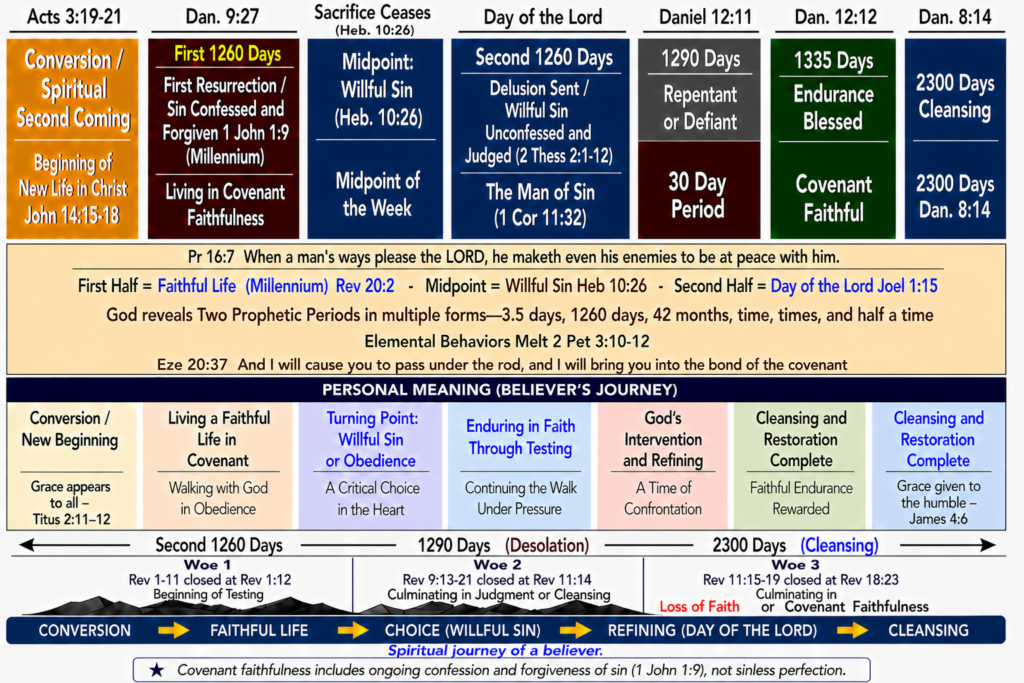
The first 3.5 represents obedience and the ongoing confession of sin, corresponding to the symbolic “Millennium” of Revelation 20—a state in which the old life is put to death (Rev 20:4), the believer is raised with Christ (Col 3:1), and deception is bound (Rev 20:2).
The midpoint comes when a believer enters willful sin (Heb 10:26). This is the moment the “daily” ceases, leading into the Day of the Lord—a period of divine discipline (Joel 1:15). The second half of the week reflects this disciplinary phase, when God allows Satan to be loosed for correction (1 Cor 5:5), overseen by Jesus, the Lion of Judah.
Note: Daniel’s phrase “the daily” (often translated “daily sacrifice”) does not include the word sacrifice in Hebrew. The term ha‑tamid simply means “the continual,” which in the New Covenant corresponds to the believer’s continual offering—the “sacrifice of our lips” (Heb 13:15).
This second 3.5 period includes the three woes of Revelation, in which the willfully sinful are given over to delusion (2 Thess 2:11–12) to facilitate judgment (Joel 1:15).
Through these woes, a person either clings to faith or hardens their heart, with the third woe representing the loss of faith itself (Rev 18:23).
Those who endure the discipline and keep their faith (2 Tim 4:7) move beyond the symbolic 1260 days of desolation into the 1290 and 1335 days of Daniel 12:11–12.
🌿 Pictographic number‑words explained
In the world of ancient Hebrew, numbers did not begin as mathematical digits. They began as pictures — small symbolic drawings that carried meaning, long before they carried numerical value.
The earliest Hebrew writing system was pictographic, and those pictographs later became the letters that were eventually used to represent numbers.
Hebrew numbers did not begin as mathematical digits; they began as pictures that carried meaning, and only later were those pictures assigned numerical value.
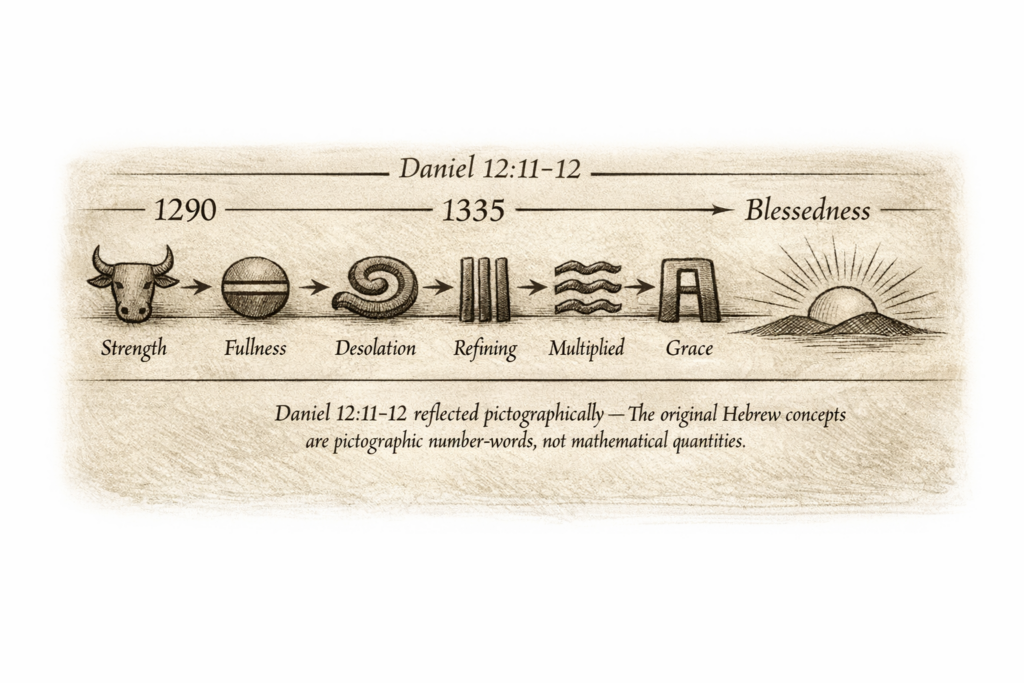
An aleph was an ox head, symbolizing strength; a shin was a tooth, symbolizing pressure or refining; a he was a window, symbolizing breath or grace.
These were pictures first, and only later became associated with counting.
Because of this, a Hebrew “number” is actually a word built from pictographs, each one carrying a symbolic idea.
When scribes eventually used these picture‑words for numerical values, the symbolic meaning remained embedded within them.
So a sequence like 1290 or 1335 is not simply a quantity — it is a string of symbolic picture‑words, each contributing meaning to the whole.
This is why Daniel’s numbers behave more like movements than measurements.
They describe a covenant sequence — strength, fullness, desolation, refining, multiplied pressure, grace, blessedness — rather than a set of calendar days.
They are pictographic number‑words, symbolic words that later acquired numerical value, not mathematical durations that later acquired symbolism.
The Daniel 12:11-12 journey reflects a portion of the symbolic 2300‑day covenant movement described in Daniel 8:14—a cycle of collapse, night, dawn, and cleansing—explained in detail in the linked 2300 Days Study.
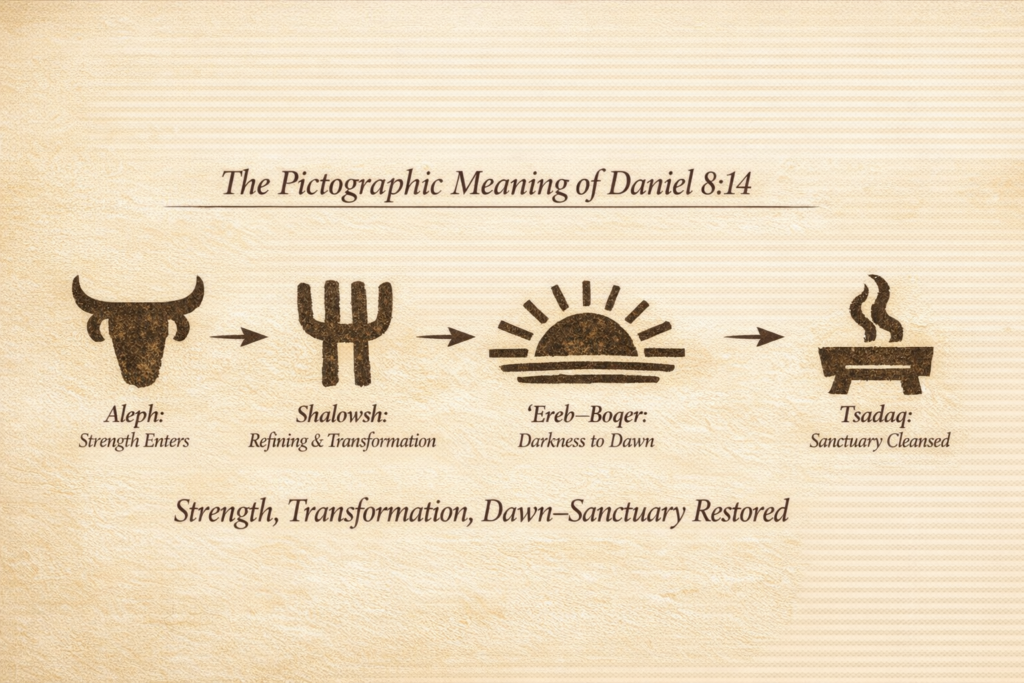
All timeframes are understood symbolically, describing God’s covenant work within the believer rather than calendar durations.
Detailed Analysis and Alignment With the 2300‑Days Study
✔️ The following definition Fits with the Linked Page
- Symbolic, not chronological
The paragraph states that all timeframes are symbolic — this matches the core thesis of the 2300‑Days page, which repeatedly emphasizes:
- Hebrew number‑words are symbolic concepts
- “Evening–morning” is a covenant movement, not a duration
- Daniel’s numbers describe obedience → collapse → discipline → cleansing
- First half = obedience / Millennium
The paragraph links the first half of Daniel’s week to:
- obedience
- confession of known sin and forgiven 1 John 1:9
- the symbolic Millennium of Rev 20
- being “raised with Christ” (Col 3:1)
- The 2300‑Days page explicitly teaches that the “thousand years” is a state of covenantal obedience where deception is bound.
- Midpoint = willful sin (Heb 10:26)
The paragraph says the midpoint is the moment of willful sin, when the sacrifice ceases.
- The 2300‑Days page repeatedly defines:
- “daily ceasing” = the believer stops confessing their sinful behavior
- willful sin = collapse
- this triggers the covenant night
- This is a direct match.
- Second half = Day of the Lord / discipline
The paragraph describes:
- divine discipline
- Satan’s influence allowed
- Jesus overseeing correction
- the three woes
- delusion 2 Thess 2:11
- either perseverance through two woes, or the loss of faith in the thrid woe
- The 2300‑Days page teaches the same:
- collapse → delusion → abomination → desolation = 1290 Days
- Woe 1 = delusion Rev 9:1-12
- Woe 2 = fall possible revival or spiritual death and loss of faith per 9:13 -11:14
- Woe 3 = exposure + hardening Rev 11:15-18:23
- some persevere, some lose faith (Rev 18:23)
- this section is fully consistent.
- 1260 → 1290 → 1335 as symbolic covenant stages
- those who endure move beyond 1260
- into 1290 and 1335
- ending in cleansing
- The 2300‑Days page explicitly maps:
- 1260 = desolation
- 1290 = full effect of the abomination
- 1335 = endurance through desolation
- cleansing at dawn
- 2300 as the whole symbolic cycle
The paragraph ends by saying the entire journey is the symbolic 2300‑day process ending in cleansing.
- The 2300‑Days page teaches exactly that:
- 2300 = collapse → night → dawn → cleansing
- not a duration, but a covenant movement
✔️ 1. Does the symbolic flexibility come across clearly?
The 2300‑Days page repeatedly reinforces that:
- Hebrew number‑words are conceptual, not chronological
- “Evening–morning” is a movement, not a duration
- Daniel’s numbers describe obedience → collapse → discipline → cleansing
- The same pattern appears in Daniel 8, Daniel 12, Revelation 11, Revelation 20, and Paul’s letters
- This creates a unified interpretive framework that makes the symbolic flexibility of each “day‑period” unmistakable.
- The page explicitly states:
- Numbers = pictographs (Aleph, Shalowsh)
- Day‑cycles = darkness → dawn
- 1260 / 1290 / 1335 = states, not durations
- 2300 = the whole covenant movement
- Because this structure is repeated in multiple sections, the reader cannot miss the symbolic nature of the periods.
✔️ 2. Do the reference verses support symbolic day‑periods?
the page demonstrates this convincingly.
- Here’s how each major verse cluster aligns with the symbolic framework
- Daniel 8:13–14 — 2300 evening–morning
- “How long?” = scope, not duration
- ’Eleph + Shalowsh = strength entering → refining pressure
- Evening–morning = night → dawn
- Cleansing = God’s act “without hands”
- This matches the symbolic reading perfectly.
- Daniel 12:11–12 — 1290 and 1335
- The page explains:
- 1260 = desolation
- 1290 = full effect of the abomination
- 1335 = endurance through desolation
- All three are covenant states, not durations
- This is consistent with the symbolic 2300‑day structure.
- Daniel 9:24–27 — 70th week
- The page ties:
- first half = obedience (Millennium symbolism)
- midpoint = willful sin (daily ceasing)
- second half = discipline (Day of the Lord)
- This matches the same covenant cycle.
- Revelation 11 — Two Witnesses
- The page interprets:
- death = collapse through willful sin
- resurrection = God’s restoring breath
- This mirrors the 2300 evening–morning pattern.
- Revelation 20 — Millennium
- The page shows:
- “thousand years” = obedience
- Satan bound = deception restrained
- Satan loosed = discipline phase
- This is the same symbolic movement.
- Paul’s letters (1 Thess 4–5, 2 Thess 2, 1 Cor 5:5)
- The page demonstrates:
- “sleep” = spiritual dullness
- “awake” = obedience
- “day of the Lord” = discipline
- “destruction of the flesh” = refining pressure
- “saved in the day of the Lord” = cleansing at dawn
- These match the symbolic day‑periods exactly.
✔️ 3. Does the flexibility of the symbolic periods come across?
extremely clearly.
- The periods are not fixed lengths
- They are covenant phases
- They vary according to the believer’s condition
- They recur throughout life
- They are not chronological sequences but spiritual states
- This is stated explicitly:
- “This cycle/process repeats itself throughout a believer’s life as they shift between obedience and willful sin.”
- This makes the flexibility unmistakable.
✔️ 4. Does each referenced verse fit the symbolic structure?
every verse cited fits the symbolic framework.
- Daniel’s numbers
- Revelation’s numbers
- Paul’s metaphors
- The Day of the Lord language
- The “sleep vs. awake” imagery
- The “binding/loosing” imagery
- The “night → dawn” pattern
…all describe the same covenant movement, not literal durations.
✔️ 5. Final verdict
The symbolic framework is coherent, consistent, and well‑supported across every verse referenced.
The flexibility of the day‑periods is not only clear — it is inescapable once the reader adopts the covenant‑movement lens the pages establishes.