
🕒 25 min read · 📝 4820 words
Daniel 8:13 begins with the angelic question “How long?”—the Hebrew phrase ʿad‑matay, which means “to what point does this go?” Rather than asking for a countdown of days, the question seeks the extent and completion of the desolating actions described in the vision. In Daniel 8:14, the reply is traditionally rendered as the number “2300,” yet the Hebrew text uses the number‑words ’eleph and shalowsh. Lexically, ’eleph means “thousand,” and shalowsh means “three,” but the phrase does not function as a duration. In Scripture, expressions like “a thousand three” operate the same way concept‑phrases such as “the millennium” or “childhood” do—describing the nature and completion of an activity rather than measuring its length.
In Daniel 8:14, this structure marks the cleansing brought to its full measure and appointed end.
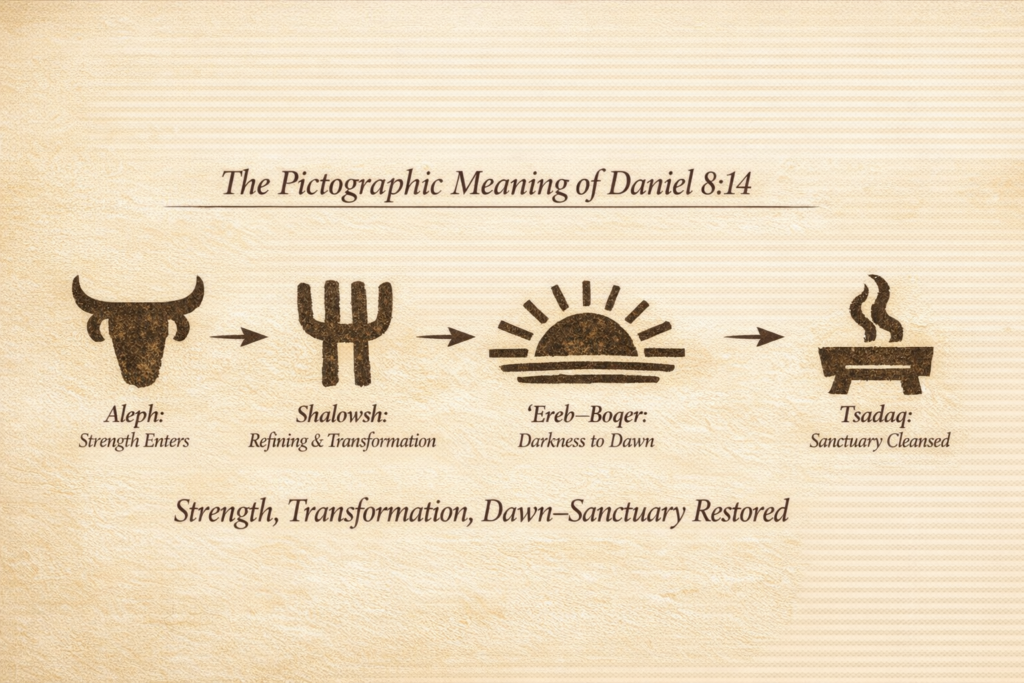
Behind ’eleph stands the ancient pictograph Aleph, the ox‑head symbol of strength, leadership, and the One who initiates the action—a conceptual parallel to Jesus’ self‑description as the Alpha and the Omega, the One who begins and completes the covenant work for His people.
The “three” (shalowsh) that follows the “thousand” marks the completion point, the decisive boundary at which the cleansing is finished.
This aligns with the cleansing goals described in Daniel 9:24–27, where God brings transgression to an end, makes atonement, and restores holiness.
And as Ezekiel 36:22 reminds us, God performs this cleansing “for My name’s sake,” not because Israel deserved it.
Yet Ezekiel 36:37 shows that God invites His obedient people to seek Him to do this work, calling them to intercede for the deluded and willfully sinful rather than ridicule them.
Daniel 8, Daniel 9, and Daniel 12 all describe this same divine work brought to its appointed completion—the cleansing that God initiates, sustains, and finishes for the sake of His holy name.
What follows unpacks these Hebrew terms in depth, so the reader can see the structure Daniel actually wrote, rather than the time‑based assumptions added later.
This study reads Daniel and Revelation through the covenant lens used by the prophets and apostles themselves.
The visions are not geopolitical timelines or predictions about nations on a map.
They describe God’s internal work within the life of the believer: obedience that preserves, willful sin that defiles, divine discipline that exposes and restores, and the dawn of cleansing that God brings “without hands.”
The numbers, fires, bindings, tramplings, and mornings are symbolic expressions of covenant conditions, not calendar durations.
This lens keeps the focus where Scripture places it—on the believer’s inner sanctuary, where Christ dwells and where God carries out His restoring work.
COVENANT MOVEMENT (Daniel → Revelation)

   Obedience  🐂 Aleph (Strength Enters)
      │
      ▼
Sanctuary Preserved
Satan Bound (deō)
      │
      ▼
Willful Sin  🔥 Shalowsh (Refining / Breaking Down)
      │
      ▼
Sanctuary Trampled
Satan Loosed (lyō)
      │
      ▼
Divine Discipline  🌒→🌅 ‘Ereb–Boqer (Night → Dawn)
("Evening" — the Night)
Fire Exposes / Breaks Down
      │
      ▼
Cleansing at Dawn  ✨ Tsadaq (Restoration “Without Hands”)
("Morning" — Restoration)
Sanctuary Renewed “Without Hands”
      │
      ▼
Return to Obedience
This cycle/process repeats itself throughout a believers life as they shift between obedience and willful sin.
A visual summary of the covenant cycle described in Daniel 8, Daniel 12, and Revelation 20.
Why the Hebrew words “How Long” in Daniel 8:13, became Time‑Based — and What the Hebrew Actually references:
Most English translations render the angel’s question in Daniel 8:13 as “How long shall be the vision…?”, which immediately frames the passage as a time‑based inquiry.
But the Hebrew word used here is , meaning vision, revelation, or the scope of what has been shown.
The question is not inherently chronological or time based.
Although most English readers assume “How long?” is a request for a duration, the Hebrew particle ʿad does not function that way.
As Gesenius notes, its ancient sense is tied to the idea of “passing on” or “advancing toward a limit,” not counting time. It marks the boundary to which an action progresses.
Thus ʿad‑matay in Daniel 8:13 asks, “To what point does this extend?”—a question of scope and completion, not a countdown.
This aligns with the structure of the verse itself, where the focus is the extent of trampling, rebellion, and desolation, not the length of days.
It is asking about the extent and nature of the removal of the daily sacrifice, the rise of transgression, and the trampling of the sanctuary by the host.
Does the Hebrew say “both the sanctuary and the host”?
Many English Bibles read, “both the sanctuary and the host to be trampled,” but the Hebrew text of Daniel 8:13 does not contain a word for “both.” The translators added it to smooth the English, not because Daniel wrote it. The Hebrew simply names two realities joined by a gentle “and”:
miqdāsh — the sanctuary, the place where God dwells
tsābā’ — the host, the posture that rises in rebellion
mirmās — the trampling that follows
There is no dual form, no pairing emphasis, and no word that binds them into a matched set. Daniel is not describing a pair; he is naming two separate things that have come under God’s searching light.
This matters because Daniel has already shown us in verse 12 that the host is the posture that sets itself against the Prince—the inner rebellion that casts truth down and damages what is holy. The sanctuary, by contrast, is the place where God intends to dwell. In New Testament language, it is the believer’s own body and life, the inner temple where Christ makes His home.
When Daniel says that “sanctuary and host” are “given to trampling,” he is not saying the sanctuary is handed to the host. He is saying that both the damage and the thing damaged are brought into God’s care and judgment. The rebellious posture is exposed, and the sanctuary it once harmed is restored. The host is not victorious; it is brought low. The sanctuary is not abandoned; it is cleansed and renewed.
Daniel 8 presents a two‑phase movement: first the host tramples the sanctuary (v.12), then the host itself is trampled under divine judgment (v.13). The sanctuary never tramples the host, and the host never tramples itself. The Hebrew grammar makes the host the active aggressor in v.12 and the passive object of judgment in v.13, revealing a divine reversal rather than a single continuous action.
Paul’s promise that “the God of peace will crush Satan under your feet” reflects the same reversal Daniel describes: the host that once trampled the sanctuary is itself brought low by God’s direct action.
The believer does not crush the enemy by personal strength any more than the sanctuary cleanses itself; rather, God acts as the active agent of judgment and restoration.
This is the same pattern Titus 2 reveals, where grace teaches the believer to deny ungodliness — grace is the divine power, and the believer becomes the place where God’s victory is revealed.
The Divine Reversal: The Host That Strikes Is the Host That Is Crushed
Daniel’s vision follows the oldest promise in Scripture — the pattern God spoke in Eden:
“He will strike your heel, and you will crush his head.”
(Genesis 3:15)
In Daniel 8, this pattern appears again in two movements:
- The host strikes the sanctuary
In verse 12, the host rises in rebellion.
It opposes the Prince, casts truth down, and tramples the sanctuary.
This is the “heel strike” — the wound caused by the posture that resists Christ. - The host is then given over to trampling
In verse 13, the sanctuary and the host are both “given to trampling.”
The host that once trampled is now itself brought low.
This is the “head crush” — the overthrow of the very rebellion that once seemed strong.
Daniel is showing us the mercy of God:
He does not leave His people in the ruin caused by their own rebellion.
He exposes the posture that harmed them, brings it to nothing, and restores the sanctuary to light.
This is the ongoing triumph of Christ in the believer.
The enemy wounds, but Christ overcomes.
The sanctuary suffers, but Christ restores.
The rebellious posture rises, but Christ brings it low.
The heel is struck —
but the head is crushed.
How Daniel 8 and 2 Thessalonians 2 Describe the Same Rebellion
Daniel and Paul describe the same spiritual conflict, each from a different angle. In Daniel 8, the host is not the person under delusion but the demonic influence that rises against the Prince, casts truth to the ground, and tramples the sanctuary. These are the same kinds of deceiving spirits Paul warns about elsewhere — spirits that work in the sons of disobedience and promote the lie.
In 2 Thessalonians 2, Paul describes the human side of the same collapse. The person who refuses the love of the truth becomes vulnerable to deception, and God allows them to believe the lie the spirits promote. The sanctuary is damaged, not because the person is the host, but because the host has gained influence within the inner life where God intends to dwell.
Daniel shows the spirits trampling the sanctuary.
Paul shows the person believing the lie.
Together they reveal a single pattern:
the demonic host deceives, the sanctuary suffers, and God ultimately brings the deceiving spirits low so the sanctuary may be restored.
This is the same divine reversal promised in Genesis 3:15.
The serpent strikes the heel — but the Seed crushes the serpent’s head.
The time‑based reading comes from the translators’ assumption that the answer in verse 14 (“unto 2300 evening–morning”) must be a calendar time period and not a symbolic description of the persons covenant with God.
The concept of ‘two’ was added because translators assumed the Hebrew number‑words were digits rather than symbolic concepts, because Western arithmetic expects a leading numeral where Hebrew does not supply one, and because the pictographic meaning of ’eleph and shalowsh had been forgotten, leaving translators to ‘complete’ the number rather than preserve the pictographic structure Daniel actually wrote.
Why Translators (and Modern Readers) Expect a Leading Numeral
Most modern readers instinctively expect a number to begin with a digit. Western numbering trains us to think in “digit + unit” patterns such as:
2 thousand
5 hundred
3 tens
So when we see the word “thousand,” our minds automatically look for a digit in front of it. If no digit appears, the number feels incomplete or broken.
But Biblical Hebrew does not work this way. Hebrew number‑words can stand alone without a leading numeral. Expressions like “thousand three‑hundreds” or “hundred eighty” are normal and grammatical in Hebrew, even though they look unfinished to Western eyes.
Because translators were trained in Western digit‑based numbering, they assumed Daniel’s phrase needed a leading numeral to “complete” it. This is why they treated Daniel’s number‑words as digits rather than symbolic concepts, even though Hebrew uses them symbolically, structurally, and pictographically. Since the total was understood as 2300, translators supplied the digit “two” to make the expression look mathematically correct in English.
In short: the translators weren’t following Hebrew structure — they were repairing what looked like a missing digit according to Western expectations.
Because translators were trained in Western digit‑based numbering, they assumed Daniel’s phrase needed a leading numeral to “complete” it. Since the total was understood as 2300, they supplied the digit “two” to make the expression look mathematically correct in English.
In short: the translators weren’t following Hebrew structure—they were repairing what looked like a missing digit according to Western expectations.
In the New Testament, the same symbolic pattern appears in Revelation 20. The “thousand years” during which the devil is bound is not a calendar duration but a covenant condition. The Greek verbs make this clear: deō (“to bind”) describes the state of obedience in which deception loses its influence, while lyō (“to loose”) describes the state of willful sin in which deception regains access. Just as Daniel’s symbolic numbers describe movements of obedience, collapse, and restoration, Revelation’s “binding and loosing” describes recurring spiritual conditions within a believer’s life, not a single linear timeline. This reinforces the point that both Hebrew and Greek use symbolic number‑language to describe covenant states rather than mathematical durations.
This same symbolic use of number‑language continues into the New Testament, where Revelation describes covenant conditions in Greek rather than Hebrew, but preserves the same movement of obedience, collapse, discipline, and restoration.
| Theme | Daniel (Hebrew) | Revelation (Greek) |
| Symbolic Number | ’Eleph + Shalowsh (strength + refining) | “Thousand years” (state of obedience) |
| Obedience | Sanctuary preserved | Satan bound (deō) |
| Willful Sin | Sanctuary trampled | Satan loosed (lyō) |
| Divine Discipline | Evening → Morning (night to dawn) | Fire from God ends deception Matt 25:41and Rev 20:9 |
| Restoration | Sanctuary cleansed “without hands” | New creation dawns; deception ends |
| Recurrence | Cycles throughout a believer’s life | Binding/loosing cycles recur as obedience shifts |
How Revelation’s “Millennium” Mirrors Daniel’s Covenant Movement
Revelation 20 describes the “thousand years” not as a calendar duration but as a covenant condition. The Greek verbs make this clear. The devil is bound (deō) when the believer walks in obedience, because obedience closes the door to deception. The devil is loosed (lyō) when the believer enters willful sin, because rebellion reopens the door that obedience had shut.
Proverbs 16:7 KJV — When a man’s ways please the LORD, he maketh even his enemies to be at peace with him.
This binding and loosing is the same covenant rhythm Daniel describes. In Daniel, obedience preserves the sanctuary, willful sin defiles it, and God’s discipline restores it. In Revelation, obedience binds the deceiver, willful sin looses him, and God’s intervention brings cleansing and renewal.
These are not one‑time historical events. They are recurring spiritual conditions that can appear many times throughout a believer’s life. Seasons of obedience bring clarity and protection; seasons of willful sin bring deception and collapse; and God’s restoring work brings the believer back into the light.
Revelation’s “thousand years” therefore functions the same way Daniel’s symbolic numbers do: not as digits on a timeline, but as a description of the covenant state in which the believer lives. The binding corresponds to obedience; the loosing corresponds to rebellion; and the final fire corresponds to God’s cleansing work that ends the cycle and restores the sanctuary of the heart.
Daniel and Revelation Describe the Same Covenant Cycle
Daniel and Revelation use different languages—Hebrew and Greek—but they describe the same covenant movement. In Daniel, obedience preserves the sanctuary, willful sin defiles it, and God’s discipline restores it. In Revelation, obedience binds the deceiver, willful sin looses him, and God’s intervention brings cleansing and renewal.
Daniel expresses this movement through symbolic number‑words like ’eleph and shalowsh, and through the evening–morning cycle that moves from darkness to dawn. Revelation expresses the same movement through the symbolic “thousand years,” a covenant state in which the deceiver is bound because obedience has closed the door to deception.
When the believer enters willful sin, the deceiver is loosed, just as the sanctuary in Daniel becomes vulnerable to trampling. When God intervenes, the deceiver is judged and the sanctuary is restored, just as the fire from God ends the deception in Revelation.
These are not one‑time historical events. They are recurring spiritual conditions that can appear many times throughout a believer’s life. Both Daniel and Revelation describe the same covenant rhythm: obedience brings protection, rebellion brings collapse, and God’s restoring work brings the believer back into the light.
Aleph and Shalowsh: A Symbolic Covenant Movement, Not a Countdown:
If the translators had approached the text through a pictographic‑symbolic lens—the same lens through which Hebrew numerals originally carried meaning—the answer in verse 14 would not be read as a countdown at all.
The components of the number—
1. <’eleph> (Aleph = ox head = strength, beginning) and (Shin–Lamed–Shin = transformation, discipline, resurrection rhythm)
—describe a movement, not a measurement of time.
When read that way the “2300 evening–morning” phrase would signify the covenant process from collapse to transformation and cleansing.
In that framework, Daniel 8:14 is not giving a timeline but a symbolic description of the believer’s fall and restoration, a “night that ends in dawn”.
The time‑based interpretation is therefore not demanded by the Hebrew; it is the result of a later interpretive choice by translators.
Summary Paragraphs
The phrase “Evening–morning” in Daniel echoes the Genesis day‑cycle and marks a season of darkness followed by the dawning of restoration.
In Daniel’s vision, this is the period in which the “daily sacrifice” ceases, transgression rises, the sanctuary is trampled, and the believer’s inner life enters a kind of spiritual death or metaphoric “sleep” as referred to in 1 Thess 4:13.
Yet this night of transgression is not endless.
It is a limited, God‑appointed span that ends when the new day breaks and the sanctuary is cleansed. This cleansing is reflected in the restored communion between formerly sleeping brethren and those who remained awake… per 1 Thess 4:17 and 2 Thess 2:3-12.
Daniel emphasizes that this cleansing occurs “without hands,” the same phrase used of the stone in Daniel 2 that is “cut out without hands.”
In both cases, the meaning is the same: God Himself acts directly, without human agency, to judge, to restore, and to renew (Titus 2:11-12). God encourages His obedient people to pray for their sinful deluded brethren in Ezekiel 36:37.
This divine intervention mirrors the resurrection scene in Revelation 11, where the two witnesses—symbolizing the believer’s Spirit‑empowered testimony—are killed through willful sin and trampling, yet are raised again by the breath of God alone.
The pattern is consistent: willful sin brings death, their testimony collapses, the sanctuary is defiled, and then God intervenes “without hands” to cleanse the inner sanctuary, and raise the believer to new life.
This is the way that the 2300 number marks the night of the believer’s fall and trampling, and the dawn of God’s restoring work.
It begins and it ends, and it is not eternal.
It is the covenantal rhythm of death and resurrection, darkness and dawn, judgment and cleansing—accomplished not by human effort, but by the direct, sovereign action of God.
Hebrew does not give Daniel’s numbers as Western digits but as symbolic words: Aleph 🐂 (strength, beginning), Shalowsh 🔥 (refining transformation), ‘Ereb–Boqer 🌒→🌅 (darkness turning to dawn), and Tsadaq ✨ (restoration “without hands”).
These components describe a covenant movement rather than a countdown.
The ancient pictographs preserve this meaning far more faithfully than the later time‑based interpretations, which flatten the Hebrew into calendar type math which Daniel never wrote about.
The real force of Daniel 8:14 is not a numeral but a pattern:
God’s strength enters, transformation unfolds, the night breaks, and the sanctuary emerges cleansed by His direct action.
This symbolic covenant movement is closer to the Hebrew structure than any day‑count reading.
This same covenant rhythm shaped the expectations of the earliest disciples as they waited for God’s restoring work.
The disciples’ question in Acts 1:6 reflects this same Hebrew covenant‑movement.
Their minds were shaped not by Western timelines, but by Daniel’s pattern of strength entering, transformation under pressure, the night giving way to dawn, and God restoring His people “without hands.”
When they asked, “Will You at this time restore the kingdom?”, they were thinking in the imagery of Aleph, Shalowsh (2300 -Dan 8:14), and the evening–morning covenant movement (How Long-Dan 8:13) — the very rhythm of collapse and divine restoration that Daniel describes.
This same covenant progression also appears within the second half of Daniel’s 70th week, moving from the collapse of the daily sacrifice to the cleansing at dawn.
“The first half of Daniel’s 70th week corresponds to the covenant state Revelation calls the ‘thousand years’—the season of obedience in which deception is bound and faith flourishes, Rev 20:3.
The second half corresponds to the Day of the Lord (Joel 1:15 and 1 Cor 5:5), the season of collapse and divine discipline in which the daily is removed, the sanctuary is trampled, and the believer enters the long night of correction.
In this latter half, some persevere and are restored at dawn, but those who harden themselves through the Third Woe lose faith itself, entering the silence where Christ’s voice ceases and eternal life is forfeited, Rev 18:23.”
Revelation 18:23 KJV — And the light of a candle shall shine no more at all in thee; and the voice of the bridegroom and of the bride shall be heard no more at all in thee: for thy merchants were the great men of the earth; for by thy sorceries were all nations deceived.
- Willful sin — the act of refusing the daily
- Practicing sin — the ongoing posture that deepens the collapse
- Abomination — the defiled state produced by that posture
- Desolation — the consequence of that state
- Darkness to dawn — the covenant movement through discipline toward restoration
- Sanctuary cleansed — the dawn moment of renewal
What is required is to maintain faith through discipline – Because God disciplines everyone that He accepts as a son.
How the Daniel 12 structure and the Three Woes trace the same covenant progression from collapse to cleansing
Sacrifice ceases per –
When a believer stops confessing and begins engaging in deliberate sin, the sacrifice no longer holds meaning for them—not in heaven, but in their own personal experience of the covenant.
Heb 10:26 For if we sin wilfully after that we have received the knowledge of the truth, there remaineth no more sacrifice for sins, 27 But a certain fearful looking for of judgment and fiery indignation, which shall devour the adversaries.
Woe One (Warning/Delusion 2 Thess 2:11) 2Th 2:11 And for this cause God sendeth them a working of error, that they should believe a lie: (ASV)
12 that they all might be judged who believed not the truth, but had pleasure in unrighteousness. (ASV)
→ Daily Ceasing (act of willful withdrawal)
→ Drift into Practiced Sin
→ Woe Two (Fall + Revival)
→ Abomination Set Up (state of hardened defilement)
→ 1260 (desolation under that state)
→ If correction is fully resisted, Jesus voice once heard begins to cease — the early movement toward the Third Woe’s silence
→ Woe Three (Exposure + Hardening)
→ 1290 (the state reaches full effect)
→ 1335 (endurance through the desolation)
→ Blessing / Cleansing / Dawn
This is the same covenant movement expressed in different symbolic frameworks:
collapse → drift → defilement → desolation → endurance → dawn → cleansing.
The Day of the Lord and the second half of Daniel’s 70th week are two symbolic descriptions of the same covenantal crisis phase summarized by the Apostle Paul in 1 Cor 5:5.
1Co 5:5 To deliver such an one unto Satan for the destruction of the flesh, that the spirit may be saved in the day of the Lord Jesus.
The word shalowsh begins with the ancient tooth‑pictograph (𐤔), whose three prongs depict the chewing, crushing, and breaking‑down action of a molar.
In Hebrew pictography, this symbol represents the decisive pressure that reduces and unfolds what is impure so that what is true may emerge.
This makes it a fitting image for the cleansing in Daniel 8:14, where corruption is broken down and brought to completion.
The ancient form of the letter shin was a three‑pronged tooth pictograph (𐤔).
The later Hebrew script added a baseline for writing stability, which makes the letter appear to have four strokes, but the symbol still represents the same three‑rooted tooth.
The ancient tooth‑pictograph of shin shows God’s refining strength at work—chewing through and breaking down .
| Daniel 8:14 – Two Interpretive Lenses | Traditional Time‑Based Translation | Symbolic–Pictographic Rendering |
| Hebrew Terms | <’eleph> (thousand) + (three) read as numerals | <’eleph> = ox/strength/beginning; = transformation/discipline |
| “Evening–Morning” | Understood as a literal day‑count | Understood as the covenant movement: darkness → dawn |
| Interpretive Assumption | The angel is asking “How long?” chronologically | The angel is asking about the nature and scope of the revealed events |
| Resulting Translation | “Unto 2300 days; then shall the sanctuary be cleansed.” | “Strength enters transformation, and the sanctuary emerges cleansed.” |
| What the Number Represents | The end of a time period | The dawn after a night; God’s act “without hands” |
| What the Cleansing Represents | The end of a time period | The dawn after a night; God’s act “without hands” |
Summary: How Daniel 8:19 Relates to the 2300 Evening–Morning Period
Daniel 8:19 uses two key Hebrew terms—acharit (“the latter part / final phase”) and qetz (“the appointed end / cutoff point”)—to describe the structure of the same period defined in Daniel 8:14 as 2300 evening–morning.
These terms clarify that the 2300 is not an open‑ended or symbolic eternity, but a period of indignation with both a final stage and a fixed termination.
In Daniel 8:13–14, the question is raised: How long will the period last in which the “daily sacrifice” (confession of sin) is removed, transgression rises, truth is cast down, and the sanctuary is trampled?
The answer is: “Unto 2300 evening–morning; then shall the sanctuary be cleansed.”
This defines the entire covenant movement of defilement, trampling, and eventual cleansing.
Daniel 8:19 then interprets this same period using covenant‑time vocabulary.
The word acharit marks the final phase of the indignation—the latter portion of the 2300 in which the consequences of willful sin reach their full expression.
The word qetz marks the appointed cutoff, the divinely fixed moment when the indignation ends and cleansing begins.
Together, these terms show that the 2300 contains both a latter stage (acharit) and a God‑appointed termination (qetz), matching the movement from “evening” to “morning” in Dan 8:14.
This structure is reinforced by Daniel 8:25, which says the transgressor is “broken without hand,” echoing Daniel 2:34.
The cleansing at the end of the 2300 is therefore a divine act, not a human one—God Himself ends the indignation at the qetz, or the appointed boundary.
Thus Daniel 8:14 and 8:19 describe the same covenant cycle: a limited period of darkness and trampling, followed by a divinely initiated restoration, all contained within the 2300 evening–morning span.
Paul expresses this same covenant pattern on a pastoral scale in 1 Thessalonians 4–5.
The believers who remain spiritually awake are instructed to stand apart from (not go before, 1 Cor 5:11) those who “sleep” until the Lord’s visitation completes its work (1 Thess 5:6–7, 14).
1 Corinthians 5:11 KJV — But now I have written unto you not to keep company, if any man that is called a brother be a fornicator, or covetous, or an idolater, or a railer, or a drunkard, or an extortioner; with such an one no not to eat.
In Paul’s language, the sleepers are those who have entered the night of spiritual dullness and discipline (willful sin), while the believers who remain awake are those who remain sober and watchful.
This mirrors the 2300 evening–morning period in Daniel 8:14 the same season of darkness, trampling, and divine indignation, followed by a God‑initiated awakening when “the Lord descends” and the “dead” are raised (1 Thess 4:16–17).
Paul is describing the same movement that Daniel outlines — a limited night that ends in a dawn of cleansing, accomplished not by human effort but by the direct action of God.
Paul summarizes this same disciplinary covenant movement even more concisely in 1 Corinthians 5:5, describing the Day of the Lord as the period in which the “flesh” is destroyed so that the spirit may be saved.
This is the doctrinal equivalent of Daniel’s 2300 evening–morning and the angelic phrase “the last end” (Dan 8:19).
In both Daniel and Paul, the Day of the Lord is a season of divine indignation/judgment (Joel 1:15) that reaches its final phase (acharit), ends at its appointed cutoff (qetz), and results in restoration accomplished “without hands.”
Paul’s summary matches Daniel’s structure precisely: a limited night of judgment that ends in the dawn of cleansing and renewed life.
Daniel 8:19 provides an interpretive lens for the same 2300 evening–morning period described in 8:14.
The angel uses two key Hebrew terms—acharit (“the latter phase”) and qetz (“the appointed end”)—to explain the internal structure of that span.
These words do not introduce a new timeline; they describe the final stage and fixed termination of the 2300‑day covenant movement in which the daily sacrifice is removed, transgression rises, and the sanctuary is trampled.
In other words, “the last end” is the angelic descriptor of the closing portion of the same period, culminating in the divinely initiated cleansing that arrives at the appointed cutoff.
The real force of Daniel 8:14 is not the numeral “2300” at all; it is the covenant movement it reveals.
When the Hebrew wording is read through its symbolic structure rather than a time‑based interpretation, the number ceases to function as a countdown and instead discloses a pattern of divine activity.
God’s strength (Aleph) enters, a refining transformation (Shalowsh) occurs, and the sanctuary emerges cleansed “without hands.”
When these two Hebrew words are flattened into the numeral “2300,” the concept becomes confusing.
Daniel 8:14 is not describing a span of time but an action brought to completion.
The meaning becomes clear when the movement is seen through the pictographs.
Daniel is not giving a calendar; he is describing the covenant movement of the fall into willful sin, the resulting discipline, and the restoration that God brings to completion at the appointed end when He uses the two words Aleph and Shalowsh.