🕒 5 min read · 📝 889 words
❓Reframing the Rapture: A Path of Discipline and Grace
This study reframes Revelation 11’s witnesses and 1 Thessalonians 4’s spiritual sleep as part of a Spirit‑led journey…
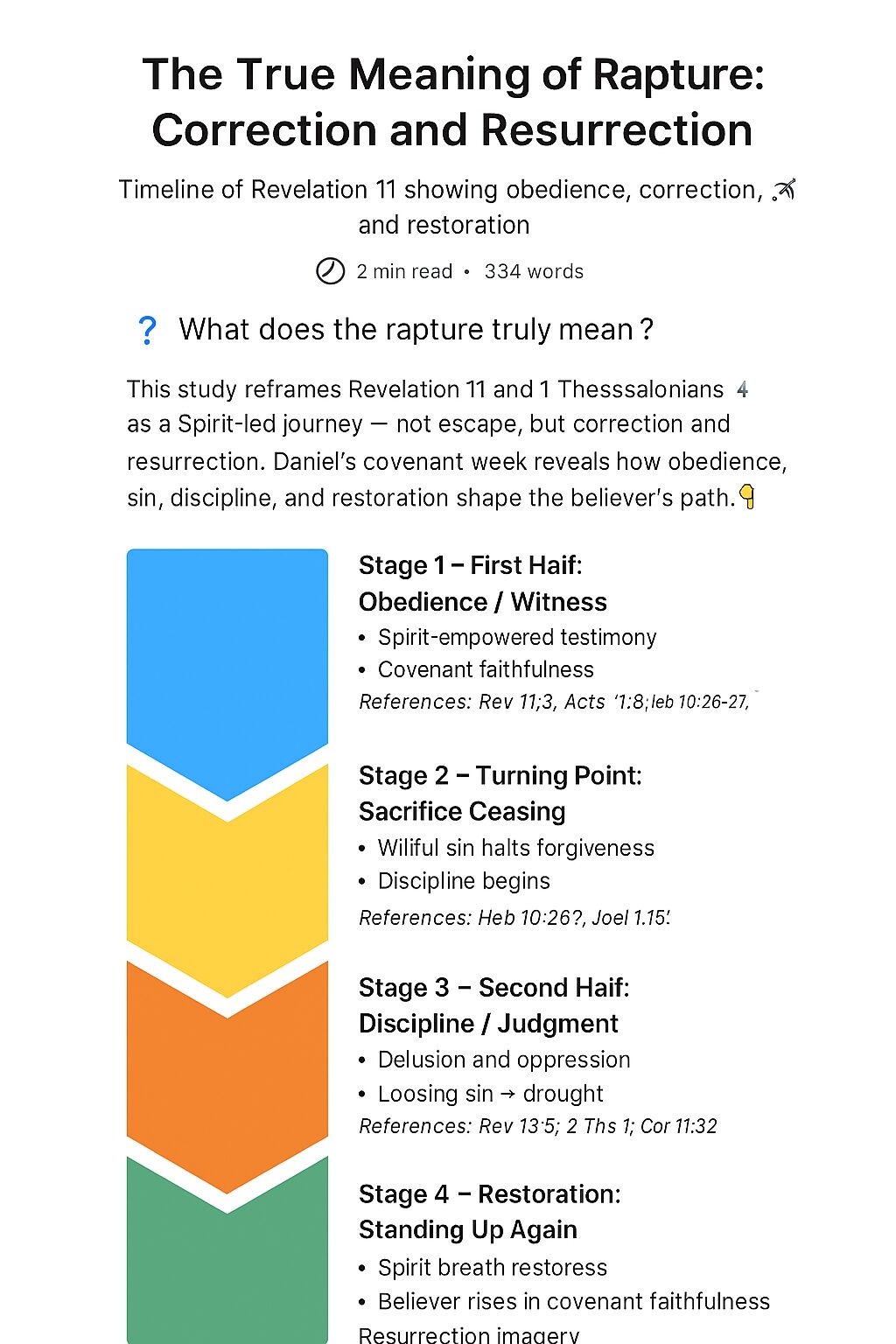
📈 Timeline Framework:
Stage 1 — First Half of Daniel’s 70th week: 🌱 Obedience / Witness
- Spirit‑empowered testimony
- Covenant faithfulness
- Binding righteousness → rain flows
- References: Rev 11:3; Acts 1:8; Heb 10:26–27; Joel 1:15–16
Stage 2 — 🔄 Turning Point: Sacrifice Ceasing
- Willful sin halts forgiveness
- Discipline begins
- References: Heb 10:26–27; Joel 1:15–16
- The sacrifice ceasing alludes to “not confessing willful sin” under the new covenant , Heb 10 :26-27 and 1 John 1:9.
Stage 3 — Second Half of Daniel’s 70th week: Discipline / Judgment
- Delusion and oppression
- Loosing sin → drought
- Correction as grace
- References: Rev 13:5; 2 Thess 2:11; 1 Cor 11:32
Stage 4 — Restoration: Standing Up Again
- Spirit breath restores
- Believer rises in covenant faithfulness
- Resurrection imagery
- References: Rev 11:11; 1 Thess 4:16
🧭 Summary: The true meaning of rapture is not escape, but restoration after a period of willful sin…
✨ Daniel’s Covenant Week and the Witness Framework
Revelation 11:3 and 11:11 illustrate the two halves of Daniel’s covenant‑confirmation week (Daniel 9:27), portraying the believer’s spiritual journey under God’s sovereign timing.
- First Half — Obedience / Witness
- Spirit‑empowered testimony (Rev 11:3; Acts 1:8).
- Covenant faithfulness before the sacrifice ceases.
- Hebrews 10:26–27 and Joel 1:15–16 warn that willful sin halts forgiveness, and precedes judgment 1 Cor 11:32.
- Binding and loosing govern this span:
- Binding (refraining from sin) permits spiritual rain — the Word flows freely.
- Loosing (choosing sin) shuts the heavens, leading to drought (Rev 11:6; Amos 8:11).
- Turning Point — Sacrifice Ceasing
- Willful sin that remains unconfessed/unrecognized is the pivotol concept
- Discipline begins as covenant faithfulness breaks.
- Second Half — 🔥 Discipline / Correction
- Delusion and oppression (2 Thess 2:11; Rev 13:5).
- The believer experiences spiritual death through rebellion (Mt 24:51 and Lk 12:46).
- Yet even discipline is grace (1 Cor 11:32): correction preserves believers from condemnation.
- Restoration — 🌅 Standing Up Again
- Revelation 11:11: “The breath of life from God entered them, and they stood on their feet.”
- Correction has completed its work; the believer rises restored.
- 1 Thessalonians 4:16 echoes this: “The dead in Christ shall rise first.”
- This is not escape (rapture), but resurrection into covenant faithfulness after discipline.
- Revelation 11:11: “The breath of life from God entered them, and they stood on their feet.”
🌿 Theological Summary
- Daniel’s 70th week is a parable of obedience and discipline.
- Revelation’s 1260 days, 42 months, or “time, times, and half a time” all refer to a defined yet intense period where the choices to bind or loose—committing or avoiding sin—play a role in whether heaven brings rain or withholds it in drought.
- The presumed “rapture” passages are better understood as the Spirit’s correction of willfully sinful Christians, culminating in restoration and resurrection (Rev 11:11; 1 Thess 4:16).
- Willfully sinful/sleeping Christians are those who have not remained “vigilant” (Strong’s #1127), 1 Thess 5:6.
- God’s grace empowers obedience, confronts sin, disciplines rebellion, and ultimately raises believers to stand faithfully before Him.
Greek Clues That “Sleep” Is a Unified Metaphor in 1 Thess 4 and 5
“For readers who want to see the linguistic evidence behind this interpretation, the Details block below walks through the Greek markers that show Paul is using ‘sleep’ consistently.”
Linguistic Markers That Signal a Metaphor Shift in Greek
A reference page for interpreting 1 Thessalonians 4–5
Overview
When interpreting Paul — especially in passages where a single metaphor appears more than once — it is essential to know how Greek writers normally signal a shift in meaning. If no signal appears, the default assumption is that the metaphor continues unchanged.
This page summarizes the standard linguistic markers that indicate a metaphor shift in Greek literature and shows why their absence in 1 Thessalonians 4:13–5:6 strongly supports a unified meaning of “sleep.”
1. Comparison Markers (ὡς / ὥσπερ)
Greek authors typically introduce a metaphor or shift in meaning with:
- ὡς — “as,” “like,” “as if”
- ὥσπερ — “just as,” “in the manner of”
These words alert the reader that the author is moving into figurative language or changing the metaphorical frame.
Paul does not use ὡς or ὥσπερ anywhere between 1 Thess 4:13 and 5:6.
2. Explicit Clarifiers (“I speak figuratively…”)
Writers sometimes mark a metaphor shift with clarifying phrases such as:
- “I speak figuratively…”
- “By this I mean…”
- “This is an allegory…” (e.g., Gal 4:24)
These phrases tell the reader that the author is changing the mode of speech.
Paul gives no clarifying statement indicating a shift in the meaning of “sleep.”
3. Vocabulary Shift
When Greek authors intend a different meaning, they normally change the word, not just the context.
Words Paul could have used for physical death:
- ἀποθνῄσκω — to die
- τεθνήκω — to be dead
- νεκρός — dead one
- μνῆμα — tomb
Words he could have used for spiritual dullness:
- νυστάζω — to nod off
- ἀμελέω — to neglect
- ῥᾳθυμέω — to be careless
Instead, Paul uses the same sleep‑vocabulary in both chapters:
- κοιμάομαι — to sleep
- καθεύδω — to sleep
No vocabulary change = no meaning change.
4. Contextual Reset
A metaphor shift is often signaled by a change in:
- topic
- audience
- tone
- argument structure
But in 1 Thess 4:13–5:6:
- same audience
- same topic (the παρουσία)
- same pastoral concern
- same metaphor cluster
There is no contextual reset.
5. Contrast Markers (δέ, ἀλλά, μέν…δέ)
Greek writers often signal a shift in meaning with contrast markers:
- δέ — but
- ἀλλά — but rather
- μέν…δέ — on the one hand…on the other hand
Paul uses none of these to indicate a new meaning for “sleep.”
Conclusion: Why This Matters for 1 Thessalonians 4–5
Because Paul:
- uses the same metaphor,
- with no comparison marker,
- no clarifying phrase,
- no vocabulary shift,
- no contextual reset,
- and no contrast marker,
the only linguistically coherent conclusion is:
Paul uses “sleep” with the same meaning in both 1 Thess 4:13 and 1 Thess 5:6 — a reversible spiritual condition under the Lord’s visitation.
This is the hinge that breaks the traditional reading and opens the door to a unified, coherent interpretation.